
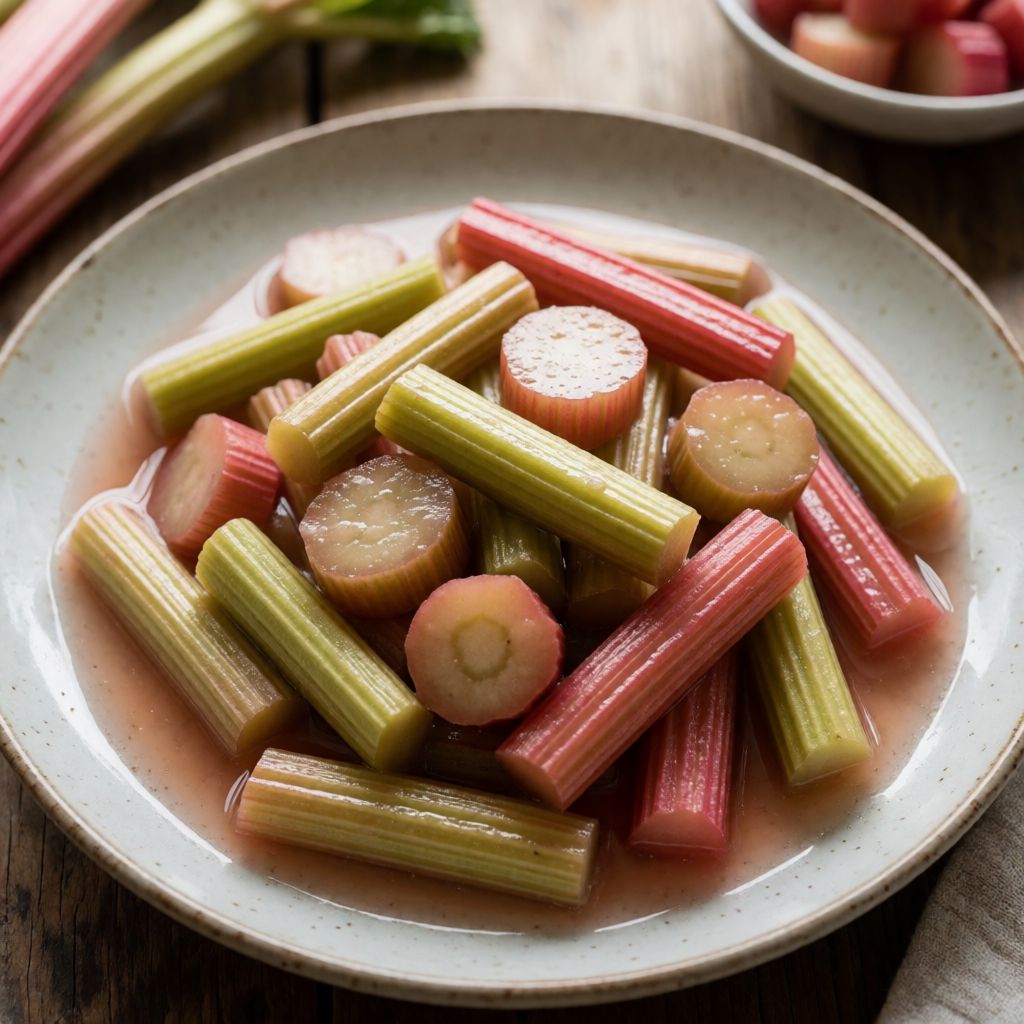
 AI photo
Pickled Rhubarb
A simple pickled rhubarb, ready to enjoy after a few days in the fridge.
Labels are worked out automatically from the ingredients and can be wrong. Check the packaging if it matters to you.
Ingredients
- 10 pcs Rhubarb
- 300 ml Water
- 300 ml Apple cider vinegar
- 300 g Sugar


Steps
Wash the rhubarb thoroughly and cut it into 1.5 cm thick slices. Place the sliced rhubarb into a clean, scalded jar.
Bring the water, apple cider vinegar and sugar to the boil in a saucepan and cook until the sugar has completely dissolved.
Pour the hot, boiling syrup over the rhubarb.
Cover with a lid and leave to rest in the fridge for at least 3 days.
This isn't jam, and it isn't a dessert. It's a pickle in the English sense — the same family as pickled walnuts or piccalilli — made from a stalk that botany calls a vegetable and the kitchen has always treated as a fruit. Sour, sweet, a little sharp from the vinegar: the kind of thing you put a spoonful of next to cold roast beef or a wedge of cheddar, because its job is to cut through fat, not to be eaten on its own.
What decides whether this works is one thing only: you never boil the rhubarb. You boil the syrup, and you pour that syrup — still at a full boil — over raw, cut stalks sitting in a cold jar. The heat does its work once, on contact, and then it's gone. If you were to tip the rhubarb into the pan and simmer it with the vinegar and sugar, the fibres would give up entirely and you'd end up with pink string in sweet water — pretty, but not a pickle, a compote. The bite you want, the slight resistance when you cut a piece with a fork, only survives if the rhubarb is cooked once, briefly, by residual heat, and then left alone in the fridge to finish the job slowly.
Some people still hesitate over raw rhubarb, because they've heard it's poisonous. It isn't — the leaves are, loaded with oxalic acid, which is why nobody sells rhubarb with the leaves attached. The stalk is just sour, not dangerous, and that's exactly why you can slice it raw into the jar with no cooking at all. The danger myth is really a leftover warning about the wrong part of the plant, applied to the whole thing out of caution nobody bothered to correct.
Ten stalks sounds vague until you weigh it: that's roughly 600–700g of rhubarb, enough to fill one large jar — a jar-and-a-half of British jam-jar size — and it will feed a household's worth of Sunday roasts over several weeks, a spoonful at a time, not one sitting. Don't scale it up thinking you'll eat it in a weekend; it keeps, that's the whole point of a pickle, and the flavour actually settles and rounds out after the first week rather than fading.
Choosing the rhubarb matters more than people assume. British forced rhubarb — the pale pink, thin-stemmed stuff grown in the dark, famously in Yorkshire sheds, originally so Victorian markets could sell "fruit" in February when nothing else was in season — is tender enough to go straight into the jar. Outdoor rhubarb, thicker and greener, often has a stringy outer skin; if yours looks fibrous rather than smooth, peel a thin strip off each stalk the way you'd string celery, or you'll be chewing threads for weeks. Either kind works for the mechanism — only the amount of trimming changes.
The cut at 1.5cm isn't arbitrary. Thinner, and the pieces turn to mush before the three days are up, because the syrup finds no resistance and the hot pour alone half-cooks them through. Thicker, and you risk a sour, barely-seasoned core even after a week in the fridge, because the syrup simply hasn't had the surface area to work with. 1.5cm is the thickness at which the hot syrup's single contact and the following days of slow soak actually meet in the middle.
Scalding the jar isn't ritual, it's arithmetic: any live mould or yeast sitting on the glass has three days of sugar-and-acid soup, sitting warm-ish before it chills, to get started in. Scald it, let it dry, and you remove that population before it ever gets the chance. You don't need a proper preserving lid here either — this is a pickle, not a ferment, so there's no gas building up that needs to escape. A clean screw lid, or even a bowl with a plate weighing it down if that's what you have, seals it well enough; nothing is going to build pressure and nothing needs burping.
Apple cider vinegar isn't sacred, it's just a vinegar with a round, fruity acidity rather than a flat, sharp one — the criterion is mild acid with no harsh chemical edge. White wine vinegar does the same job. Avoid malt vinegar, which is traditional for British pickles generally but too aggressive and too brown for rhubarb's colour and delicacy here, and avoid balsamic, which brings its own sweetness and darkens everything to a colour rhubarb was never meant to be.
Sugar at a near 1:1 ratio with the liquid looks like a lot until you remember rhubarb is genuinely sour — this isn't a sweet pickle wearing a disguise, the sugar is there to balance, not to dominate, and it dissolves fully in the boiling syrup precisely so you're not left with grit at the bottom of the jar. If you want less sweetness, you're free to cut it back, but go gently — too little sugar and the vinegar simply bullies the rhubarb instead of seasoning it.