
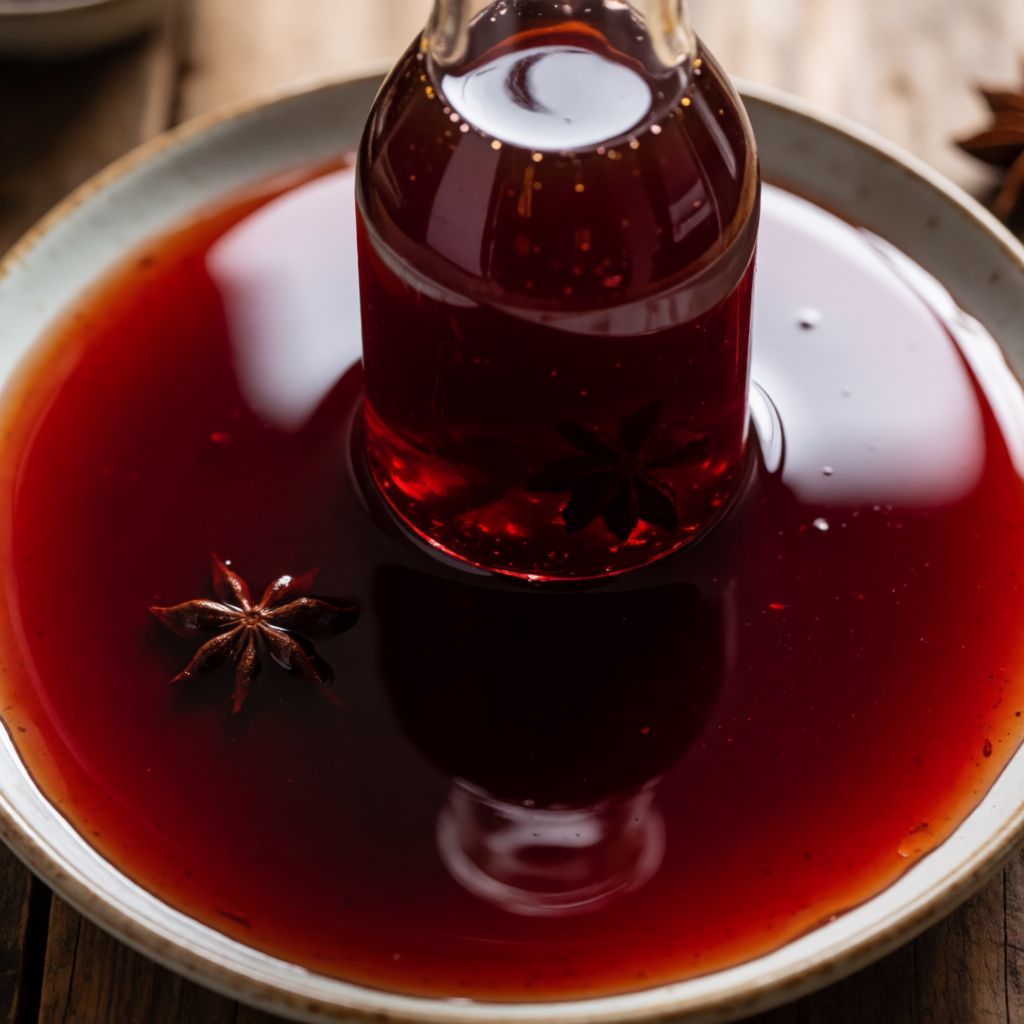
 AI photo
Pomegranate Syrup
A simple homemade syrup made from fresh pomegranate juice, sugar, honey and star anise.
Labels are worked out automatically from the ingredients and can be wrong. Check the packaging if it matters to you.
Ingredients
- 2 pcs Pomegranate
- 90 g Sugar
- 1 tbsp Honey or glucose syrup
- 3 pcs Star Anise




Steps
Tap the pomegranates on the worktop to loosen the seeds.
Cut the pomegranates in half and scoop the seeds and juice into a saucepan.
Remove the white membranes.
Add a few star anise pods, the sugar and the honey or glucose syrup.
Bring to the boil and simmer for 15–25 minutes, checking the consistency a few times; once the syrup is ready, strain it into a clean jar or bottle.
20 min
This is pomegranate molasses with English manners — syrup from pomegranate juice and seeds, reduced down with sugar until it thickens, with honey keeping it from going grainy and star anise giving it a dry, almost savoury edge. It is not jam. There is no pectin here to help you — the only thing making it thick is water leaving the pan. That's the whole mechanism, and once you've understood it, you stop watching the clock and start watching the pan.
What decides whether it works is reduction, not time. Fifteen minutes in one kitchen and twenty-five in another can both be correct, because it depends on your pan's width, how juicy your pomegranates happened to be, what your hob actually puts out — things a recipe card can't know about your flat. What the card can give you is a rough lower bound; what your eyes have to tell you is when it's done: the syrup slows down off the spoon, runs in a ribbon instead of a stream, and a drop on a cold plate holds its shape rather than spreading thin.
Tapping the pomegranate on the worktop first — some say you should squeeze it instead, roll it under your palm until it's soft. Don't. That bursts the juice sacs early and you lose juice through the skin before you've even cut it open. Tapping along the ridges does the opposite job: it shakes the seeds loose from the white pith without breaking them, so once you halve the fruit, they practically fall into your hand.
Two pomegranates sound modest, but this isn't a dish for a plate — it's a basic, a condiment you make once and spoon out for weeks, a teaspoon here over roast lamb, a teaspoon there into a dressing or stirred into gravy for a Sunday roast that wants a sharp edge against all that richness. Read the "servings: 1" on the card loosely: it means one batch, not one portion. Two pomegranates reduce to a small jar, maybe 150ml, and that goes a long way because it's concentrated.
Choosing the pomegranate matters more than any step after it. Pick by weight, not colour — heavy for its size means full juice sacs, and in a UK shop the skin colour tells you almost nothing, since most fruit comes from Spain or Turkey and finishes ripening in transit rather than on the tree. A light pomegranate, however red, is mostly air and pith.
Sugar here isn't for sweetness alone, it's doing two jobs. It draws juice out of the seeds by osmosis as it dissolves, so you end up with more liquid in the pan than the seeds alone would give you, and it's the substance that eventually concentrates into the syrup's body. Plain white granulated sugar is right for this — nothing fancier is needed, since whatever flavour a fancier sugar carries gets boiled straight out of it.
Honey or glucose syrup stops the finished syrup turning grainy as it cools. Plain sugar syrup, boiled hard and left to sit, wants to crystallise back into sugar — chemistry remembering where it came from. Honey and glucose syrup are made mostly of sugars that don't line up into that lattice the same way, so a spoonful of either interrupts the pattern and keeps the result glossy instead of sandy. With neither in the cupboard, a teaspoon of lemon juice does a related job by a different route — acid splits some of the sucrose into simpler sugars that also resist crystallising — and it will nudge the flavour sharper, which pomegranate usually takes well.
Star anise is the one ingredient here you can honestly play with. It brings a dry, aniseed warmth that sits oddly well against pomegranate's sourness — not a pairing anyone invents on purpose, but one that's earned its place through use. Any whole, mild spice with its own quiet character can stand in — a cinnamon stick, a couple of cloves — just keep it whole. Ground spice turns to grit at the bottom of the pan instead of infusing and then leaving cleanly with the strainer.
Use your widest pan, not your deepest pot. Reduction happens at the surface, where water escapes into the air, so a wide surface clears liquid faster and more evenly than a narrow one, where the bottom scorches before the top's even started to thicken. It's the same logic that makes a kazan work the way it does in its own setting, scaled down to a UK hob: breadth over depth, whenever you're reducing rather than boiling.
And patience is not a nice-to-have here. The last few minutes are when the syrup moves fastest from nearly-there to burnt sugar, because as water leaves, the sugar concentration climbs and the same flame heats the mixture higher. Walk away in that window and you'll come back to toffee welded to the pan, not syrup in the jar. Stay close once it starts looking right, and test it properly rather than guess it done.