
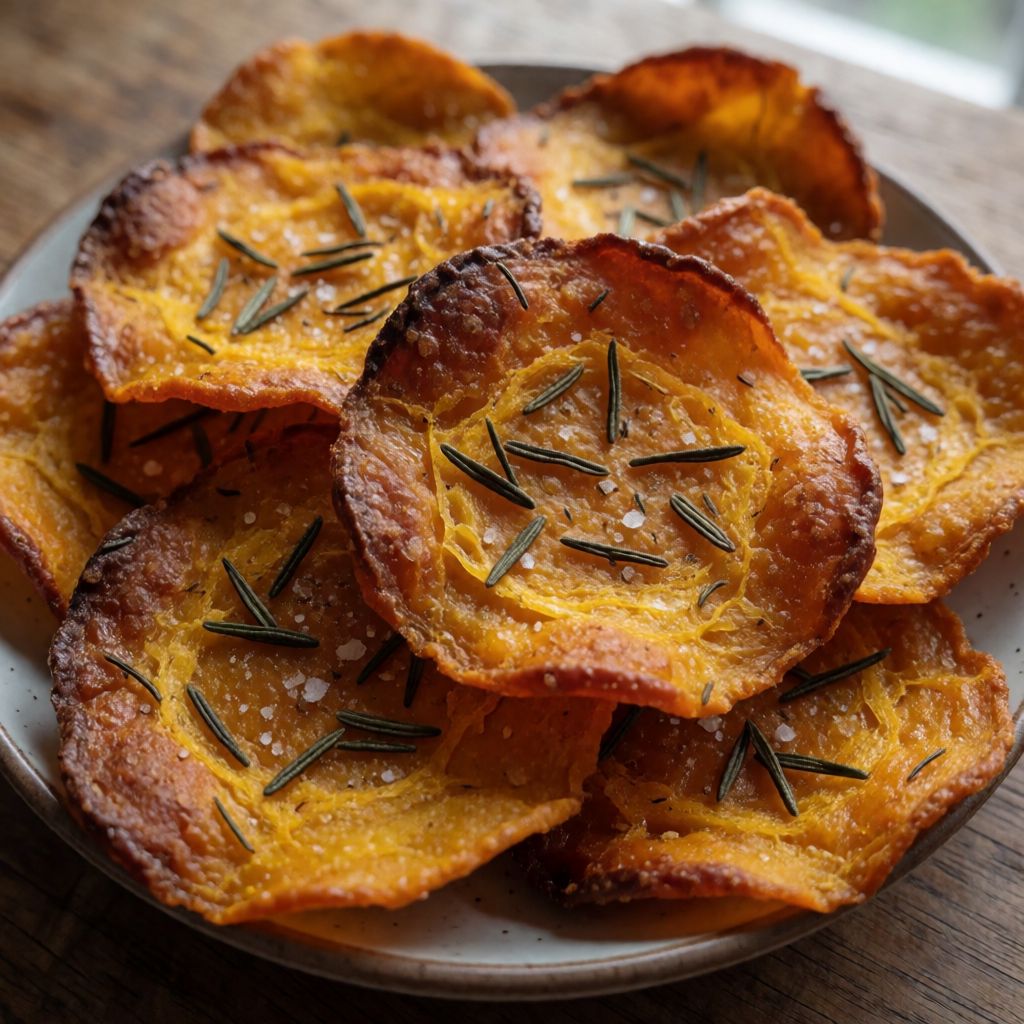
 AI photo
Pumpkin Crisps
Thin pumpkin slices baked until lightly golden, a simple savoury snack or side.
Labels are worked out automatically from the ingredients and can be wrong. Check the packaging if it matters to you.
Ingredients
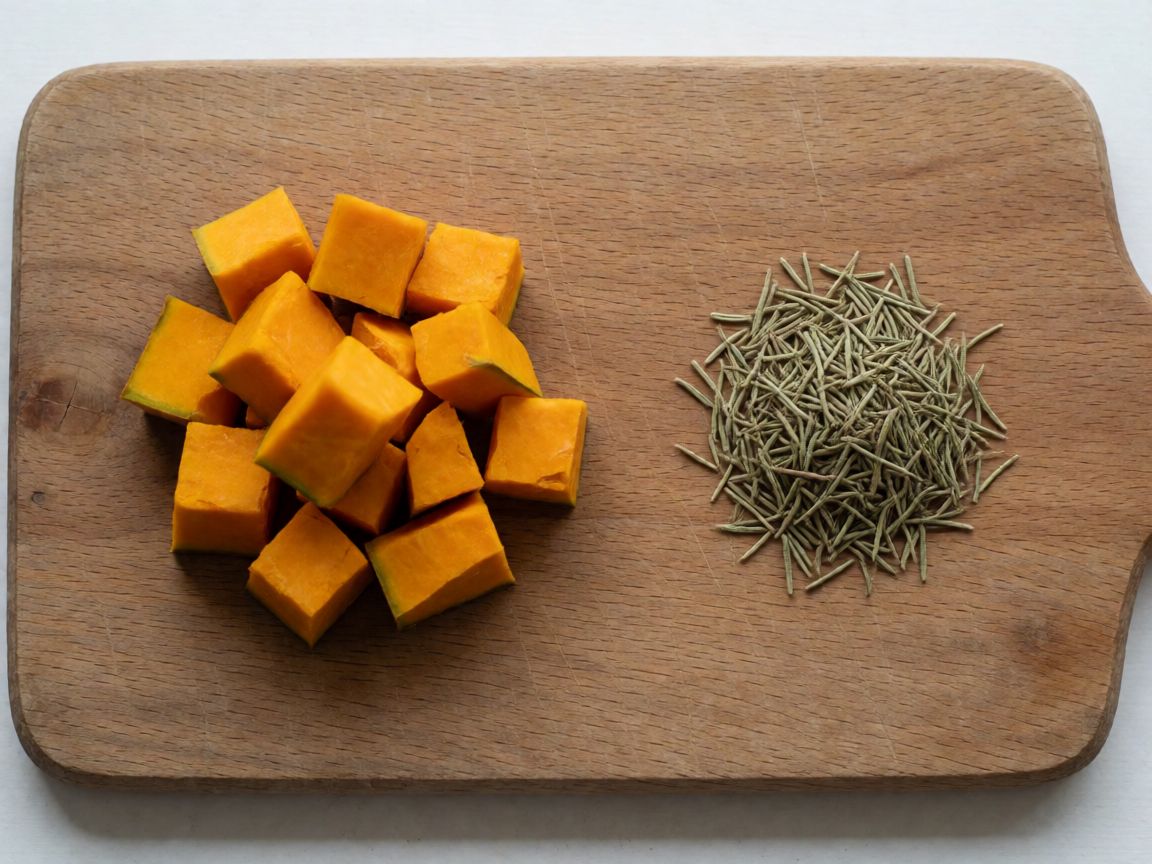
- 400 g Pumpkin butternut squash variety
- Olive Oil to taste
- Ground Dried Rosemary to taste
- Salt to taste



Steps
Peel the pumpkin, removing the seeds and skin. Cut into rectangular or square pieces, then slice thinly using a mandoline or knife.
Arrange the thin pumpkin crisp slices on a baking tray lined with baking parchment, spaced evenly with a little gap between them.
Drizzle the slices with olive oil and sprinkle with ground rosemary.
Bake in the oven at 180°C for about 20–25 minutes, until lightly golden at the edges.
23 minServe the crisps on kitchen paper, sprinkled with salt.
This is not baking in the usual sense — it's water leaving a thin slice of pumpkin until what's left is crunch instead of bite. Think of it as a slow, dry version of frying: the oven does what hot oil does, just without the fat doing the main work. The slice has to lose nearly all its moisture before the sugar in it starts to catch and darken at the rim — that gold edge is the signal you're actually waiting for, not a clock.
What decides whether it crisps or just goes soft and leathery is the thickness of the slice, not the number on the oven dial. A slice the thickness of a coin takes forever to dry through and burns at the rim before the centre gives up its water. A slice thin enough to see your hand through dries evenly, right to the middle, in about the time it takes the edge to turn gold. This is why the mandoline matters here — not because a knife can't do the job, but because a knife on a tired evening gives you six different thicknesses on one tray, and six different outcomes.
Space between the pieces is doing work too. Crowd them and the steam each slice throws off has nowhere to go — it sits over the next piece and keeps it damp, so instead of going brittle it just goes soft. Give each slice air on every side and the steam lifts away as fast as it forms.
Pumpkin here means butternut squash specifically, and that's not fussiness. Butternut has dense, comparatively dry flesh in one straight run, without the stringy, watery centre a round pumpkin carries — less water to drive off, less waste from scooping out a cavity, and a sweetness that caramelises cleanly at the edge rather than turning bitter. If what's in the cupboard is a different squash — onion squash, kabocha — it'll still work, just expect a slightly longer dry-out, and judge by the gold edge rather than the clock, because wetter flesh takes its own time.
The olive oil is doing two jobs: carrying heat evenly into the slice, so you don't get scorched spots where it touches bare metal, and laying its own flavour alongside the rosemary. Use it the way you'd dress a salad, not the way you'd fry — a film, not a puddle. Too much oil and the slice sits in it as it tries to dry, which slows the whole process down and gives you something closer to a soft-fried chip than a crisp. If you'd rather not taste the oil at all, the criterion is simple — any oil without a strong smell of its own will carry the heat just as well, a light sunflower or rapeseed oil, for instance — and then what you taste is the pumpkin and the rosemary, nothing else.
Ground rosemary, not whole needles, and that's deliberate. A whole needle is a spike — it either slides off the oiled surface or sits there charring on its own schedule while the pumpkin underneath is still pale. Ground, it clings to the oil film and lies flat, toasting at the same rate as the slice it's sitting on. The same logic covers any dry herb you might swap in — thyme works the same way — as long as it's ground fine enough to stick and doesn't turn bitter under dry heat.
Salt goes on at the very end, over the kitchen paper, and that's not plating fussiness, it's chemistry doing what it does. Salt draws water towards itself. Put it on before baking and you'd be working against your own oven, pulling moisture back up to the surface exactly when you're trying to drive it off. Salt it after the water's already gone and it just sits there tasting salty, with nothing left to dissolve into and soften.
The kitchen paper under the finished crisps is the one piece of kit an ordinary British kitchen already has, no gadget needed. Whatever oil didn't turn to steam along the way ends up as a thin film on the surface, and the paper takes it off before a crisp turns greasy on the plate.
Patience is the real ingredient in this one, more than the rosemary. Four hundred grams sliced thin enough is a slow job, by hand or by mandoline, and there's no shortcut through it — rushing the cutting is exactly what gives you a tray of mixed thicknesses and mixed results. Count on this as a plateful for eight to pick at before a Sunday roast, not as something that feeds anyone on its own.