
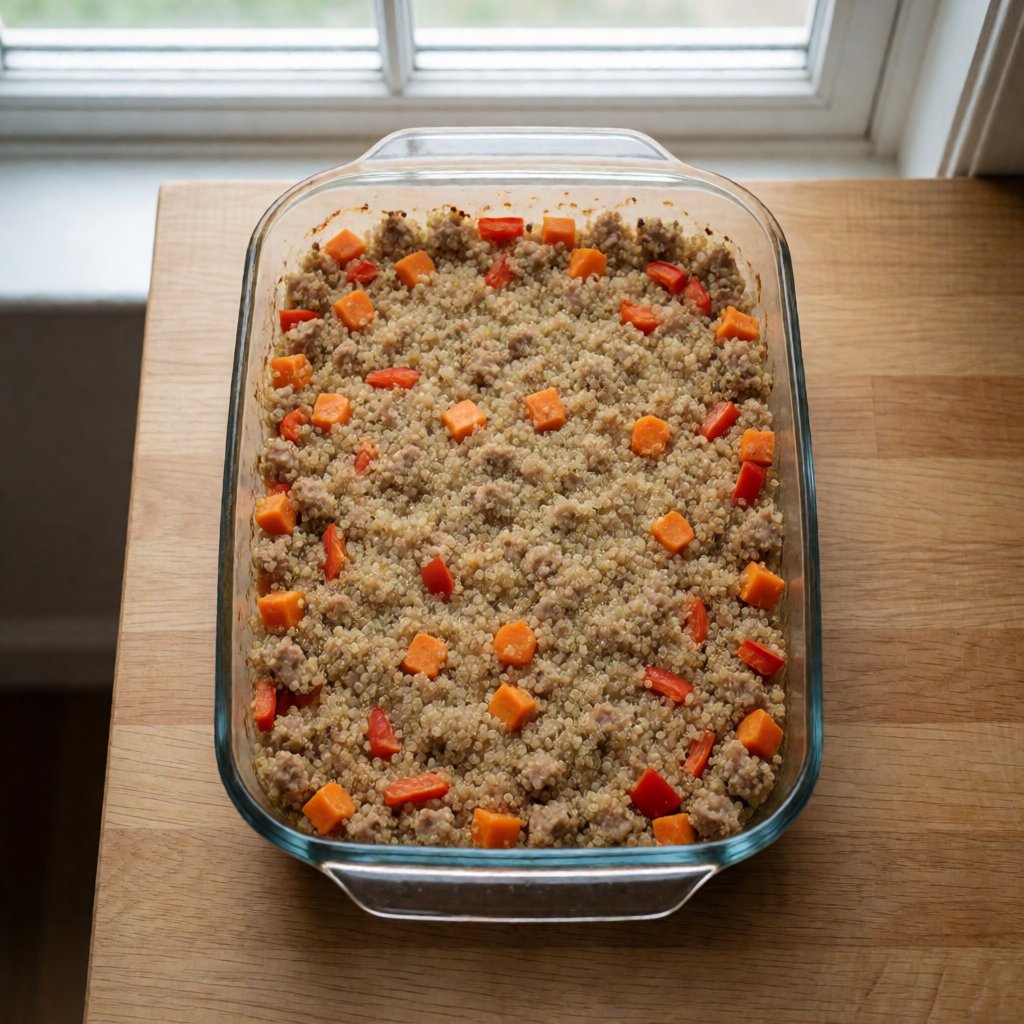
 AI photo
Quinoa with Turkey and Vegetables
A quick one-pan bake of quinoa, turkey mince and vegetables, finished in the oven.
Ingredients
- 120 g quinoa rinsed until no more foam appears
- 250 ml boiling water
- 250 g turkey mince
- 1 pcs carrot diced
- 1 pcs bell pepper diced
- 1 tbsp sunflower oil
- 1 pinch salt to taste
- 1 pinch paprika to taste







Steps
Place the quinoa in the baking dish, top with the diced vegetables, and drizzle with oil.
Season the turkey mince with salt, sprinkle with paprika, break it into pieces over the top, and pour over the boiling water.
Cover the dish with foil.
Put the dish in the oven at 200°C for 40 minutes.
40 minTake the dish out of the oven and check: the turkey mince should reach 74°C inside.
Stir to combine.
This isn't a stew, and it isn't quite a pilaf either — it's quinoa doing what rice does under a heavy lid in a kazan, except here the kazan is a baking dish and the lid is a sheet of foil. You tip in 120g grain, drown it in 250ml boiling water, pile vegetables and broken mince on top, then seal the whole thing shut and put it in a hot box. The foil is standing in for what a stovetop pot does with its own weight: it traps the steam so the grain finishes softening in moisture it can drink, instead of drying out in plain oven air. You probably don't own a kazan, and your oven's main job is usually a Sunday joint, not a grain dish — this is the honest adaptation for that kitchen, not a lesser version of something else.
What decides whether it works is the seal, not the clock. Lift the foil early to peek, and you let out exactly what it was holding in — steam — and what should have become a soft, swollen grain stays half-hard, sitting in liquid it never got the chance to absorb. So trust the cover. Open it once, at the end, and open it to check the meat, not to admire the vegetables.
Start with the rinse. Quinoa in its raw state carries saponins — a bitter, faintly soapy coating on the outside of the seed, there originally to put off birds who'd otherwise eat the plant's whole future crop. You rinse until the foam stops because that foam is the saponin leaving; skip it, and a perfectly healthy grain ends up tasting like it fell in the washing-up water.
The water goes in boiling, not cold, and in roughly double the grain's volume — that ratio is what lets the quinoa absorb everything over the cooking time without you topping it up or draining a puddle at the end. Boiling rather than cold matters because the dish is sealed: you want the grain and the meat climbing to cooking temperature together, not the quinoa sitting in cold liquid waiting for the oven to catch up while the meat races ahead. No kettle handy, or you want more flavour underneath — any very hot liquid does the job, stock included, since quinoa on its own is mostly texture and needs something to lean on for taste.
The mince goes on broken into pieces, not left as one slab, and that's not cosmetic. A solid lump of mince has little surface and a dense, cool centre — asking it to reach 74°C inside in the same window the quinoa needs to soften is asking too much of it, and you'd end up choosing between undercooked meat and overcooked grain. Broken up, it has far more surface meeting the boiling water and the rising steam, and gets there evenly, on the same clock as everything else. Any minced poultry with a similar loose fat content substitutes fine — chicken, most obviously — the 74°C target doesn't change with the bird, because it's about bacteria, not flavour.
The carrot and pepper sit under the meat and over the grain for a reason: the meat's juices and the trapped steam baste them from above, instead of them drying out exposed to oven air the way they would on an open tray. Don't look for a minute count to tell you they're ready — look at the carrot. When it bends instead of snapping, it's done; if it still snaps at the end of cooking, the dice were cut too large, not the oven too gentle. Swap in other root vegetables that hold their shape under moist heat if you like — courgette isn't a good trade here, it collapses to mush long before the carrot would even soften.
The oil's only job is to stop the vegetables and the grain surface sticking and drying at the edges where the foil's seal is weakest — nothing gets hot and dry enough in here for actual frying. So the criterion is simply any oil with no smell of its own: sunflower is the obvious choice in a British kitchen, but a flavourless vegetable oil or a mild olive oil both do the same quiet job.
Salt and paprika are the only seasoning this dish gets, with no sauce later to correct an imbalance, so put thought into where they land. Salt goes directly on the raw mince because meat seasoned before cooking gives up seasoned juice as it cooks, and that juice is what flavours the grain underneath it — there's no other route for salt to reach the quinoa at all. Paprika is there for warmth and colour, not heat, so if you want more character, reach for a smoked paprika rather than simply more of the sweet kind; a mild grain carries smoke better than it carries bulk pepper. And if you're scaling this up for more people, scale the water with the grain, not just the meat and vegetables — the absorption only works if that ratio holds, whatever size pan you end up using.
·