
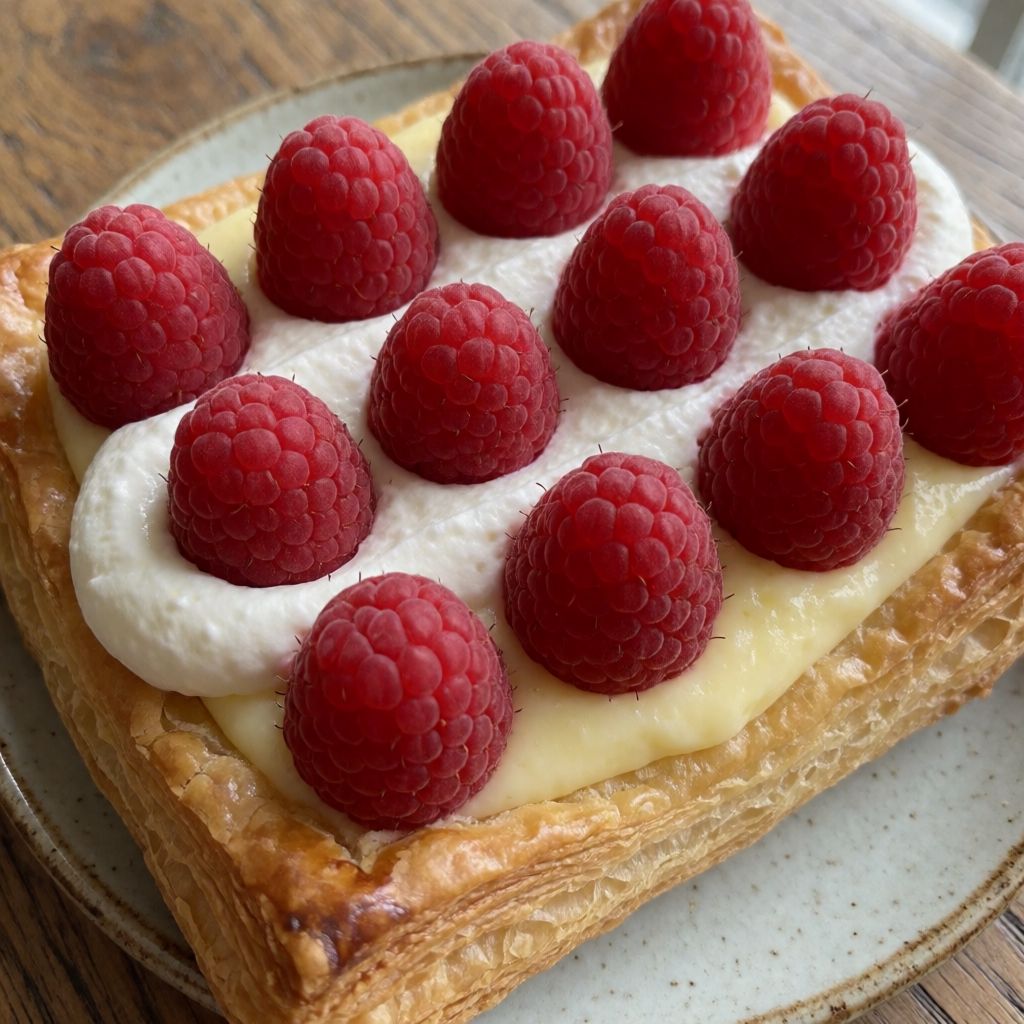
 AI photo
Puff Pastry Raspberry Tart
A simple puff pastry tart topped with a light custard cream and fresh raspberries.
Labels are worked out automatically from the ingredients and can be wrong. Check the packaging if it matters to you.
Ingredients
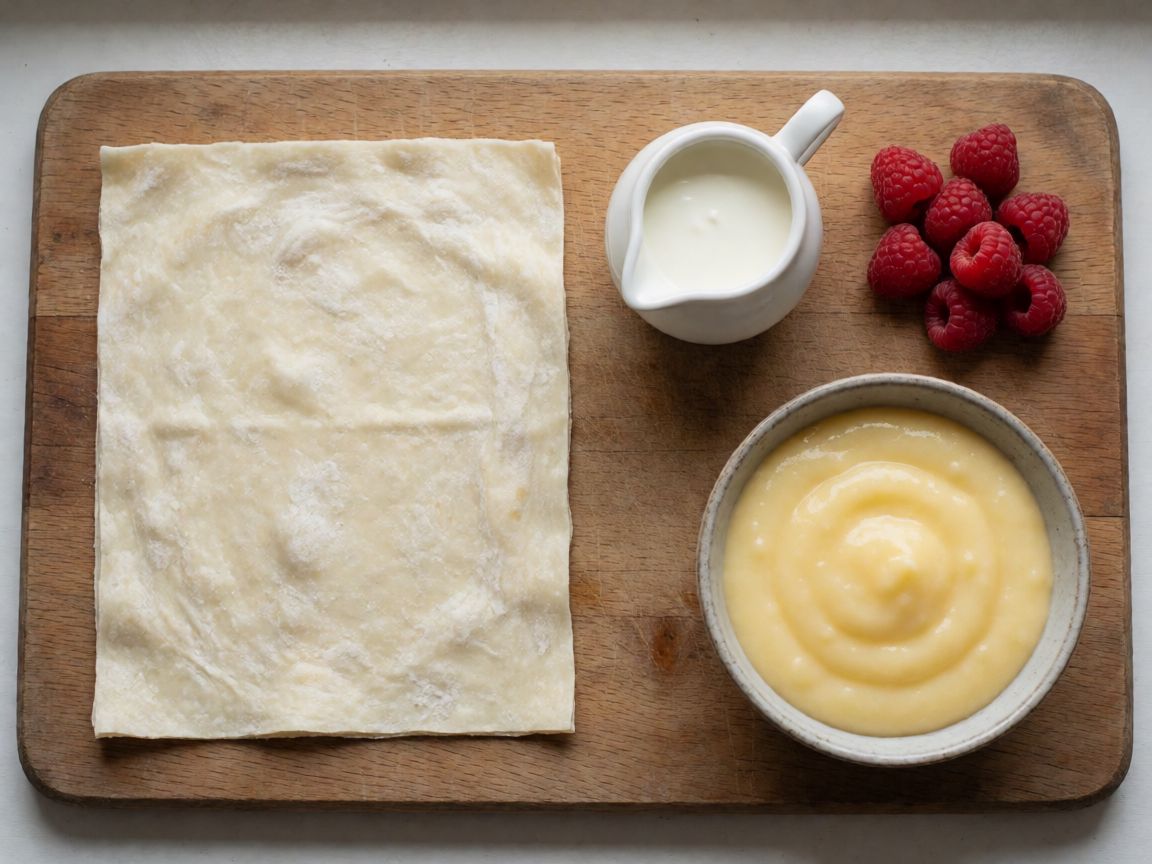
- 1 pcs Ready-Rolled Puff Pastry Sheet
- 100 ml Double Cream
- 250 g Crème Pâtissière ready-made thick custard
- 300 g Raspberries or mixed berries




Steps
Place the pastry sheet on a baking tray lined with parchment paper, shaping it into a heart, and prick the surface all over with a fork.
Bake in a preheated oven at 180°C for 20 minutes.
20 minRemove the base from the oven and leave it to cool completely.
Whip the cream to soft peaks and gently fold it into the crème pâtissière.
Spread the cream mixture evenly over the cooled pastry base.
Arrange the raspberries on top, covering the whole surface.
What this is: a flat tart, not a pie — a crisp puff pastry base carrying a cold creamy filling and fresh raspberries. Nothing goes back in the oven once the fruit is on, so everything after baking is assembly, which is why this is quick once the base is done and cold.
What decides whether it works has nothing to do with the clock on the custard stage: the base has to be properly cold before anything creamy touches it, and the cream-custard mix has to be thick enough to sit still, not run. Get those two right and you get a crisp bite under soft fruit; get them wrong and you get warm cream turning a good base into wet cardboard inside an hour.
Some say pricking the pastry all over with a fork is there to stop it rising — no, because a pastry that refuses to rise at all is just a biscuit, and that's not what you want on a tart. What the fork actually does is decide where the rise happens: steam escapes through the holes in the middle, so the centre stays relatively flat, while the untouched edges puff freely and build their own rim — a wall that will later hold the cream in place without you shaping one by hand.
And some say twenty minutes, out, done, no questions. No — domestic ovens lie about their own temperature, by ten degrees, sometimes twenty, and the sheet of pastry in your hand might be thinner or thicker than whichever one the time was tested on. Go by what you see: deep gold colour, a risen dry rim, no pale or oily patches left anywhere. Twenty minutes is where you start checking, not where you stop.
The pastry itself, bought ready-rolled, is an honest admission that nobody is laminating dough at home on a Tuesday for a tart. Puff pastry is just dough and butter folded and rolled into many thin alternating sheets; in the oven, water trapped in the dough turns to steam, the steam has nowhere to go but push the buttery layers apart, and that push is your rise. If you're choosing a block or sheet, pick one that lists butter as the fat, not vegetable fat — the vegetable kind still puffs, it just tastes of nothing, and this tart has no other flavour on the base besides pastry and berries. A standard supermarket sheet gives you enough base for about six modest wedges — plenty for a dessert after a Sunday roast, when nobody actually wants a large slice of anything sweet.
Crème pâtissière, ready-made, is the backbone of the filling. It's custard thickened with starch rather than egg alone, which is exactly why it holds a shape instead of running off the pastry the way loose custard or plain cream would. If you have none, don't reach for pourable custard as a stand-in — it's too thin, and it will soak into the pastry instead of sitting on top of it. Mascarpone loosened with a splash of cream is a workable alternative: different in flavour, close enough in body.
Double cream, whipped to soft peaks and folded — not stirred — into the custard, adds air without adding liquid, which is the whole point of folding. Any cream that will hold a soft peak does the same job; in practice that means something around 35% fat or above. Thinner cream won't hold the air long enough to survive the fold, and you'll end up back where you started: a dense, cold custard, with nothing lightened about it.
Raspberries go on last, close to serving, because berries weep — their juice sits on the surface and works its way down through the cream and eventually into the pastry underneath. If you want to assemble ahead, keep the three parts — base, cream, fruit — apart until the last moment. Any berry that holds its shape under light handling will behave the same way: blackberries, halved strawberries, blueberries. Softer, overripe fruit just bleeds faster and shortens how long the base stays crisp.
The heart outline is only a cut, not a mechanism — it changes how much edge you get relative to centre, since more edge means more of that risen crisp rim, and nothing beyond that. Cut it round or square if that suits your tray better; the fork pattern and the oven do exactly the same work regardless of the shape you draw it into.
Patience is the one ingredient missing from the list: letting the base go from oven-hot all the way to properly cool, not just cool on the surface, before cream goes anywhere near it. There's nothing to stir while that happens, no trick to speed it up safely in an ordinary kitchen without a blast chiller — you just have to let the time pass.