
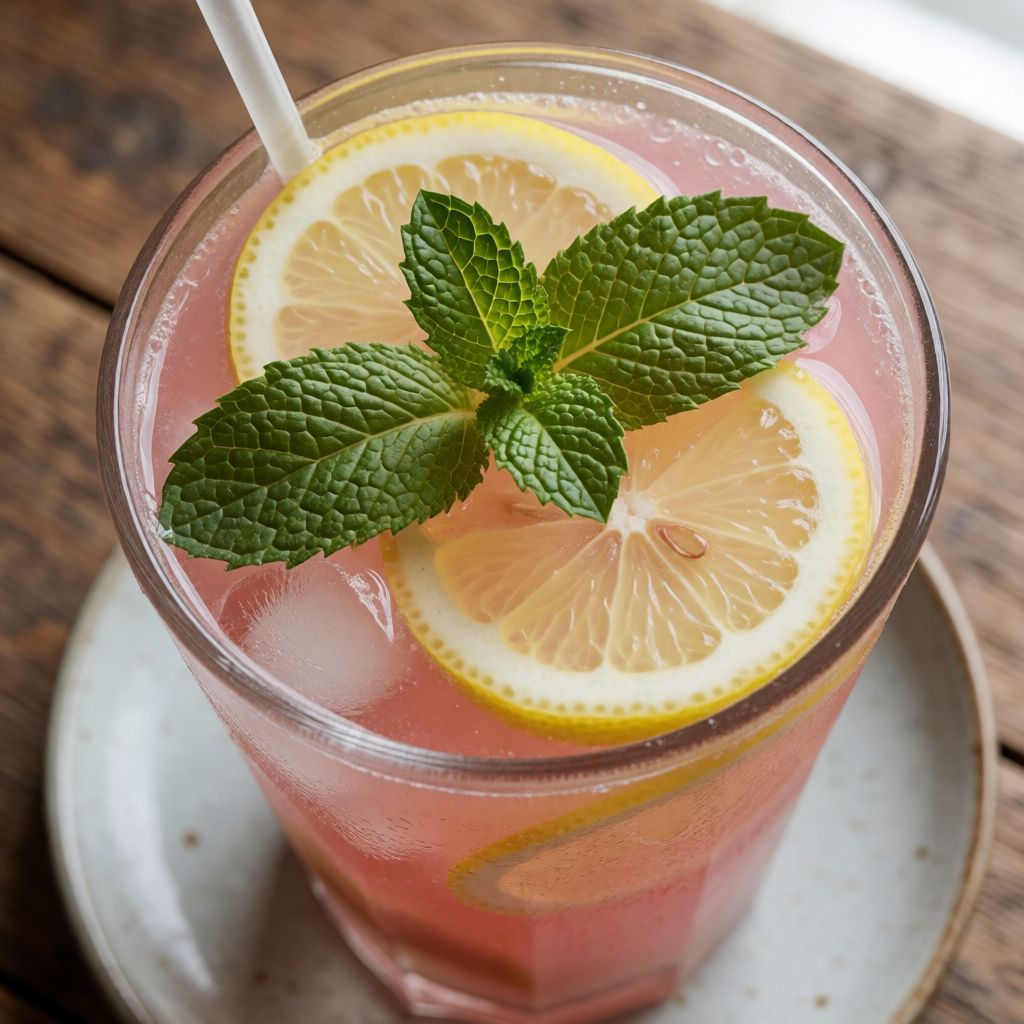
 AI photo
Rhubarb Lemonade
A refreshing homemade rhubarb and lemon cordial, lightly infused with fresh mint and vanilla sugar.
Labels are worked out automatically from the ingredients and can be wrong. Check the packaging if it matters to you.
Ingredients






Steps
Put the rhubarb, finely grated lemon zest, mint leaves, sugar, vanilla sugar and water into a saucepan.
Bring to the boil and simmer over medium heat for 10 minutes.
10 minRemove the pan from the heat, stir in the lemon juice and let the syrup cool completely in the pan.
Strain the syrup through a sieve and pour it straight into a clean, scalded bottle.
This is not lemonade, despite the name — it's a rhubarb cordial, a concentrate you cut with water or soda afterwards. Call it lemonade because the acid and the clarity remind people of lemon squash, and because "rhubarb cordial" sounds like something your gran made, which, in Britain, it probably did. Rhubarb was the glut vegetable of every allotment from April onwards — it grows like a weed, costs nothing, and by June you have more of it than any crumble can absorb. Cordial was the answer: boil it down, bottle it, drink it in December.
What decides whether this works is heat and timing, not flavour balance. Rhubarb stalks are fibre packed with water and acid, held together by pectin in the cell walls. A gentle simmer breaks that pectin down and lets the water out — that's where your syrup comes from, not from the litre you poured in. Boil it hard instead of simmering and you don't speed anything up; you just scald the sugar at the bottom of the pan before the rhubarb has had time to collapse, and you get a faint burnt note that no amount of mint will cover. Some people crank the heat because they're impatient. Don't — the rhubarb tells you when it's ready by falling apart into string and mush, not by the clock. Ten minutes is the lower bound, not the answer.
Rhubarb, a kilo of it, peeled and diced — peeling is the trade-off here. The skin carries the pigment that gives rhubarb its lipstick pink; strip it off and you lose some colour for a cleaner, less stringy syrup. If you want the deeper colour, leave a few unpeeled stalks in and strain harder at the end — the sieve will catch the fibre either way. Forced rhubarb, the pale pink stuff sold in Yorkshire shops in early spring, is softer and sweeter and collapses faster; the thick green-red garden rhubarb from midsummer is more sour and needs the full simmer to break down. Either works; just expect the garden stuff to need every minute of that ten.
Two lemons, organic, because you're using the zest. Ordinary waxed lemons carry a coating meant to survive shipping, and that wax goes into your pan along with whatever was used to keep pests off a skin nobody was meant to eat. If you can't get unwaxed, scrub hard under hot water before you grate, and grate only the coloured zest — the white pith underneath is bitter, and that bitterness doesn't cook out, it just sits in your cordial reminding you it's there.
The mint is there for lift, not decoration — it goes in raw with everything else and simmers alongside the rhubarb, which mellows it rather than keeping it sharp. If you want a brighter, more obviously minty cordial, hold half the bunch back and stir it in with the lemon juice at the end, off the heat, then strain it out with the rest.
Sugar, half a kilo, plus a spoon of vanilla sugar for roundness — this is not a recipe you can quietly de-sugar. The sugar isn't seasoning here, it's doing two jobs: pulling water out of the rhubarb cells by osmosis so you get syrup instead of stewed fruit, and preserving the bottled cordial once it's capped. Cut it back hard and you'll shorten how long the bottle keeps. If you have no vanilla sugar, a short scrape of a vanilla pod or a few drops of extract stirred in with the lemon juice does the same rounding job — vanilla sugar is just vanilla that's been living with sugar for company.
A litre of water is the frame, not the flavour — too little and you've made rhubarb jam by accident, too much and the syrup tastes like coloured water. You don't need a kazan or a preserving pan for this; any wide saucepan that holds everything without the rhubarb mounded three deep works, because what matters is the rhubarb having room to let its liquid out, not any particular vessel.
Straining: a sieve gets you a usable, slightly cloudy cordial. If you want it glass-clear, like a shop squash, line the sieve with a clean tea towel or a piece of muslin — cheesecloth if you have it, a scalded J-cloth if you don't, your kitchen, your rules. The bottle wants scalding, not sterilising-kit theatre: boiling water swirled round a clean bottle and tipped out does the job, because what you're guarding against is nothing dramatic, just mould finding a foothold in sugar syrup left lukewarm in a jar. This makes enough concentrate for four people across several glasses each, diluted — figure one part cordial to four or five parts cold water or soda, adjusted by how sweet your particular rhubarb turned out to be, because no two batches are quite the same strength.