
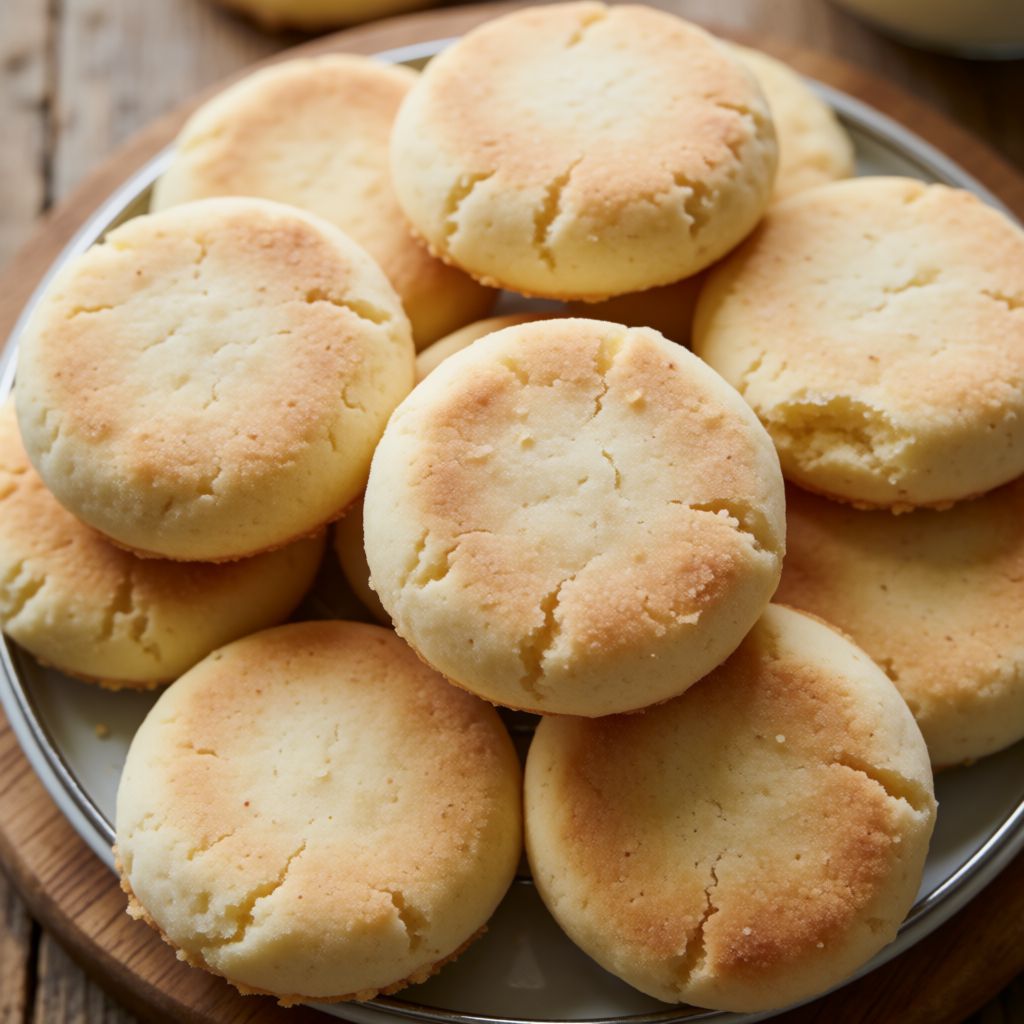
 AI photo
Gluten-Free Rice Flour Biscuits Without Butter
Light, chewy gluten-free rice flour biscuits made without butter, finished with a dusting of icing sugar.
Labels are worked out automatically from the ingredients and can be wrong. Check the packaging if it matters to you.
Ingredients
- 300 g Rice Flour
- 50 ml Vegetable Oil
- 120 g Brown Sugar
- 1 pcs Egg
- 50 ml Milk
- 1.25 tsp Lemon Juice
- 5 g Baking Powder
- 1 pinch Icing Sugar for dusting








Steps
In a bowl, combine the vegetable oil, brown sugar and egg, then beat with a mixer or whisk until smooth.
Add the milk, then gradually mix in the sifted rice flour and baking powder.
Pour in the lemon juice and knead the dough thoroughly until it holds together, with a texture similar to shortbread.
Shape small balls about the size of a walnut and place them on a baking tray lined with baking parchment.
Bake at 180°C for 10 minutes, keeping an eye on them so they don't brown too much.
10 minOnce the biscuits have completely cooled, dust them with icing sugar.
These aren't shortbread's twin — they're the question gluten-free baking always forces you to answer: what holds a biscuit together when there's no gluten to stretch into sheets? Rice flour starch sits loose, with no protein mesh to trap air or hold a crumb in place. So the whole recipe is built around stand-ins for that mesh — egg protein, enough fat to coat the grains so they don't rub into grit on your tongue, enough sugar to glue the crumb into something you can lift whole.
What actually decides whether it works is the dough at step 3: worked "until it holds together, like shortbread" — not a flavour note, it's the only doneness cue you get before the oven. Too dry, it crumbles apart in the tin. Too wet, it spreads thin on the tray and bakes into a crisp wafer, not a biscuit. You're feeling for dough that rolls into a ball without cracking at the edges and without sticking to your palm.
Some say gluten-free dough needs xanthan gum or it simply won't hold. No — because this dough doesn't need stretch, it needs glue, and at biscuit size, egg plus oil-coated sugar does that job fine. Gum earns its place when you want elasticity — bread that has to rise and hold a crumb full of gas. A flat, dense biscuit never asks for that.
On the flour: get fine white rice flour, ground almost like icing sugar — not the coarse grainy stuff sold for dusting fish before frying, which will leave grit no amount of baking disguises. And don't reach for glutinous (sticky) rice flour thinking "rice is rice" — it's a different starch, and it will turn this dough gummy rather than sandy.
On oil instead of butter: butter at room temperature is a web of solid fat crystals. Cream it with sugar and you trap air inside that web, which stays rigid until oven heat melts it — that's where a flaky, lifted shortbread crumb comes from. Oil is already liquid. It doesn't trap air, it just coats the flour grains on contact, so from the first mix you're heading toward a denser, slightly moister, sandier biscuit — closer to a dense tea biscuit than a flaky shortbread. That's not a downgrade, it's a different mechanism with a different result. Use any oil with no smell of its own — sunflower, rapeseed, a plain vegetable oil off the supermarket shelf. Olive oil will fight the sugar and you'll taste it.
The egg is doing gluten's old job of holding the crumb together, not lift — one egg across 300 g of flour is too little to expect any rise from it, so don't wait for these to puff.
Brown sugar isn't just colour: its molasses content holds moisture in the crumb and keeps the biscuit from drying out as fast as white sugar would. If you swap to caster or white sugar, expect a paler, drier result, and put a splash more milk back in to cover what the molasses was holding.
Milk here is simply the liquid that lets everything come together — the amount is small enough that any milk with no strong flavour of its own will do, dairy or otherwise, and you've already got milk in the house for tea.
Lemon juice looks redundant next to baking powder, since baking powder already carries its own acid and alkali. But a little extra acid reacts further with that mix for a touch more lift, and it also softens whatever structure the egg's protein tries to set up, keeping the crumb from toughening as it bakes. A few drops of vinegar does the identical acid job if you're out of lemon — the quantity's too small to taste either way.
Dust the icing sugar only once the biscuits are properly cold — on a warm biscuit it dissolves into a wet shine instead of sitting as a soft, matte layer. That's patience doing real work, not decoration for its own sake. And on equipment: an ordinary tray lined with baking parchment is all this needs — the parchment's job is to stop a sugar-heavy dough caramelising onto bare metal, nothing fancier required for a flat biscuit shaped by hand into walnut-sized balls, which flatten themselves as they bake.