
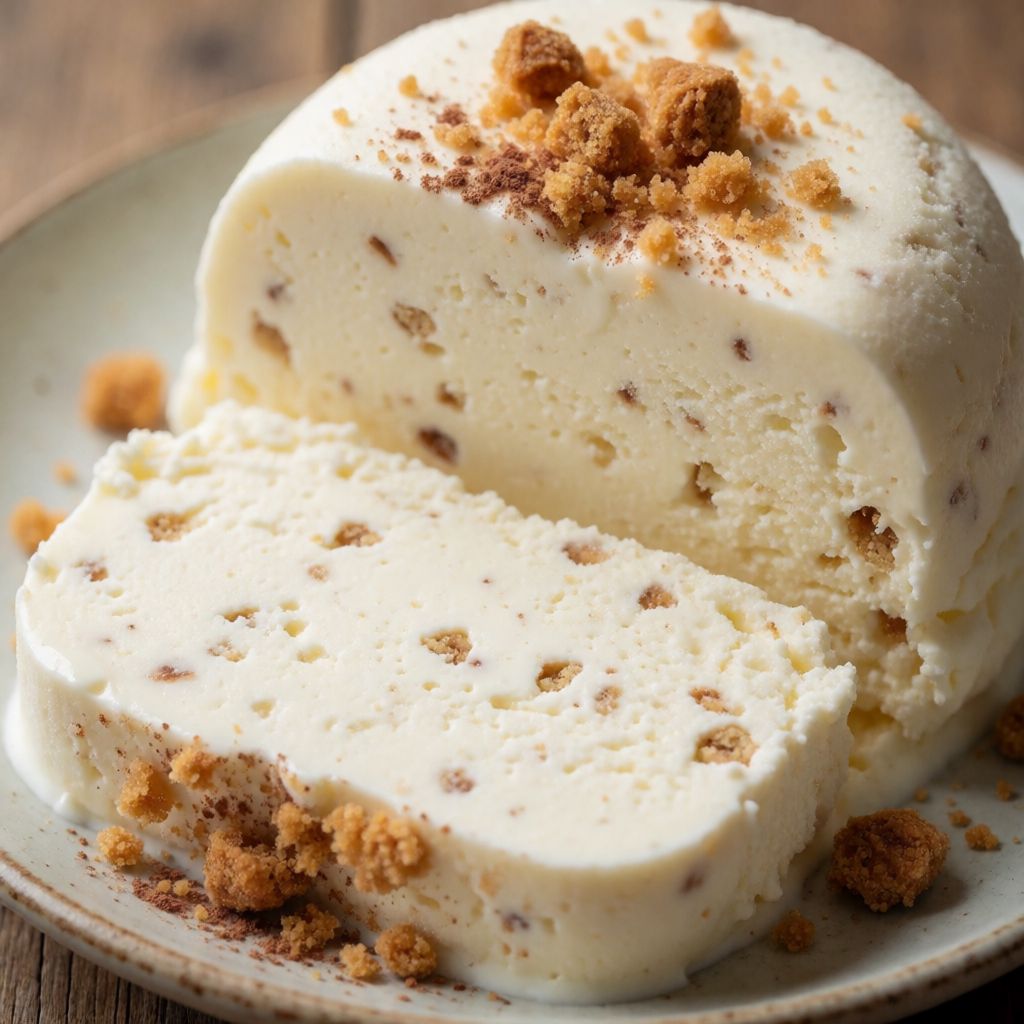
 AI photo
Ricotta Semifreddo
A chilled Italian-style ricotta semifreddo layered with amaretti and pavesini biscuits, finished with rum.
Labels are worked out automatically from the ingredients and can be wrong. Check the packaging if it matters to you.
Ingredients






Steps
Mix the ricotta with the sugar and a little milk, then leave to rest for 12 hours.
Add the rum to the mixture.
Crush the amaretti biscuits and fold them into the ricotta mixture.
Quickly dip the pavesini biscuits in milk and line the walls of a foil-lined mould with them.
Spoon the ricotta mixture into the mould and cover the top with a layer of milk-soaked pavesini biscuits.
Place the mould in the freezer for several hours.
Remove the mould from the freezer about 20 minutes before serving.
20 min
Semifreddo means half-cold, not half-made — it's the Italian answer to ice cream for a kitchen with no churn. You don't freeze a custard into a solid block; you build a mixture rich enough in fat, sugar and alcohol that the freezer can never quite finish the job. What you get out is something between a frozen mousse and a very cold cheesecake, held in a cage of biscuit instead of a baked crust. No oven, no machine — just a mould, foil, and the fridge's cold cousin doing the work overnight.
Three things decide whether it holds together or turns into a watery brick. First, the twelve-hour rest of ricotta, sugar and milk — that's not idle waiting, that's the ricotta's whey separating out so sugar can dissolve properly into it and the curd stop tasting grainy. Skip it and you're freezing wet lumps of cheese, which is exactly what it will taste like once thawed on a spoon. Second, the rum goes in after the rest, because its job isn't flavour — alcohol doesn't freeze at household freezer temperatures, so it gets in among the ice crystals and keeps them small and separate instead of locking into one solid sheet. That's the whole trick behind semifreddo: some say you need an ice-cream machine for anything creamy and frozen — no, because the machine's only job is beating air in and breaking up ice as it forms. Fat, sugar and alcohol can do the same thing sitting still, just slower.
Ricotta is the whole architecture of this dish, so don't swap it for cream cheese thinking they're interchangeable — cream cheese is nearly all fat with almost no whey, ricotta is a loose curd that's mostly water held by a little protein and fat. That looseness is exactly why it needs the long rest with sugar: osmosis pulls the whey out, the sugar dissolves into that liquid, and what you fold the rum and amaretti into afterwards is a smooth paste rather than a bowl of wet crumbs. If ricotta genuinely isn't available, cottage cheese passed twice through a fine sieve gets you close enough — it's the same idea, whey-based curd, just coarser to start with.
Sugar here is doing two jobs at once, which is why six tablespoons for 500g doesn't read as excessive once you know the second job: beyond sweetness, dissolved sugar also lowers the freezing point of the mixture, same principle as the rum, so it's part of why the dessert stays soft rather than turning into a flavoured ice cube. Any white sugar that dissolves cleanly works; nothing exotic needed.
The rum's criterion is simple — any spirit with real aroma and no watering-down of the mixture's structure. Dark rum, brandy, even a grappa if that's what's in the cupboard; what matters is alcohol content more than flavour profile, because it's the alcohol that keeps ice crystals from binding solid. Leave it out entirely for a non-alcoholic version and you'll get a harder, more honestly frozen dessert — not a failure, just a different texture, closer to a true ice than a semifreddo.
Amaretti bring bitterness and crunch against all that sweet soft curd — that contrast is the point, not an afterthought. They're small, hard, almond macaroons; fifteen of them crushed gives you grit through the whole mixture rather than pockets of biscuit in some bites and none in others. No amaretti in the cupboard, any dry almond biscuit crushed with a few drops of almond extract gets you close.
Pavesini are the thin, dry sponge fingers — think of the drier end of what you'd dunk in a cup of tea, not a soft cake. Their whole value is that they're dry enough to survive a quick milk dip and still hold shape as a wall; savoiardi (ladyfingers) are the standard substitute and work the same way, just slightly thicker, so your dip should be quicker still.
As for the mould — nobody's domestic kitchen has a proper charlotte tin lying around, and it doesn't need one. A loaf tin or any straight-sided bowl, lined with foil so the whole thing lifts out cleanly, does exactly what a professional mould does. This dessert's whole history is frugality dressed as a pudding: Italian households using up day-old biscuits that had gone past their best for dunking, built into something cold and worth serving on a Sunday, the same instinct that turns stale bread into a trifle. Make it the day before — the rest, the freeze, the patience all need to happen while you're busy doing something else, your roast included. There's no rushing a 500g block of ricotta into setting; the freezer does that on its own clock, usually a good deal slower than you'd guess, and 500g in a small mould for two is a rich enough portion that it stretches comfortably to four smaller ones if you're feeding more than a pair.