
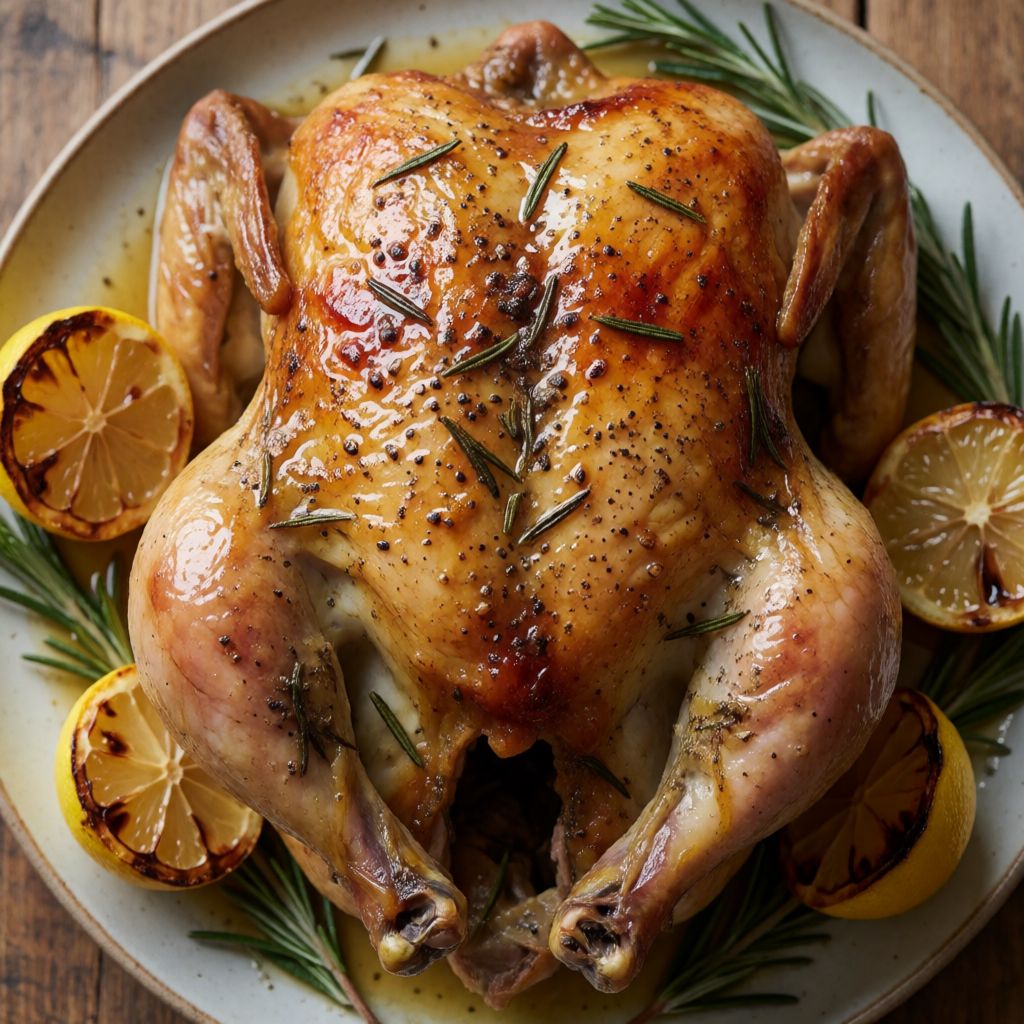
 AI photo
Roast Chicken with Lemon and Rosemary
Whole chicken roasted with lemon, butter and rosemary tucked under the skin, for a juicy Sunday roast.
Labels are worked out automatically from the ingredients and can be wrong. Check the packaging if it matters to you.
Ingredients







Steps
Grate the zest from one lemon and mash it with 1 tablespoon of rosemary needles, the butter, salt and pepper until it forms a paste.
Mix the lemon wedges, rosemary, olive oil, salt and pepper in a bowl, then stuff the chicken with this mixture.
Rub the chicken skin all over with salt and pepper.
Carefully, without tearing the skin, make pockets under the breast skin — easiest from the neck opening — forming a pocket between the breast and the meat on both sides.
Fill these two pockets with the lemon-butter rosemary paste.
Place the chicken on a baking tray, in a roasting dish or in a roasting bag and roast in a fan oven preheated to 150°C for about 2 hours, until the internal temperature reaches 78°C and the juices run clear.
120 min
This is a whole bird roasted slow and low, with the fat doing the work a baster usually does by hand, feeding four with usually enough left for Monday sandwiches. What decides whether it comes out right isn't the lemon or the rosemary — it's whether you solve the oldest problem in a roast chicken: the breast is lean and finishes fast, the legs are fat and take their time, and by the moment the legs are ready the breast has often gone past the point where it's still juicy.
The two pockets under the breast skin are the whole trick. You tuck herbed butter in there, not on top of the skin, so that as it melts over two hours at a gentle 150°C it runs down and bastes the breast meat continuously from the inside — no spoon, no opened oven door. Skip the pockets, or tear the skin making them, and that fat just runs out onto the tray and does nothing for the meat at all.
The lemon and rosemary stuffed into the cavity aren't there to flavour the meat deep down — flavour doesn't travel that far through intact muscle in two hours. What they do is turn to steam inside a closed space and keep the cavity from drying out while the outside roasts, and they scent the air the bird sits in. The real flavour payoff comes later, in the juices left behind in the tray.
Start with the bird itself. Buy one with the skin whole and unbroken — that skin is the container that holds the melting butter and juices exactly where they're useful, over the meat. Size changes nothing about the method, only the clock: a bigger chicken needs longer at the same 150°C, so trust the probe over the stated two hours, which is a floor, not a target. Economics explain the Sunday roast tradition more than nostalgia does: one whole bird, roasted slow while you're out doing anything else, feeds a family on the day and leaves enough for sandwiches the next — cheaper per kilo than buying the same weight split into breasts and thighs.
The lemon is there for moisture and scent, not deep flavour. Citric acid and aromatic oils sit mostly in the zest and pith, and heat releases them as steam inside the cavity rather than soaking them into the meat, which simply doesn't happen through intact fibre in two hours. Skin-on wedges matter because the skin is where those oils actually live. If you've none, any watery, aromatic thing does the same job — an apple, half an onion, even a splash of water with the rosemary thrown in.
Rosemary earns its place here for being tough. Woody herbs survive two hours of dry heat; soft ones like parsley or basil would be ash by the time the legs catch up. Any other stiff-leaved, low-moisture herb — thyme, sage, bay — works on the same logic, slow to burn because it has little water to boil off first.
The olive oil never actually fries anything here, whatever the label says — its real job is coating the lemon wedges and rosemary so they roll around loose in the cavity instead of sticking together and steaming solid. Any oil with no smell of its own does this; a spoon of melted butter would too.
The butter under the skin has to be soft, and not for comfort's sake — cold butter tears skin when you try to work it into a pocket, and a torn pocket leaks its fat straight onto the tray instead of over the breast, which is exactly the dryness this whole method is built to prevent. Butter beats plain oil here for a second reason: its milk proteins brown the skin above them as they slowly warm through, where oil alone would baste but add nothing to the colour. Without dairy, rendered chicken fat does the same work, just paler.
One myth worth naming: that you have to keep opening the oven to baste by hand every twenty minutes or the breast dries out. Don't — every time you open a domestic fan oven you dump a chunk of its heat straight into the kitchen, and the bird spends good minutes just climbing back to temperature. The butter in the pockets is already basting, on its own, the whole time. Spend your patience instead at the end: rest the chicken loosely covered — an upturned bowl does the job a lid would — for ten to fifteen minutes before carving, so the juices settle back into the meat instead of running out onto the board.