
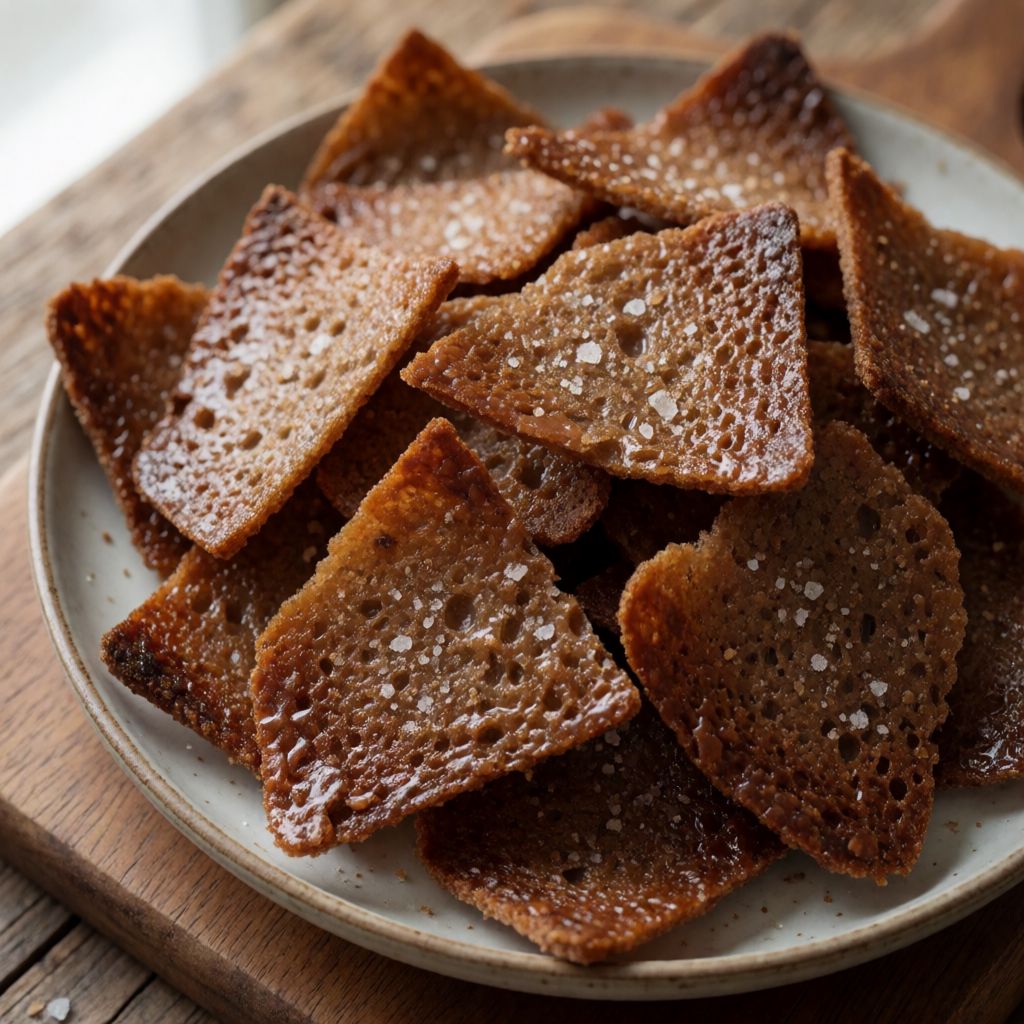
 AI photo
Rye Bread Chips
Crispy, thin rye bread chips baked with olive oil and salt — a simple homemade snack.
Labels are worked out automatically from the ingredients and can be wrong. Check the packaging if it matters to you.
Ingredients
- 5 pcs Rye bread slices cut very thin
- 3 tbsp Olive oil
- 1 tsp Salt



Steps
Cut the rye bread slices into triangles.
Arrange the thinly sliced bread on a baking tray lined with parchment paper.
Drizzle or brush with olive oil, sprinkle with salt, and bake in the oven at 175°C (fan) for 10–15 minutes.
12 min
These aren't croutons and they aren't crackers — they're something in between, rye bread shaved down to almost nothing and baked until the water in it is gone and only the structure is left. That's the whole mechanism: a chip is bread that has lost its moisture without losing its shape. Too thick, and the middle stays chewy while the edges turn to charcoal. Too thin, and there's nothing left to bite.
What decides whether it works is the slice, not the oven. "Very thin" isn't a style note — it's the one variable you control that the oven can't fix. A slice that's two or three millimetres thick dries through at the same rate the surface browns. A slice that's six or seven millimetres thick never gets there: by the time the centre is dry, the outside is black. Rye bread makes this easier than white, because rye has less gluten stretch and more density — it holds a thin slice without tearing, where a soft white loaf would just flop.
Forget minutes as your instruction. Twelve is a guess, a lower bound, nothing more — ovens lie, trays sit closer to the element on one side than the other, and "fan 175°C" on your dial might run a touch hot or cold depending on how old the thing is. Watch colour instead. The chip starts pale and a bit matte. It goes through a stage where it still bends slightly if you lift the tray and nudge one with a spatula. You want it past that — stiff, no longer bending, the colour gone from dull brown to something closer to ginger-biscuit amber at the edges. That's done. Past that is bitter, and bitter doesn't come back.
Rye bread is the one ingredient here that isn't flexible, because it's doing a structural job, not a flavour one. You want a loaf dense enough to slice thin without the slice falling apart — proper dark rye, the kind sold as a solid small loaf rather than a fluffy sandwich one, has enough body for that. If all you've got is a lighter rye-wheat blend, it'll still work, just expect slightly less snap and a touch more puff at the edges, because there's more gluten in it to trap air as it dries. True wholly-wheat bread is a different dish, not a substitute — it browns and puffs instead of drying flat, and you'd get toast triangles, not chips.
The five slices is really a proportion of surface area to tray, not a fixed number — thin bread shrinks almost nothing in the oven, so however many triangles five slices make is roughly what fits on one tray without overlapping. Overlap is the real enemy here, more than any oven setting: two triangles touching trap steam between them, and that patch stays soft no matter how long you leave the rest. One layer, gaps between pieces, that's the actual rule hiding behind "arrange on a tray."
Olive oil is doing two things at once — carrying heat into the bread's surface more evenly than dry air can, and giving you that shallow-fried flavour and colour without a pan of hot fat. The criterion for substituting it is simple: any oil that can sit at oven heat for ten-plus minutes without smoking or turning bitter. Rapeseed oil, the everyday one in most British kitchens, does this fine and costs less; a flavourless sunflower oil works too, though you lose the faint olive note in the finish. What you don't want is anything that smokes at this heat — butter, for instance, burns well before the bread's dried through, and you'd taste it.
Salt goes on before baking for a reason beyond habit: dry heat doesn't dissolve it the way a sauce would, so whatever grain size you sprinkle on is roughly what you'll taste later. Fine table salt spreads evenly and vanishes into the surface — good if you want the bread flavour to lead. A coarser flaked salt sits as little crystals you actually bite into, better if these chips are heading for a cheeseboard or alongside something rich, a pâté after your Sunday roast, say. A teaspoon over five slices is light-handed on purpose; you can always add more at the table, you can't take it off the bread.
This whole thing, if you trace it back, is an economy trick dressed up as a snack. Bread that's a day or two past its best doesn't make good toast — too much structure already lost — but it makes excellent chips, because what you want here is bread that's already lower in moisture to begin with. Fresh-from-the-bag rye will work, but slightly stale rye works better and bakes a touch faster, since there's less water for the oven to drive out. It's the same instinct behind using yesterday's roast potatoes for bubble and squeak: nothing wasted, and the staleness turns out to be an advantage once you know what you're using it for.
Patience here is short but real. Twelve to fifteen minutes isn't long, but it's long enough that walking off to make tea and forgetting the tray is the single most common way this goes wrong — the gap between "just right" and "bitter" at the tail end is a minute or two, not ten. Stand near the oven for the last few minutes. That's the whole ask.