
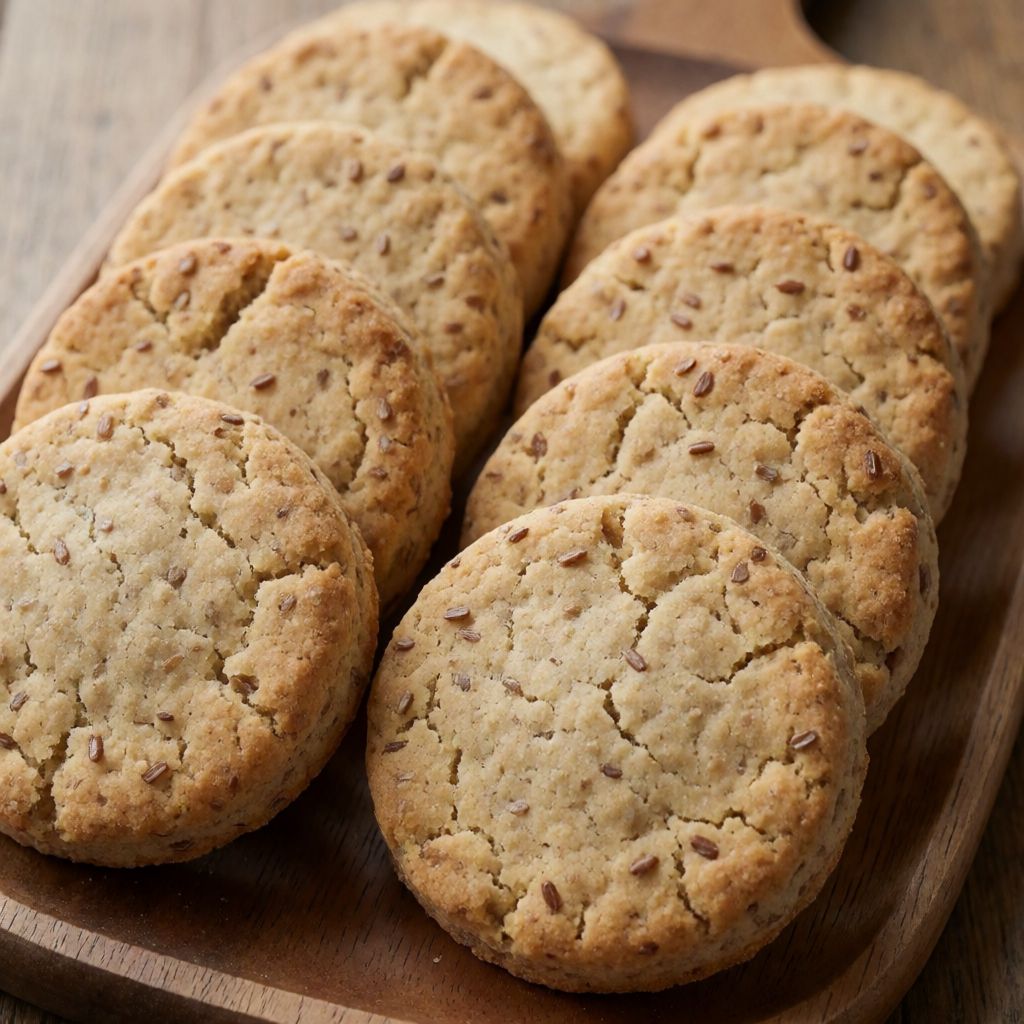
 AI photo
Rye Biscuits
A simple rustic biscuit made with rye flakes and rye flour for a nutty, wholesome crunch.
Labels are worked out automatically from the ingredients and can be wrong. Check the packaging if it matters to you.
Ingredients
- 100 g Butter at room temperature
- 30 g Rye flakes
- 120 g Plain flour
- 50 g Rye flour
- 45 g Caster sugar
- 100 ml Water
- 0.5 tsp Baking powder
- 0.5 tsp Salt







Steps
Pour 100 ml of boiling water over the rye flakes in a bowl and let them soak and cool slightly.
Cream the butter with the sugar, then mix in the flour, salt and baking powder.
Add the rye flour and the soaked rye flake mixture, and briefly knead into a dough.
Gather the dough into a ball, place it in a covered bowl and chill in the fridge for 1 hour.
60 minRoll out the dough on a lightly floured work surface.
Cut out the biscuits using a glass, your favourite cutter, or simply slice into squares.
Arrange the biscuits on a baking tray and prick them with a fork.
Bake in a preheated fan oven at 180°C for about 15 minutes.
15 min
What was changed
The oven temperature was rounded up to 180°C to fit the display steps used by UK ovens.
These are not sweet biscuits in the Marks and Spencer sense — they're closer to a Baltic rye cracker that wandered into the biscuit tin. Dense, a little sour from the rye, short rather than crumbly, good dunked in strong tea. What decides whether they work is not the oven, it's two things that happen before the oven ever gets switched on: how you treat the rye flakes, and how cold the dough is when you roll it.
Pour boiling water on rye flakes and they swell — the starch in them takes up water and softens. Skip that step, or use lukewarm water, and the flakes stay as hard little shards buried in the dough, and you bite into what feels like gravel instead of grain. This is the whole reason for step one; it has nothing to do with "activating" anything mystical, it's just starch doing what starch does in hot water.
Then the dough goes into the fridge for an hour. Some say you can skip the chill if you're in a hurry — no, because the butter in this dough is the only thing holding the shape of the biscuit until the oven sets it. Warm butter is soft butter, soft butter spreads under its own weight the second it hits a hot tray, and your neat little squares turn into thin greasy puddles that fuse together. An hour in the fridge firms the fat back up so the biscuit holds its cut edge.
Rye flour is the reason this dough needs a partner. It has almost no gluten-forming protein, so a biscuit made from rye flour alone wouldn't hold together — it would crumble before it got anywhere near your tea. The plain flour here isn't padding out the recipe cheaply, it's doing the structural job rye can't: giving the dough enough gluten to be rolled and cut without falling apart. If you want to push the rye flavour further, you can shift the ratio a little, but go all rye and you'll be eating dust, not biscuits. No rye flour at all? Wholemeal flour gets you closer in colour and bran-speckled texture than anything else in a normal kitchen, though you lose the faint sourness that's rye's whole personality.
Rye flakes are the whole grain rolled flat, the same idea as a porridge oat but from a different plant. They need the boiling-water treatment described above because, unlike flour, they're still structurally a piece of grain, not a powder — water has to physically get inside and soften them. If you've no rye flakes in the cupboard, ordinary rolled oats soaked the same way will behave almost identically in texture; you just lose a bit of the characteristic rye tang, which oats don't have.
Butter at room temperature means soft enough that your finger leaves a dent without the butter looking greasy or pooling — not melted, not fridge-hard. Creaming it with the sugar at this stage beats a little air into the fat and coats the sugar crystals evenly, which is why caster sugar is specified rather than granulated: the finer crystal dissolves into the butter cleanly instead of sitting there gritty. If all you have is granulated, give it an extra minute of beating; it'll get there, just more slowly. For the fat itself, any firm, flavour-bearing fat that's spreadable at room temperature will do the mechanical job — margarine, for instance — but you'll notice the absence of butter's own taste more in a plain biscuit like this than you would in a cake, where other flavours cover for it.
Baking powder here is a whisper, not a shout — half a teaspoon for this whole batch. These biscuits aren't meant to rise, they're meant to stay flat and short; the baking powder just takes the heaviness off, stopping the rye and butter combination from baking into something leaden. Salt does the ordinary two jobs salt always does in baking: it rounds off the sugar so the biscuit doesn't taste flatly sweet, and it tightens up what little gluten structure is there, which matters more than usual in a dough this low on gluten to begin with.
Pricking the biscuits with a fork before baking isn't decoration, it's venting. As the dough heats, moisture trapped inside wants to turn to steam and push the surface up into uneven blisters; a few fork holes give that steam a way out instead of a reason to lift the top off your biscuit. A fan oven at this heat browns the rye sugars at the edges reasonably evenly because the moving air stops hot spots forming — on a conventional oven without a fan, expect the ones at the back or on the upper shelf to colour faster, so turn the tray round partway through rather than trusting the dial.
Rye itself has a story worth a sentence while the dough chills: it's the grain that grows where wheat gives up — poorer, colder soil, Northern and Eastern Europe. Biscuits like these come from kitchens where rye was what you had, not a flavour choice but an economic one, and the slight sourness people now pay extra for in a fancy bakery used to just be what grain you were given. Worth remembering, with your cup of tea, that frugality and flavour aren't always on opposite sides.