
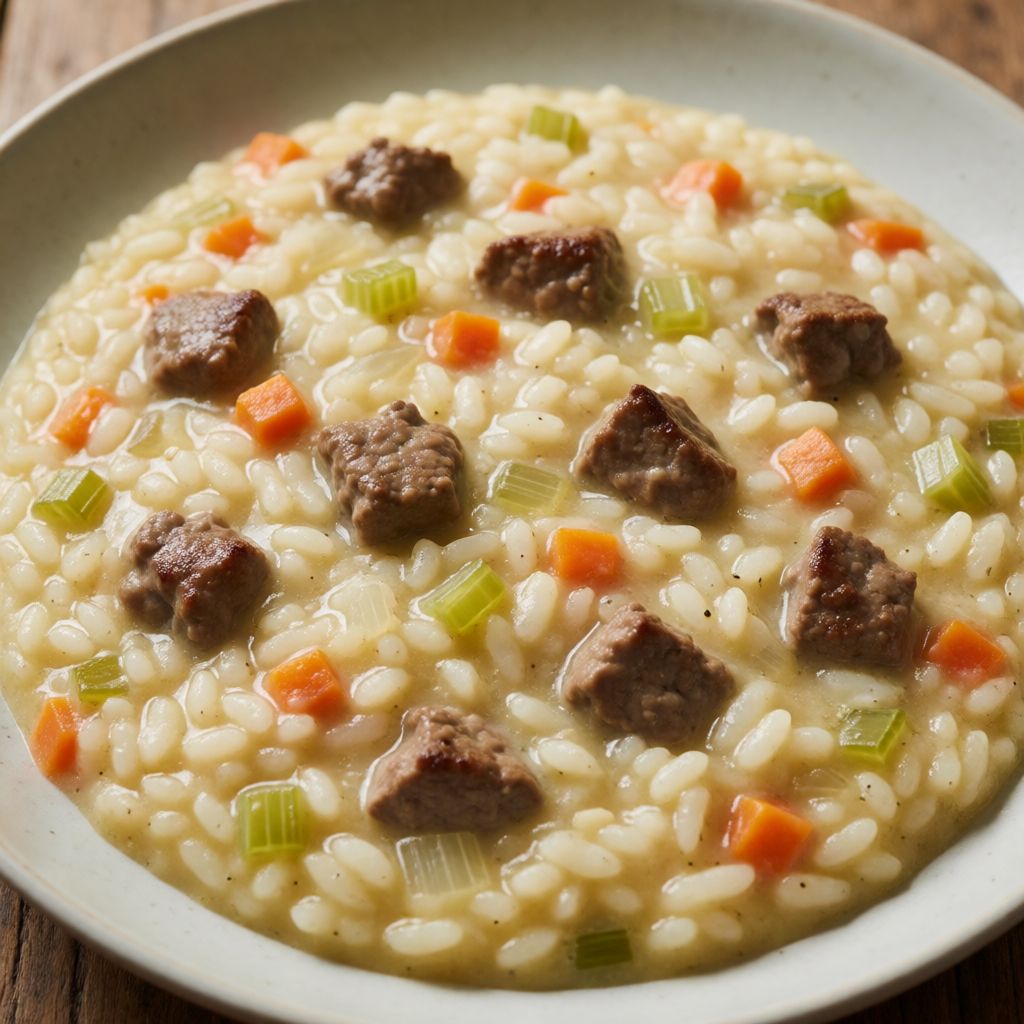
 AI photo
Risotto with Chicken Liver
A creamy Italian-style risotto with tender chicken livers, slow-cooked in stock with white wine and finished with Parmesan.
Labels are worked out automatically from the ingredients and can be wrong. Check the packaging if it matters to you.
Ingredients
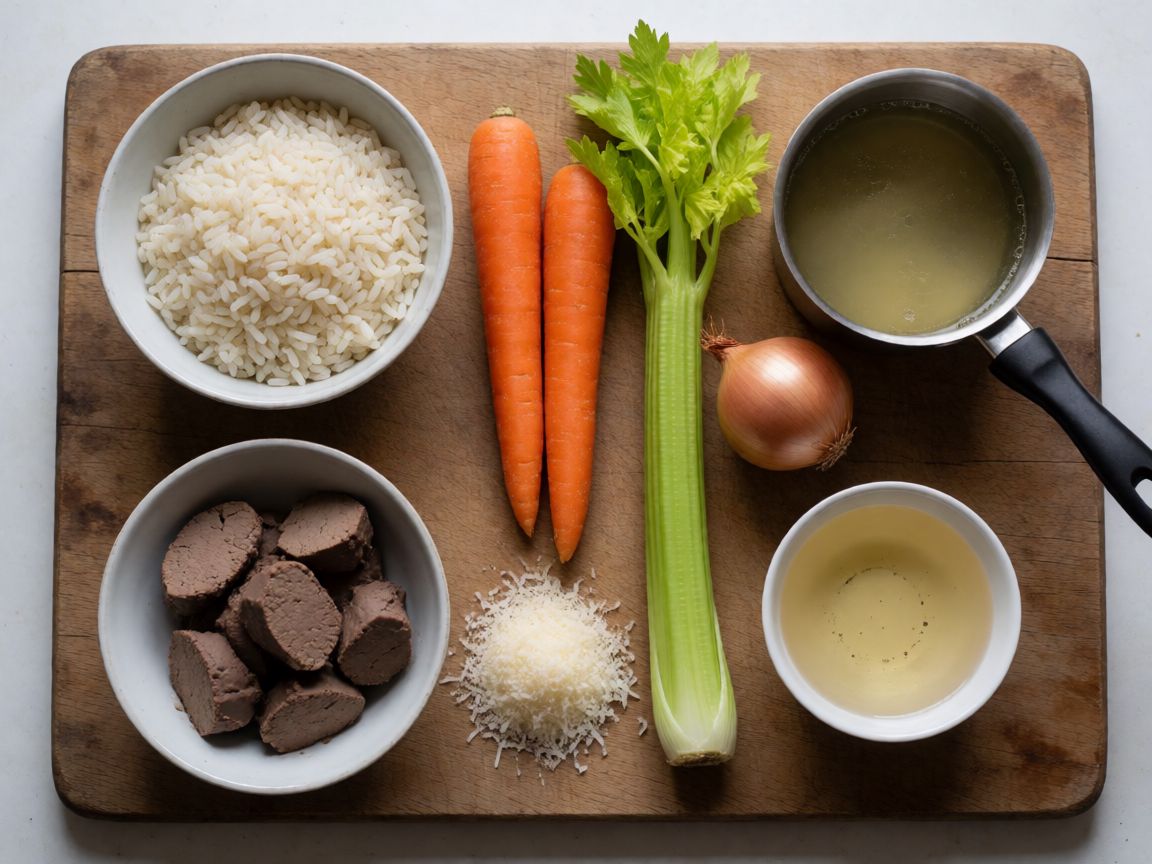
- 500 g Carnaroli risotto rice
- 500 g Chicken livers
- 2 pcs Carrot
- 1 pcs Onion
- 1 pcs Celery stick
- 0.5 l Stock
- 250 ml White wine
- 100 g Parmesan grated
- Salt to taste
- Olive oil a small amount










Steps
Rinse the chicken livers under cold water, trim away any fatty membranes, and slice them thinly.
Finely chop the carrot, onion, and celery, then sauté them in a pan with the olive oil.
Add the sliced chicken livers and sauté.
Pour in the white wine and let it evaporate completely.
Add the stock and cook for 2 hours, stirring occasionally. Ready when the internal temperature reaches 74°C.
120 minAdd the risotto rice and cook, stirring well, salting to taste.
Add the grated Parmesan, let the flavours meld for a few minutes, and serve.
This isn't a risotto cooked the usual way — ladle of stock, stir, twenty minutes, done. It's two clocks bolted together: a long, slow liver ragù that eats up most of the two hours, and the actual rice-cooking, which happens fast, right at the end, once the rice goes into that ragù. Once you see it that way, the long cooking time stops looking strange.
What decides whether this works is what happens to the liver during those two hours, not whether it's cooked — thin slices in a hot pan are done in minutes, nowhere near two hours. On a hard simmer the proteins seize up and the liver turns grainy, dusty, the texture people complain about when they say they don't like liver. On a bare, lazy bubble — barely a tremor on the surface — it keeps giving up flavour into the stock and wine while staying soft, and the whole pan slowly collapses into a dark, dense, savoury base. That base, not the liver's doneness, is the actual point of the long cook.
Some say offal needs long cooking to be safe, the way a tough shin of beef does — no, because liver has almost no connective tissue to break down. It reaches a safe core in moments; 74°C is the point poultry liver is instantly clear of salmonella, and thin slices cross it fast. The two hours aren't about getting there, they're about reduction and depth, the stock thickening around the liver until it's closer to a ragù than a soup.
Start with the rice, because it decides the texture, not the liver. Carnaroli is chosen for what's inside the grain: a high proportion of starch that rubs off into the liquid as you stir, making the sauce around each grain creamy, while the grain itself keeps a firm core because its structure holds up under heat better than ordinary rice. Buy it marked superfino if you can, grains whole and unbroken — broken grains leak starch too fast and you get porridge. If you've none, Arborio or Vialone Nano do the same job, just watch Arborio more closely as it softens faster. Don't reach for a long-grain rice like basmati here — it's built to stay separate and dry, the opposite of what this dish needs.
The liver is the other half of the character. Buy it firm, deep red-brown, no green staining — green means a nicked bile duct, and bile tastes bitter and metallic, no amount of cooking fixes that, cut it away the moment you see it. Trimming the membranes isn't fussiness: left in, they stay tough and stringy no matter how long you simmer, because they're connective tissue that liver itself barely has, and chewy threads in an otherwise silky sauce stand out badly.
The wine's job is acid and lift. Dry white, because its sharpness cuts the richness of the liver and lifts the browned bits off the pan when you pour it in. Letting it evaporate completely isn't about a timer — it's about smell: the sharp, raw alcohol vapour has to go, replaced by something rounder. If you've no wine open, dry vermouth does the same work, or skip it and add a squeeze of lemon near the end instead — not a perfect swap, but it covers the same job of acid.
Carrot, onion, celery — the soffritto — is there for the oldest reason in the book: it's cheap, and chopping it finely and sweating it slowly draws out its own sugars so it melts into the base rather than sitting there as vegetable. This trio stretching an expensive or scarce protein is exactly how offal cooking survived in home kitchens for centuries — a little liver, a lot of root vegetable and rice, feeding five people instead of two.
Stock is the liquid the whole ragù reduces into, so its flavour ends up concentrated, not diluted — homemade is better here than anywhere else in your cooking, because weak stock just gets weaker as it reduces. A shop-bought fresh stock is fine; a stock cube works in a pinch but go easy on added salt later, since parmesan and a two-hour reduction already bring plenty.
Parmesan goes in off the heat, stirred through while the pan is still hot but not over flame — that's the mantecatura, and it's not a flourish, it's what keeps the sauce glossy and emulsified instead of cheese and fat splitting into grease on the surface. Any hard, aged, salty grating cheese does this job — pecorino works, just cut back the added salt since it's sharper. The oil at the start needs to do nothing except let the vegetables soften without catching — any oil with no smell of its own does it, a light olive oil or sunflower oil, save a peppery extra virgin for dressing something raw, not for carrying a liver ragù.
One last thing about your hob: a UK flat hob rarely has a true gentle simmer at its lowest setting, it still idles hotter than a gas flame would. Use your widest, heaviest pan, keep the lid off a crack with a plate over it if you need to slow evaporation, and check the bottom every so often with a wooden spoon so nothing catches while you're elsewhere. Patience is the real ingredient in the first two hours — there's no shortcut that gets you the same depth, only a faster way to scorch it.