
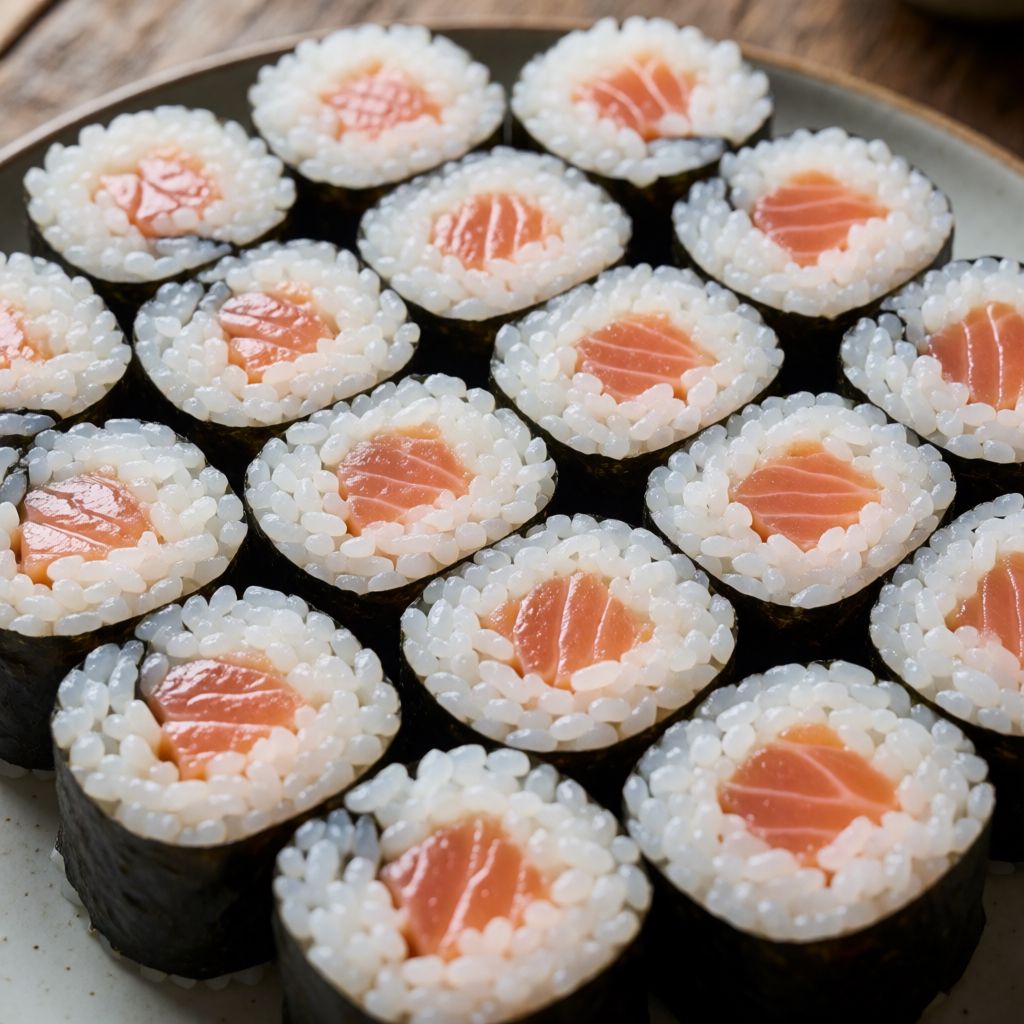
 AI photo
Lunchbox Sushi – Tasty Salmon Maki Rolls
Neat salmon maki rolls that pack perfectly into a lunchbox, with sticky rice, nori and smoked salmon.
Labels are worked out automatically from the ingredients and can be wrong. Check the packaging if it matters to you.
Ingredients
- 150 g Sushi rice
- 200 ml Water
- 1 tbsp Rice vinegar
- 0.5 tsp Sugar
- 1 pinch Salt
- 50 g Smoked salmon
- 2 pcs Nori sheets
- 1 tbsp Soy sauce to serve
- 50 g Edamame beans to serve
- 1 pcs Lemon to serve








Steps
Mix the rice vinegar, sugar and salt, and leave in a glass overnight until the sugar dissolves.
1440 minRinse the rice in a sieve under running water.
Put the rice in a saucepan with water and let it stand for 30 minutes.
30 minBring the rice to a boil over medium heat with the lid on.
Simmer the rice covered for 10 minutes.
10 minTurn off the heat and leave the rice in the covered saucepan for 30 minutes.
30 minAdd the vinegar mixture, cover and let the rice cool.
Cut the nori sheet in half, spread the rice over it with hands dampened in cold water, then lay on the salmon.
Roll it up tightly and slice into pieces with a sharp knife.
Pack the sushi snugly into a lunchbox, and add the soy sauce, edamame beans and lemon.
What was changed
Soybeans were swapped for Edamame beans, as that is how shoppers buy them here.
Sushi rice is the whole dish. Everything else — the salmon, the nori, the soy — is garnish by comparison. What you're actually making here is a starch that has been coaxed into stickiness without being mashed into porridge, and that one fact decides whether these rolls hold together on the Tuesday commute or collapse into a bowl of rice with regrets.
Some say sushi needs special equipment — a cedar tub, a bamboo mat, a rice cooker with a sushi button. No: a saucepan with a lid and a sharp knife will do it, because the mechanism is simple. Starch grains swell in water, burst a little at a steady simmer, and then — this is the part people skip — need to sit, lid on, heat off, so the steam trapped inside finishes the job gently instead of scorching the bottom layer. That rest is not laziness. It's the step that stops you getting crunchy rice on the bottom of the pan and wet rice on top.
The vinegar dressing is the second half of the trick, and it goes in cold, after cooking, never during. Add it hot and you cook the vinegar's sharpness clean out of it, and you partly stew the rice into mush. Add it cold and it seasons the surface of each grain while the starch is still flexible enough to take it up — that's the sourness and faint sweetness you actually want, not a reduction.
Rolling with wet hands isn't a flourish either. Rice is stickier than a wet sponge; it will glue itself to your palms before it glues itself to the nori. Damp fingers stop the rice sticking to you, not to the sheet — the sheet it sticks to on its own, because that's its job.
Sushi rice specifically means a short-grain, high-starch rice — look for a bag labelled "sushi rice" or "Japanese rice" rather than reaching for basmati or long-grain in the cupboard. Long-grain rice has less of the starch that gelatinises and binds; it stays separate and fluffy, which is exactly wrong here. If sushi rice genuinely isn't available, a risotto rice like arborio is the closer substitute by starch content, though the grain shape and flavour will drift.
The overnight vinegar steeping is really just dissolving sugar and salt into the vinegar without heat — nothing mystical, just patience doing the work that a saucepan over heat would do in thirty seconds, chosen here presumably so the mixture is ready and cold the moment the rice needs it. If you're short on foresight, you can warm the vinegar gently just until the sugar disappears, then cool it fully before it touches the rice — the one rule that doesn't bend is that it goes on cold.
The soaking-before-cooking stage (that thirty minutes with rice sitting in its water) lets the grains take up moisture evenly before any heat arrives, so they swell from the inside rather than cooking hard in the centre while the outside turns to paste — a common cause of rice that's gluey on the surface and chalky in the middle. Rinsing first matters for the same reason from the other direction: it washes off the loose surface starch dust that would otherwise cloud the water and make the pot boil over into a sticky film.
Smoked salmon here is doing a flavour job, not a textural one — it's already "cooked" by the smoking, so there's no doneness to judge, just quality: look for slices with a deep, slightly translucent colour and no grey dullness at the edges, which signals it's been sitting too long after opening. Any cold-smoked fish works on the same principle if salmon isn't to hand — smoked trout behaves almost identically.
Nori is dried seaweed sheet, and its only real demand is that it stays crisp until the moment the rice goes on; a nori sheet gone soft and leathery in a half-open packet won't hold a roll's shape, it'll just fold wherever it likes. Keep the packet sealed, and if you've got a UK kitchen without a bamboo mat, a clean tea towel laid flat does the rolling job well enough — you're not making a perfect cylinder for a photograph, you're making something that survives a lunchbox.
Edamame, soy sauce and lemon are the lunchbox's seasoning kit, added at the end rather than cooked in, because their job is to be fresh contrast against rice that's been resting for hours — pack them separately if you can, so the lemon doesn't turn everything a bit soggy by the time lunch arrives. This whole dish, for two people, assumes a weekday lunch problem being solved on a Sunday evening — which is really the economics of it: an hour of attention upfront buys you two mornings where you're not thinking about lunch at all.