
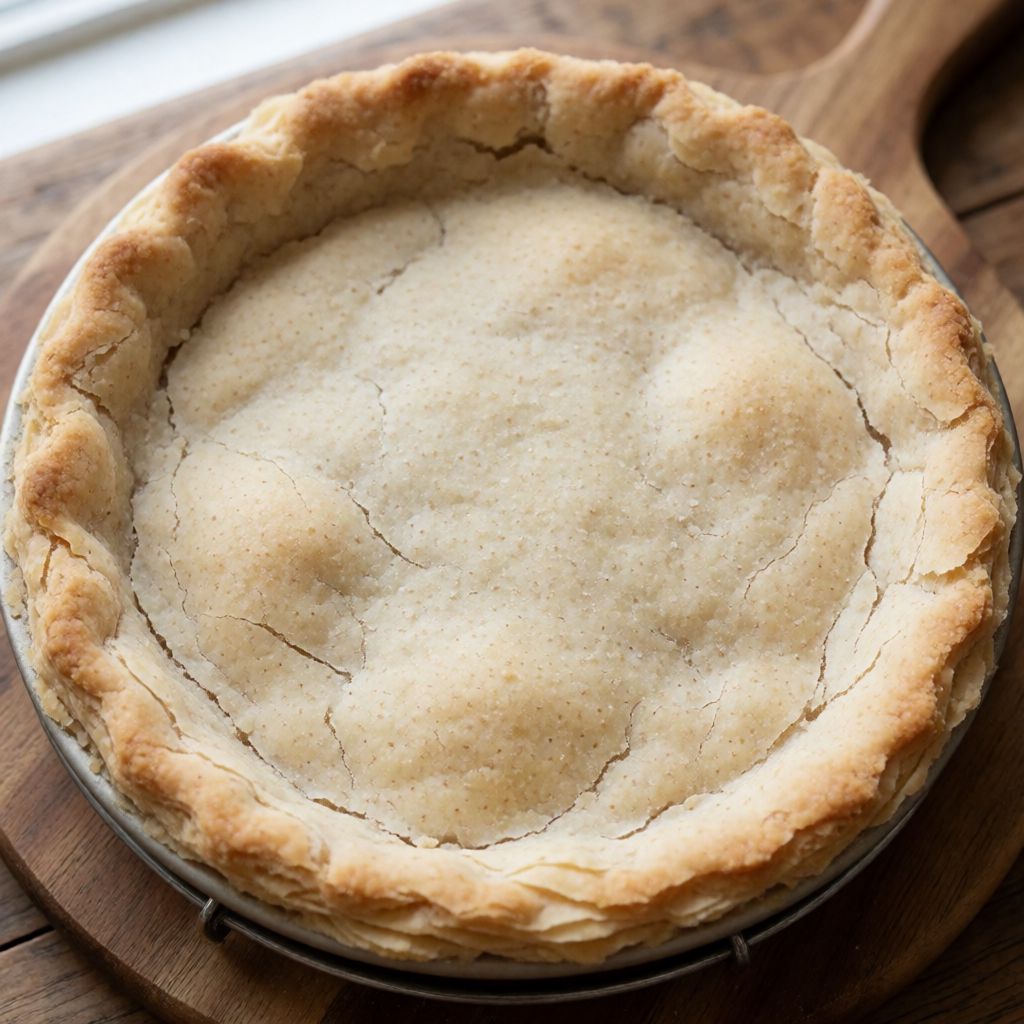
 AI photo
Savoury Pie Pastry
A simple shortcrust pastry for savoury pies, made with wholemeal and plain flour.
Labels are worked out automatically from the ingredients and can be wrong. Check the packaging if it matters to you.
Ingredients
- 50 g Wholemeal Flour
- 125 g Plain Flour
- 100 g Butter cold
- 2 tbsp Water
- 1 tsp Salt





Steps
Mix the wholemeal flour, plain flour and salt in a bowl, then rub in the cold butter until the mixture resembles breadcrumbs.
Bring the dough together, adding a little water until it is smooth.
Shape the dough into a ball, put it back in the bowl and chill in the fridge for 15–30 minutes.
15 minRoll out the dough into a circle to match the size of your pie tin, and press it firmly into a greased tin about 27cm in diameter.
Prick the base with a fork and bake in an oven preheated to 175°C (fan) for 10 minutes. It is now ready for filling.
10 min
This is not a pie. It's the box the pie lives in — a plain, sturdy shortcrust that has to do two jobs at once: hold a wet filling without turning to paste, and still break when you bite it, not bend. Everything in the method is aimed at keeping those two things true at the same time.
What decides whether it works is temperature, not time. Cold butter, rubbed into flour with cold fingers (or a cold food processor blade), coats each flour particle in fat before any water gets near it. That coating is the whole trick — it blocks the flour's starch from linking into long chains of gluten. Gluten is what you want in bread, where you need stretch and chew. Here you want the opposite: short, crumbly, 'shortcrust' is literally named after the thing it refuses to do, which is stretch. The moment your hands warm up and the butter starts to smear rather than crumble, you've lost that barrier, and the dough will shrink and toughen in the oven no matter how carefully you roll it after.
Some say you can skip chilling if you're in a hurry. No — because the fifteen to thirty minutes in the fridge isn't there to make the dough easier to handle, though it does that too. It lets the gluten you couldn't avoid forming relax, and it re-firms the butter that your hands softened while kneading. Skip it, and the base will slump and slide down the sides of the tin as it bakes, because nothing is holding its shape until the heat sets it.
On the ingredients, one by one. The flour is split between wholemeal and plain — not for virtue, for flavour and bite. Wholemeal brings a nutty taste and a slightly sandy texture because it still carries the bran; too much of it and the pastry turns gritty and refuses to hold together, because bran cuts through the sheets of fat-coated flour the plain flour is forming. A quarter wholemeal to three-quarters plain, as here, is about the most you can push before the dough gets stroppy. If you've only got plain flour in the cupboard, use it all — the pastry will be paler and a touch blander, nothing more dramatic than that.
Butter, and it has to be cold — straight from the fridge, maybe ten minutes in the freezer if your kitchen is warm. What matters is the criterion, not the brand: any solid fat that stays firm at room temperature and doesn't carry a strong smell of its own. Butter gives the best flavour and the cleanest break. Lard, where you can get it, makes an even shorter, flakier crust, because it has a wider melting range and less water in it than butter — that's a genuine mechanical difference, not folklore. A hard block margarine will get you through in a pinch, but it melts earlier and softer, so chill it harder and handle it faster than you would butter.
Water is the dangerous ingredient here, which sounds odd for something so plain. Two tablespoons is a minimum, added a little at a time — because water is what finally does activate gluten, the thing you spent step one preventing. Add it gradually and stop the moment the dough holds together, and work it as little as possible from that point on. Add it all at once, or knead it like bread dough, and you build exactly the elastic, chewy structure you were trying to avoid — the pastry comes out tough instead of short, and that toughness is blamed, wrongly, on 'bad pastry hands' when it was really excess handling after the water went in.
Salt earns its place by taste, not chemistry — a savoury pie base with no salt is flat and a bit sad under a rich filling, so don't drop it even if you're nervous of a full teaspoon; most of it ends up diluted across a whole pie.
Pricking the base with a fork before it goes in the oven is a small thing with a clear job: trapped steam under a sealed sheet of pastry pushes up blisters and uneven bulges as it bakes blind. The holes let that steam escape evenly instead of forcing its way out in one spot. A proper blind bake for a thick, long-baked pie would also ask for baking beans or dried rice on top of greaseproof paper, to weigh the base down while the butter inside melts and the sides are still soft enough to slide. This recipe skips that, because ten minutes is short enough that the dough, well chilled going in, holds its shape on its own — but if your oven runs fierce and the sides are sagging by minute six, a scrap of greaseproof and a handful of rice or dried beans costs you nothing and saves the shape.
One honest note on the oven: 175°C fan is a fan-oven setting, and fan ovens run hotter for the same number than a conventional one, because the moving air carries heat to the surface faster. If yours is conventional only, you're looking at closer to 190–195°C, and you judge it by colour and firmness — pale gold, dry and firm to a light touch at the rim — rather than trusting the ten minutes blindly, since that figure is a floor, not a verdict. And give yourself the full chilling time if you can; patience here is doing the work that no amount of clever rolling can do after the fact.