
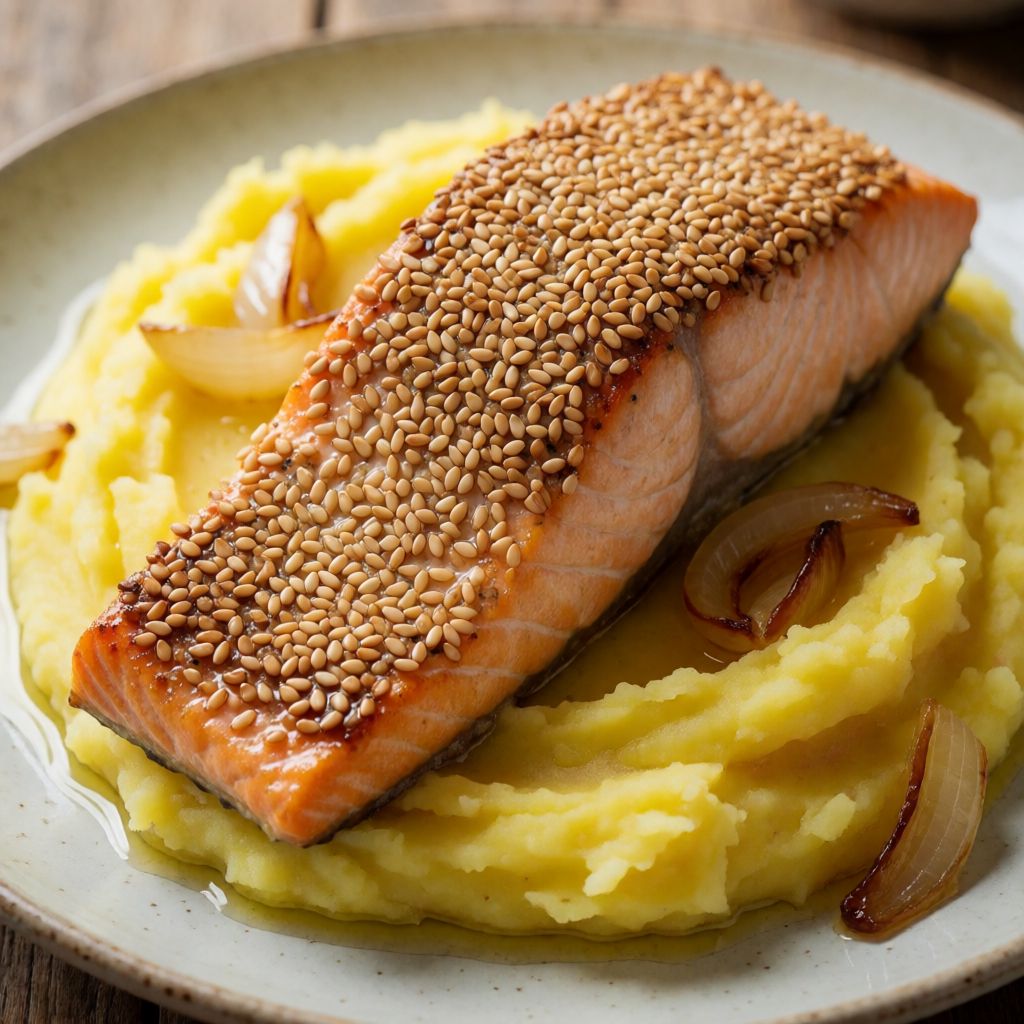
 AI photo
Sesame-Crusted Salmon on Saffron Mashed Potatoes
A simple salmon dish with a sesame crust, served over creamy saffron mashed potatoes.
Labels are worked out automatically from the ingredients and can be wrong. Check the packaging if it matters to you.
Ingredients
- 4 pcs Salmon
- 1 pcs Onion
- 1 tbsp Sesame seeds
- Olive oil to taste
- 4 pcs Potatoes
- Salt to taste
- White pepper to taste
- Parsley to taste
- 1 pcs Saffron
- 8 tbsp White wine








Steps
Peel the potatoes, cut them into pieces, put them in a pot and cover with water.
Heat olive oil in a frying pan and sauté the onion until soft.
Place the salmon, coated in sesame seeds, into the pan together with the onion.
Pour in the white wine and let it evaporate, turning the fillets over. Season with salt and sprinkle with white pepper. Cook until it reaches 63°C.
When the potatoes are cooked, add olive oil and saffron, then blend until smooth.
Spoon the mashed potatoes onto plates, place the salmon on top and sprinkle with parsley.
Serve immediately.
This is a one-pan main built around a tension: you want a crisp sesame shell on the salmon, but the recipe also wants you to splash wine into the same pan and let it hiss away. Crust and moisture are enemies. The dish only works if you understand that order — sesame goes on dry, in hot fat, before the wine ever touches the pan, and the wine's job is to finish cooking and deglaze, not to baste a crust into submission.
The second thing that decides the dish is temperature on the fish, not time. 63°C is where salmon's proteins have just set — the flesh turns from glassy translucent to an even matte pink, and it still holds its own moisture. Push past that because it "doesn't look cooked enough," the habit most people bring from a Sunday roast where you cook meat until there's no doubt — and the fish turns chalky and dry in about ninety seconds, because fish has far less connective tissue to hold water once the proteins over-tighten. There's no coming back from that; a fillet isn't a joint, it won't rest its way to juicy again.
Third: the mash. People think any potato, bashed hard enough, becomes smooth. No — because potato cells are little sacks of starch, and if you blend too long or pick a waxy variety, those sacks burst and release a sticky starch chain that turns your mash into wallpaper paste, no matter how much saffron you throw at it to distract from it. Good mash is softness from gentle handling, not from brute blending.
Salmon: buy fillets of even thickness, because the sesame coating only helps if the fish cooks through at roughly the same rate across the piece — a thin tail end and a thick belly end on the same fillet will never hit 63°C together. No thermometer at home? Fine — press the flesh with the back of a fork. It should give slightly and separate into flakes but still look moist at the centre, not dry and pale right through. If salmon's not to hand or too dear that week, any oily, firm-fleshed fish works the same way — trout is the obvious stand-in, just watch it, leaner fish like cod cooks faster and dries out faster too.
Sesame seeds: their whole purpose is the crust, and a crust needs dry heat and a dry surface to form — that's why it goes into the pan before the wine, not after. Toast the seeds lightly in a dry pan first if you want more than a shell; raw sesame crisps fine but tastes thinner, because the nutty flavour sits in the oil inside the seed and that oil needs a bit of heat to wake up.
Onion: cooked to soft and translucent, not browned. This isn't caramelising for sweetness on its own account — it's building a mild base that won't fight the wine's acidity or the fish's fat. If it catches colour and turns from gold toward ginger, it's gone past soft into something sharper and slightly bitter, and that's the one failure this step is actually guarding against.
Olive oil: for frying, any oil with no smell of its own does the job — sunflower, a neutral vegetable oil, whatever's in the cupboard. Save the olive oil with actual character for finishing the mash, where you taste it raw and it matters.
Potatoes: for mash you want a starchy, floury type — in the UK that's Maris Piper or King Edward, not Charlotte or other waxy salad potatoes, which hold their shape precisely because they resist breaking down, and that's the opposite of what you want here. Boil whole or in large pieces so they take up water evenly, and don't rush them off the heat — a potato that still resists a knife will never mash smooth no matter how hard you blend, it'll just turn lumpy and over-worked at the same time, which sounds impossible until you've done it.
Saffron: one pinch of threads, not more — saffron is priced by the gram because each crocus flower gives up three thread-thin stigmas picked by hand, there's no shortcut to it, which is the actual reason it's rationed by the pinch in every kitchen, not mystique. Its colour and scent are oil- and water-soluble but need warmth to let go — stir it into the hot potato, don't add it cold, or you'll get flecks of red and none of the aroma.
White wine: it does two jobs — the acid cuts through the richness of the fish and onion, and the evaporation concentrates whatever flavour's left in the pan rather than diluting it. Some say the alcohol all burns off the moment it hits a hot pan — no, because a shallow splash in an open pan reduces fast but not instantly; what's left after that reduction is mostly flavour, the sharp edge is what cooks away. White pepper over black is about colour as much as taste — no dark flecks against a pale mash — and it brings a muskier, more fermented heat than black pepper's bright bite. Parsley at the end isn't decoration, it's acid and freshness cutting fat on the plate, same job wine does in the pan, just raw.
And patience, because it's the one ingredient with no substitute: letting the potatoes go properly soft before you touch them, letting the wine actually reduce instead of pulling the pan off early, letting the fish sit at its real doneness instead of your impatience's idea of doneness. Rush any one of those and you've made three good ingredients fight each other on the plate.