
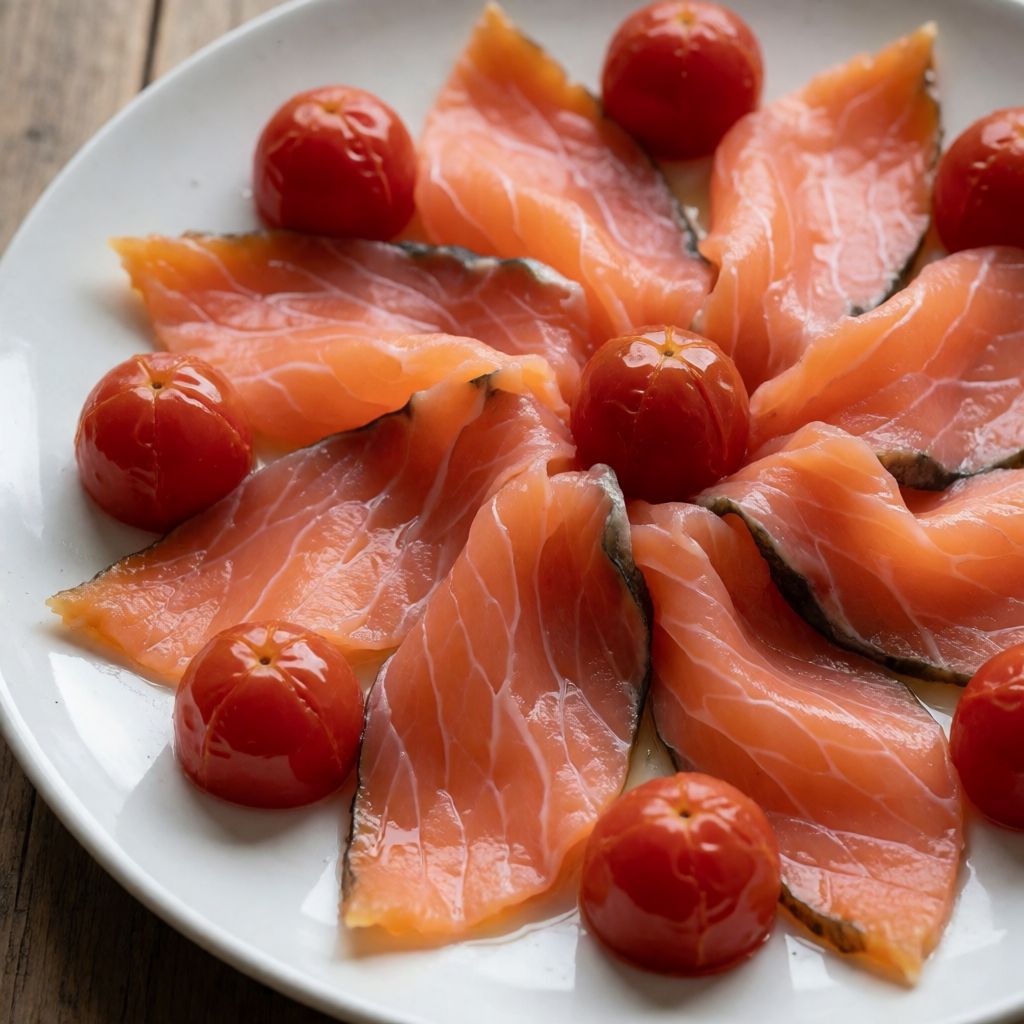
 AI photo
Mediterranean-Style Smoked Salmon Trout
A simple Mediterranean-style starter of smoked salmon trout, cherry tomatoes and a lemon-olive oil dressing.
Labels are worked out automatically from the ingredients and can be wrong. Check the packaging if it matters to you.
Ingredients
- 2 pcs Smoked salmon trout
- 150 g Cherry tomatoes (Pachino)
- 2 tbsp Olive oil to taste
- 1 pcs Lemon juice juice of 1 lemon
- Salt to taste
- Black pepper ground, to taste
- Parsley chopped, to taste






Steps
Make the dressing: combine the lemon juice, olive oil, salt and black pepper.
Arrange the smoked salmon trout fillets on a serving plate.
Cut the cherry tomatoes into wedges and scatter them over the trout.
Drizzle with the dressing and sprinkle with the chopped parsley.
Chill in the refrigerator for at least 20 minutes.
20 min
No heat touches this dish at all — that's the whole point. The trout is already smoked, already cured by salt and smoke long before it reached your kitchen. What you're doing here isn't cooking, it's composing: putting something salty-fatty-smoky next to something sharp and something sweet, and letting them sit together until they agree. If it goes wrong, it's not because you undercooked anything — you can't — it's because the balance between acid, oil and salt doesn't match the richness of the fish, or because the tomatoes were picked for colour instead of sweetness.
The 20 minutes in the fridge is not a food-safety step — smoked fish is already stable, that's the whole reason smoking exists, more on that below. It's there so the salt in the dressing can pull a little juice out of the tomato, and that juice mixes with the oil instead of sitting as two separate liquids on the plate. Some people skip the rest and serve straight away: the dish still works, but it tastes like three things on a plate rather than one thing. Don't go much past an hour, though — cold numbs the smell of good olive oil, and the tomatoes will start weeping properly instead of just seasoning themselves, leaving you with a puddle.
On the trout itself: most smoked trout you'll buy in the UK is hot-smoked, meaning it was cooked through by warm smoke, not just cured cold like classic smoked salmon. That's why it flakes rather than slices thin, and why it can sit happily at fridge temperature without feeling raw. If you want to substitute, stay inside that category — hot-smoked salmon fillets work the same way. Cold-smoked salmon will technically sit on the plate fine, but it's a different animal: more delicate, saltier in a different register, and it wants less acid, not the same squeeze of a whole lemon. Smoked mackerel is the other obvious stand-in, but it's oilier and stronger, so cut the olive oil back and lean harder on the lemon to cut through it.
Cherry tomatoes specifically, and Pachino by name, because that's a protected Sicilian tomato grown on volcanic, mineral-poor soil near the sea — the plant gets stressed just enough that it puts sugar into the fruit instead of water. That's not mysticism, that's agronomy: less water uptake, more concentrated flavour. In a UK shop, you won't always find true Pachino, so judge by the same logic — pick the smallest cherry tomatoes still on the vine, the ones that smell of something at the stem end and give slightly when pressed. A tomato with no smell has no flavour either; colour alone tells you nothing, it's often just ripeness of skin, not flesh.
Olive oil here isn't a neutral carrier the way it might be in a dish built around a sauce — it's one of the flavours on the plate, same rank as the lemon. So the usual advice ("any oil with no smell of its own") doesn't apply; you actually want the smell. Buy extra virgin, and specifically one you'd be happy dipping bread into — if it tastes of nothing, it'll contribute nothing. A good UK-available cold-pressed rapeseed oil is a reasonable stand-in if you want a change, since it has its own green, nutty character rather than hiding behind a neutral label.
Lemon juice: squeeze it yourself. Bottled lemon juice is often cut, oxidised, and missing the aromatic oils that live in the zest and skin contact of a freshly cut lemon — it'll give you sourness without brightness, which is not the same thing. If you're out of lemons, a splash of white wine vinegar diluted with a little water gets you the acid, but you lose the citrus smell entirely, so it's a fallback, not an equal swap.
Parsley wants to be flat-leaf if you can get it, because that's where the flavour sits — curly parsley is mostly there for looks and carries less of the aromatic oil. Either way, use it fresh. Dried parsley has none of the volatile oil left in it by the time it's dried and jarred; sprinkling it on here would just be adding green specks with no scent, which defeats the only job parsley has in this dish.
Salt and pepper are listed "to taste" because they genuinely are — there's no fixed amount that works across every batch of tomato and every fillet of trout, since smoking salts fish to different degrees depending on the producer. Taste the dressing alone before you pour it on; if it tastes complete on a spoon, it'll season the plate correctly. If it tastes flat, it's usually missing salt, not oil — people reach for more oil out of habit, and it just makes the dressing heavier without fixing the problem.