
 AI photo
Caprese with Strawberries and Rocket
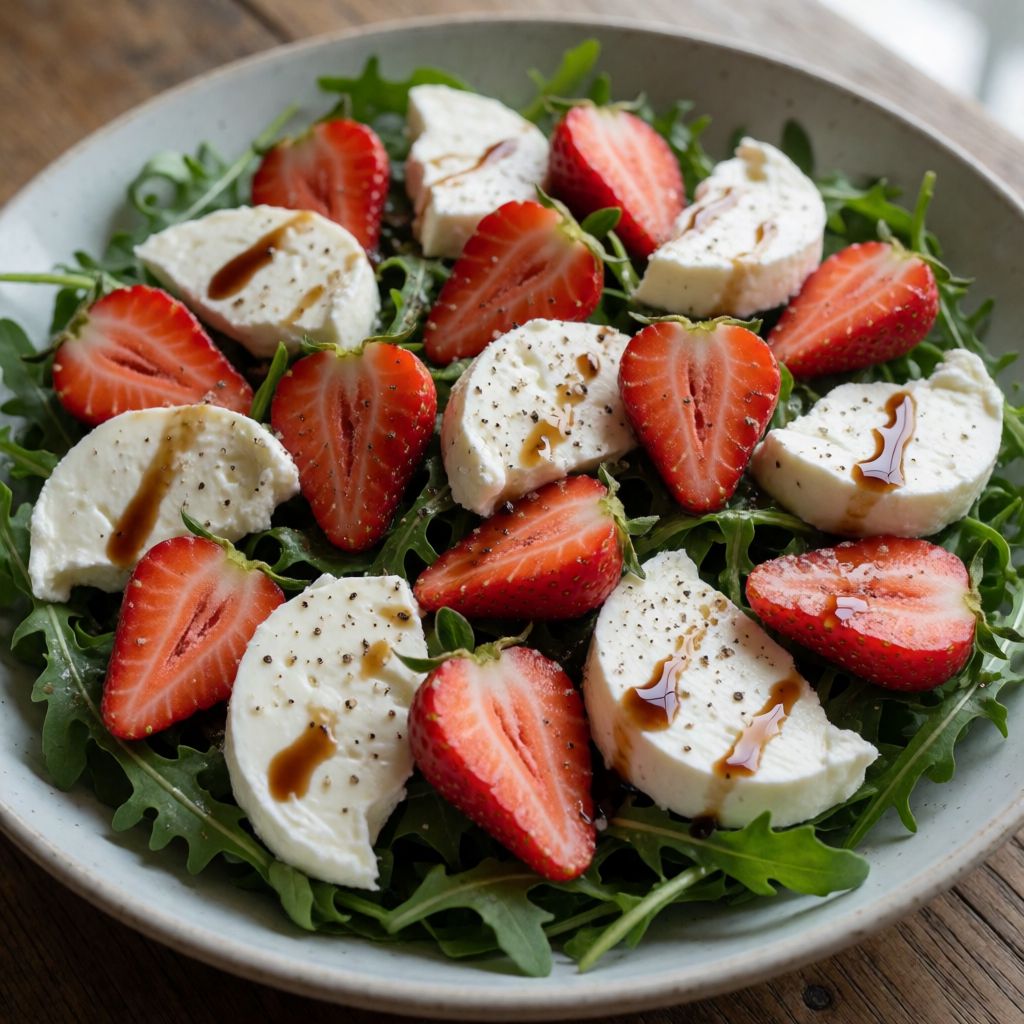
A fresh strawberry and rocket caprese salad with sliced mozzarella, finished with a balsamic glaze.
Labels are worked out automatically from the ingredients and can be wrong. Check the packaging if it matters to you.
Ingredients
- 125 g Rocket
- 200 g Strawberries quartered
- 125 g Mozzarella sliced
- Salt flakes to taste
- Black pepper freshly ground
- 100 ml Balsamic vinegar






Steps
Pour the balsamic vinegar into a small saucepan and bring to the boil.
Simmer uncovered over a low heat for about 20-25 minutes, until roughly 3 tablespoons of glaze remain.
23 minArrange the rocket on a serving platter and top with the strawberries and mozzarella.
Drizzle the salad with a few streaks of the balsamic glaze, then sprinkle with salt flakes and freshly ground black pepper.
This isn't really caprese — it's the caprese logic borrowed. A bland, milky cheese needs a sharp, juicy partner and something bitter to stop the whole plate tasting like dessert. Capri's original used tomato. Here strawberry does the same job — acid and juice set against mozzarella's blandness — and rocket's bitterness keeps the sweetness honest.
What decides whether this works is the glaze, not the arranging. Balsamic vinegar off the shelf is thin and sharp; boiled down, the water leaves and what's left is sugar and acid concentrated into something that coats a spoon instead of running off it. Get that right and three tablespoons dress four plates with real character. Push it too far or too fast and you've got scorched sugar — bitter, sticky, useless.
Some say you need a dark, expensive, long-aged balsamic for a glaze like this to mean anything. No — you're not drinking it neat, you're boiling out the water until what's left is concentrated flavour. A cheap, young vinegar reduces into a perfectly good glaze, because the pan is doing in twenty minutes the job the barrel would have taken years over, just cruder.
Assemble close to serving, not ahead. Strawberry juice sitting on warm rocket for half an hour is a salad that's wilted and bled pink across the plate. Four light plates, a starter, the kind of thing you'd put out before a Sunday roast rather than in place of one.
Balsamic vinegar: buy the ordinary sharp kind, not one already thickened into a pourable glaze — some bottled "balsamic glazes" on supermarket shelves are exactly that, pre-reduced with sugar or starch added, and if that's what you've bought, skip the pan and drizzle straight away. For this recipe you want young, thin, properly acidic vinegar, because the reduction is your job, not the producer's.
The mechanism of step two: you bring it to the boil to get it moving fast, then drop the heat right down, because above a gentle simmer the sugars concentrating at the surface will catch on the base of the pan and turn bitter before the liquid has thickened at all. Low heat here isn't caution for its own sake — it's what stops the glaze scorching. And don't time this by the clock; 20–25 minutes is a lower bound, not a deadline. Watch the volume instead: thin red-brown pool becomes something that coats the back of a spoon and drips in a slow ribbon, not a stream. Stop there. I've taken that glaze too far more times than I'll admit — gone to answer the door, come back to a brown puddle stuck fast to the pan. The gap between glaze and ruin is short, which is exactly why it wants watching, not timing.
Mozzarella's job is to be bland and wet, so the other three ingredients have something quiet to argue around. Buffalo mozzarella is softer and wetter if you can get it; the firmer cow's-milk kind from most UK supermarkets does the same work, just with less drama. Don't reach for anything mature or hard here — the whole point is a cheese that offers no resistance and no flavour of its own.
Rocket's bitterness is structural, not decorative. Any sharp leaf will do the same job — watercress, mustard leaves, even baby spinach with a bit more black pepper to make up the difference. Without that bitter edge, strawberry plus mozzarella plus sweet glaze is just fruit and cheese — pleasant, flat, nothing holding it together.
Strawberries want to be properly red through, not the pale-shouldered ones forced early under a polytunnel. Underripe fruit is mostly water and crunch with no sugar to push back against the vinegar's acid, and the whole balance depends on that sugar being there. Quarter them rather than slice — the cut faces hold salt and glaze instead of shedding it.
Salt flakes go on last, over the cut strawberry and the cheese, not stirred through earlier — on a wet surface they stay as flakes, a crunch of salinity, rather than dissolving into the dressing and vanishing. It's the only real technique in the assembly stage; everything after the pan is just arranging, and any eye can manage that.