
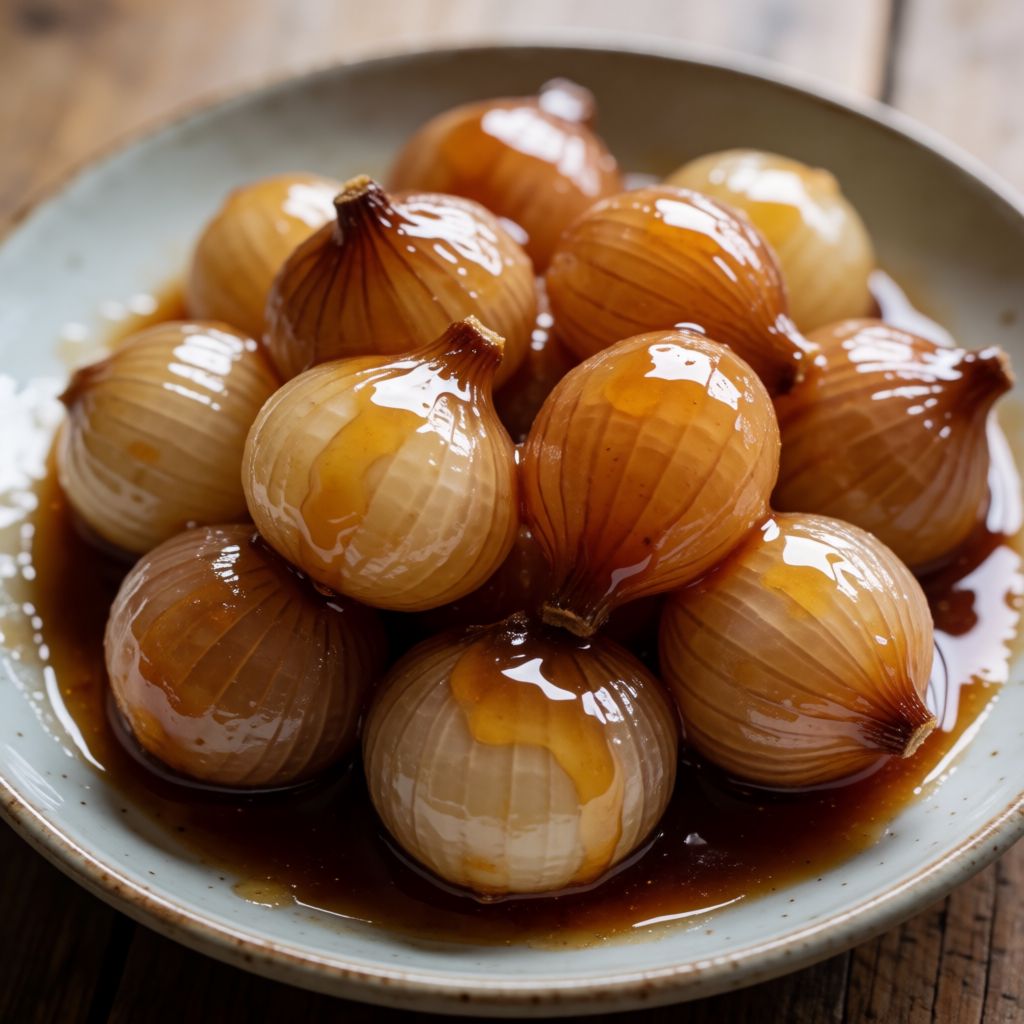
 AI photo
Baby Onions in Sweet and Sour Sauce
Baby onions gently braised whole in a tangy, sweet vinegar sauce until tender and golden.
Labels are worked out automatically from the ingredients and can be wrong. Check the packaging if it matters to you.
Ingredients
- 500 g Baby onions (borettane), whole
- 50 ml Water
- 10 g Sugar
- 2 tbsp White wine vinegar
- 1 tbsp Olive oil
- Salt to taste






Steps
Peel the baby onions, keeping them whole: remove the skins, take off any remaining bits of soil and rinse under running water.
In a glass or small bowl, mix the white wine vinegar, sugar and water until smooth.
Heat the olive oil in a frying pan and add the whole baby onions, frying over high heat for a couple of minutes until lightly golden.
2 minPour in the prepared vinegar, sugar and water mixture, reduce the heat, cover and simmer for about 20 minutes, stirring occasionally.
20 minWhen the baby onions are ready, remove the lid and fry for another couple of minutes over high heat.
2 minSeason with salt to taste, let cool slightly and serve the baby onions in their sweet and sour sauce.
This is a plate of small whole onions cooked down in a thin sweet-sour syrup until the layers go translucent and the outside holds a faint gloss. It is a side, not a main event — the kind of thing you'd put next to a roast where everything else is heavy and brown, because it cuts through fat with sharpness and a little sugar at the same time. Two people, a small bowl, nothing more.
What decides whether it works is whether the onion stays a whole onion. These bulbs are held together by the root plate at the base — cut that off when you peel and the rings fall apart into a soup of onion scraps. Trim close, leave the base, and the onion survives the pan as a unit even once it's gone soft inside.
The other thing that decides it is patience with the covered simmer. Some say onions in vinegar should be cooked fast so they don't turn to mush — no, because the twenty minutes under the lid is exactly what tames the vinegar. Raw, it's sharp and flat; given time with heat and sugar, the sharpness rounds off into something you'd call sour rather than acidic. Rush that stage and you taste the vinegar bottle, not the dish.
The final uncovered fry at the end isn't decoration — it's where the water boils off and what's left is syrup, thick enough to sit on the onion instead of pooling under it. You're looking for the onion to bend when you press it with the back of a spoon, not collapse, and for the liquid in the pan to have gone from thin and sloshing to slow and sticky.
Baby onions — borettane, if you can find them, are flat little discs named after a town near Reggio Emilia, bred small on purpose because a thinned-out onion bed is still worth selling. That's the economics of the whole dish: small onions used to be a byproduct, cheap, and sweet-sour syrup was how you made a byproduct worth eating and worth keeping a few days longer before refrigeration existed. If you can't get borettane, any small pickling onion or shallot works — the criterion is size, not variety: small enough to cook through whole in twenty minutes, roughly uniform so they finish together. Shallots will push the dish sweeter on their own, which isn't wrong, just a different balance.
White wine vinegar is chosen for being clean and not too aggressive — around the mildness you want so the sugar can tame it in twenty minutes rather than an hour. Any vinegar without a flavour so strong it overwrites the onion will do: cider vinegar is close enough. Balsamic will work too, but it brings its own sweetness and colour, so you'd want to cut the added sugar back — it's not a straight swap, it's a different dish wearing the same shape.
Sugar here isn't for making candy — it's there to meet the vinegar halfway and to give the final high-heat fry something to catch and thicken into a glaze rather than just evaporate as water. Ten grams is not much; this stays a savoury side, sweet-and-sour in the way a good pickle is, not a dessert gone wrong.
Olive oil is for the first two minutes only — just enough fat to brown the outside of the onion before the liquid goes in. If you don't have olive oil, any oil with no strong smell of its own will do the job; sunflower, for instance. The point of browning first, against the instinct to just dump everything in the pan and simmer, is that a seared skin holds the onion's own sugars in rather than letting them leach straight into the water — skip this step and you get paler, wetter onions with less character.
On an ordinary hob, in a wide frying pan rather than anything deeper, the lid matters more than it looks. You want steam trapped enough to soften the onion through without boiling the liquid away too fast — a loose-fitting lid, or even a plate set on top if your pan has none, is enough. You're not pressure-cooking, you're keeping moisture circulating; a slightly imperfect seal is forgiving here, which is lucky, because most kitchens don't have a lid that fits every pan they own.
Last thing — let it cool a little before you eat it, as the recipe says. Straight off the heat the glaze is still loose; given a few minutes it sets just enough to coat rather than run off the onion, which is the difference between a dish that looks finished and one that's merely done.