
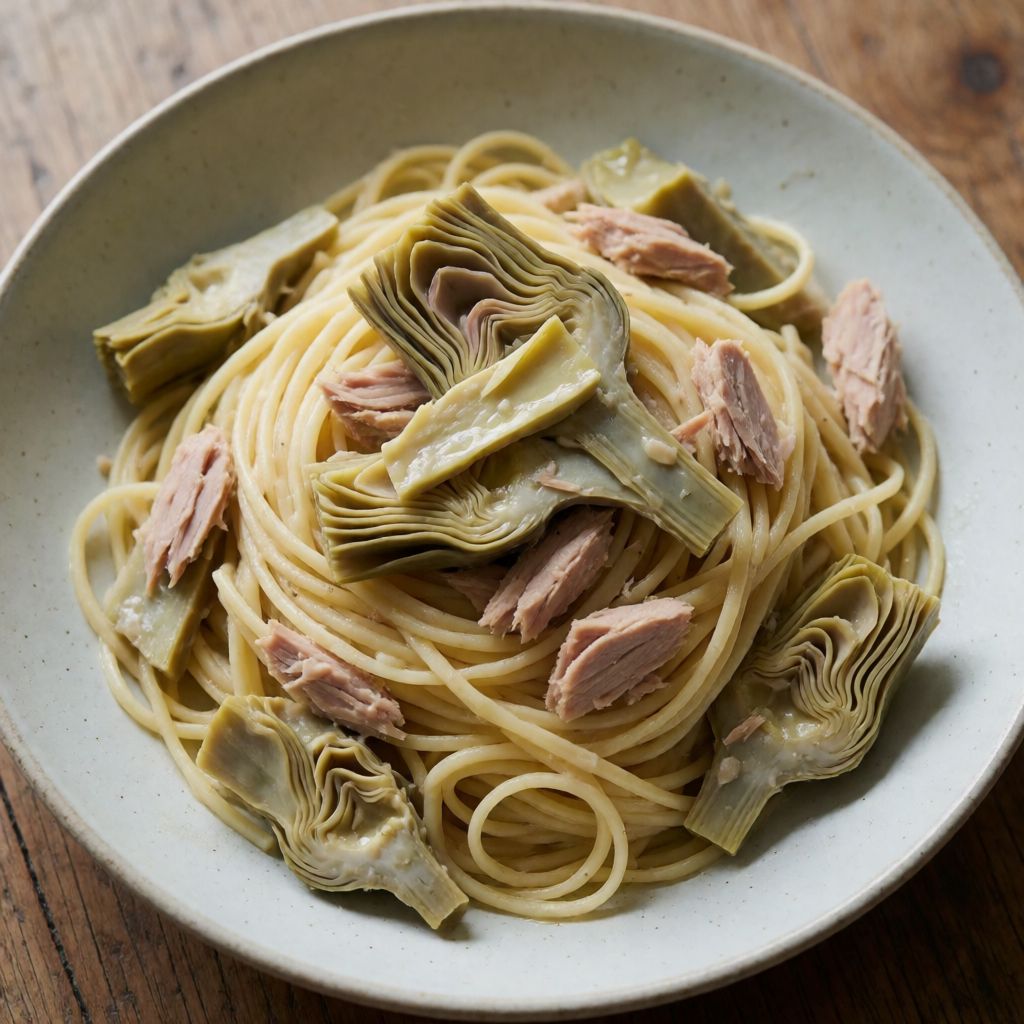
 AI photo
Tagliolini with Tuna and Artichokes
A light pasta dish with tender artichokes, fresh tuna and olive oil, finished in a delicate fish stock sauce.
Labels are worked out automatically from the ingredients and can be wrong. Check the packaging if it matters to you.
Ingredients
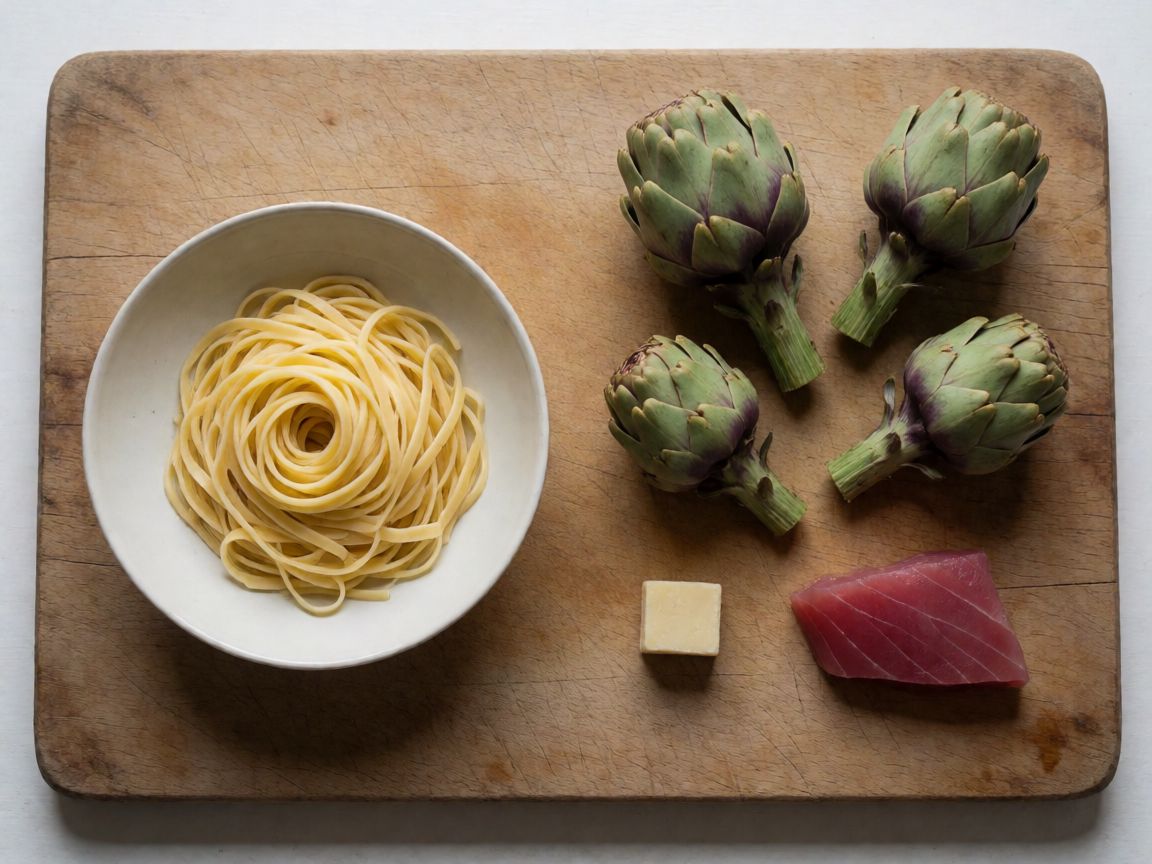
- 250 g Egg tagliolini
- 4 pcs Artichoke
- 1 pcs Fresh tuna steak
- Fish stock granules to taste
- Olive oil to taste
- 1 pinch Salt





Steps
Clean the artichokes, cut them into slices and simmer over low heat until tender.
Add the tuna steak, cut into pieces, and pour in a little fish stock. Cook the fish until done (63°C at the thickest point).
Boil the tagliolini in salted water for a few minutes, then finish cooking it in the prepared sauce, adding more fish stock as needed.
This is a dish built on three different clocks running at once, and the whole trick is knowing which one to set first. Artichokes want slow, patient softening. Tuna wants almost nothing — a few minutes of gentle heat and then stop. Pasta wants to finish its life not in boiling water but in the sauce it's about to live in. Get the order wrong and one of the three pays for it: usually the tuna, because it's the one with no second chances.
Some say tuna should be seared hard in a screaming-hot pan, crusted outside, raw and cool in the middle, like a good steak. No — not here. That treatment is for tuna eaten on its own, where the crust is the point. Here the fish is going to end up flaked through ribbons of pasta, carrying stock and artichoke with it, so it's poached gently instead — cooked in liquid alongside the artichokes rather than seared on bare metal. Gentle heat all the way through means moist flesh all the way through. A hard sear here would just give you a crusted outside sitting on top of raw fish hiding in a pasta dish, which nobody wants to discover with a fork.
The 63°C for the tuna isn't a fussy restaurant number, it's the point where the muscle fibres just set and turn from that dark, almost bruised red to a pale, faintly pink opaque — but haven't yet started squeezing their moisture out. Push past it and you get the dry, sawdusty texture people blame on "bad fish," when really it's just fish cooked the way you'd cook beef, which has fat marbled through it to carry it past overcooking. Tuna has almost none. There's very little margin, which is exactly why it goes in near the end, cut into pieces so it cooks evenly and fast rather than as one thick steak that stays raw in the centre while the outside's already done.
For the artichokes, choose ones that feel heavy for their size and whose leaves still squeak a little when pressed — that's moisture, not age. Trim them properly: the tough outer leaves and the woody stem base are most of what you're paying for by weight, which is the real reason fresh artichokes feel expensive for what ends up on the plate — you're buying inedible leaf along with the heart. In a British kitchen, where fresh globe artichokes are a seasonal, imported, slightly fussy thing rather than a roadside crop, jarred artichoke hearts in oil or brine are a fair stand-in. They're already cooked, so you're not softening them, just warming them through in the stock briefly — rinse off the brine first or the sauce turns sharp instead of savoury.
Fish stock granules exist for a reason that has nothing to do with laziness: real fumet needs fish bones and trimmings, which a restaurant kitchen has lying around from butchering whole fish all day, and a home cook simply doesn't. Granules, or a fish stock cube, or even diluted bottled clam juice, all do the same job — they give the pasta something of the sea to drink while it finishes, without anyone needing to keep a stockpot of fish heads going. If none of that's in the cupboard, a light dashi will get you closer than plain water, though that's a different coastline's logic grafted onto a Mediterranean dish.
For the tagliolini, fresh egg pasta is kinder here because it's already soft and needs barely any time in water before it moves into the sauce to finish. Dried egg tagliolini works too, but pull it out of the water earlier than you would for a plate of pasta eaten straight — if it's fully al dente already, by the time it's absorbed stock in the pan it'll have gone past tender into mush. That final stretch in the sauce isn't decoration, it's mechanism: the pasta surface is still releasing starch, and that starch is what turns the stock from a thin liquid into something that actually clings to the ribbons instead of pooling under them. As for quantity — 250 g of pasta with a whole tuna steak and four artichokes is generous for one person eating alone after a long day, more realistically it stretches to two.
Olive oil here just needs to not fight the fish — any oil with no strong smell of its own will carry the heat without a problem, but a fruity extra virgin earns its place as a finishing drizzle, adding a note the stock doesn't have. The pinch of salt is doing ordinary work: seasoning the pasta water and rounding off the sauce, nothing more mysterious than that. And since most flats don't have a kazan or a proper braising lid, a wide saute pan with a plate set loosely over the top does the same job for the artichoke stage — holding in just enough steam without sealing it shut.