
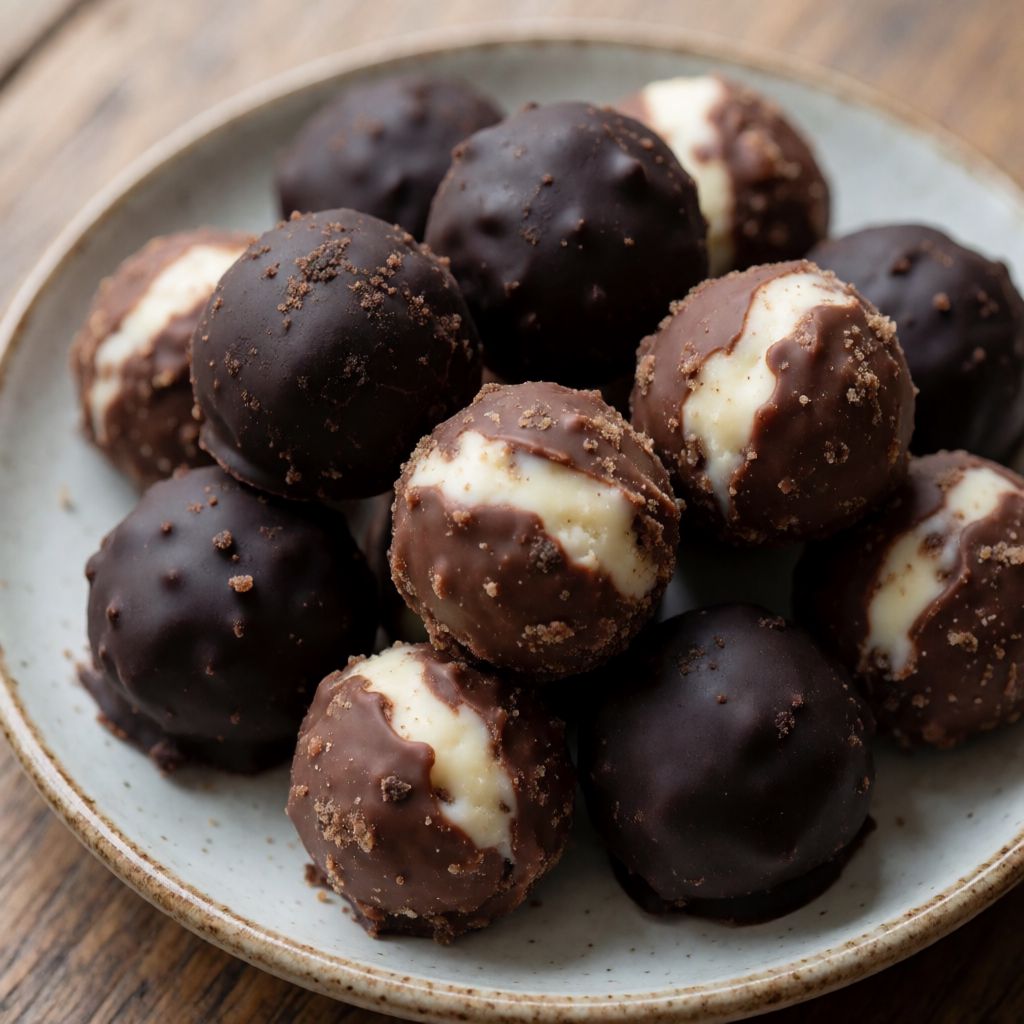
 AI photo
Ricotta and Chocolate Truffles
A simple no-bake truffle made from crumbled biscuits, ricotta and melted chocolate.
Labels are worked out automatically from the ingredients and can be wrong. Check the packaging if it matters to you.
Ingredients
- 200 g Crumbly biscuits
- 100 g Ricotta
- 100 g White chocolate
- 100 g Milk chocolate
- 100 g Dark chocolate




Steps
Blend the biscuits into fine crumbs, tip into a large bowl and add the ricotta.
Mix first with a spoon or spatula, then knead by hand for a few minutes until the mixture is smooth, pliable and no longer sticky.
Shape the mixture into small balls and place them on a plate.
Chill in the fridge.
30 minMelt the chocolate in a heatproof bowl set over a pan of simmering water (a bain-marie), or in the microwave.
Dip the balls one by one into the melted chocolate, coating them evenly.
Place the truffles on a wire rack and chill in the fridge until set.
This isn't a truffle in the French sense — no cream, no butter, no tempering ritual on a marble slab. It's biscuit crumbs bound by cheese, shaped cold, then armoured in melted chocolate. Nothing here gets cooked except the chocolate, and even that only gets warmed, never cooked properly. The whole mechanism depends on two things: a paste that holds its shape without heat, and a shell that sets glossy rather than grainy. Get those two right and the rest is just assembly.
The ratio is the real decision point — roughly two parts biscuit crumb to one part ricotta. Too much ricotta and you've made wet sand that won't hold a ball shape; too little and the mixture crumbles the moment you squeeze it. You knead by hand, not with a spoon, because your fingers can feel the exact second it stops being sticky and starts being pliable — a spoon just tells you it's mixed, which isn't the same thing.
Some say a proper dessert needs the oven — no, because the entire point of a biscuit-and-cheese sweet like this is that it skips it. This kind of confection exists in most kitchens with a fridge and a packet of stale biscuits, because somebody once had leftover biscuits, a tub of fresh cheese, and six people wanting pudding without heating up the kitchen. That's the history. Not magic, just thrift with a fridge.
Start with the biscuit. What you want is called crumbly for a reason — a biscuit with enough fat already baked into it (digestives, Hobnobs, any plain sweet biscuit with vegetable oil in the dough) crumbles into crumb that still clings together when pressed, rather than turning to powder that won't bind at all. A dry rich tea biscuit, built to be crisp and nothing else, won't give you the same grip. If all you have is something drier, you can rescue it by using slightly less ricotta and letting your hands do more of the binding work — the fat in your palms does more than you'd think.
Ricotta's job here is purely mechanical: it's moisture and fat to glue crumb into paste, not flavour, which is why it doesn't fight the chocolate. The one thing that ruins it is water — ricotta that's been sitting in its own whey will make a mixture that stays sticky no matter how long you knead, because you're fighting liquid that has nowhere to go. Tip it into a sieve lined with paper towel for ten minutes before you start, and most of that problem disappears before it begins. Mascarpone works too, but it's richer and wetter with fat rather than whey, so use a touch less of it; cream cheese works at a pinch but brings a tang that nudges the whole thing sourer.
For six people this makes about a dozen bite-sized truffles — two each with a cup of tea is about right, and tea with milk cuts the sweetness nicely, which is useful because three kinds of chocolate is a lot of sugar in one small ball.
Melting the chocolate over a pan of water — a bowl sitting above, never touching, the water underneath doing nothing more than shivering, not rolling — exists to solve one specific failure: a single drop of condensed steam landing in melted chocolate makes it seize, turning thick and grainy in seconds, and there's no fixing it once it's happened. That's a moisture problem, not a heat problem, which is why a microwave works just as well provided you go in short bursts and stir between them rather than blasting it. White chocolate has the least cocoa solid in it of the three, so it has the least buffer against scorching — melt it first, watch it like it owes you money, and do the dark last since it's the most forgiving.
Lay the dipped balls on a wire rack, not a plate. A plate traps the excess chocolate underneath the ball, where it pools and glues the truffle to the surface by the time it's set. A rack lets gravity pull the extra off and air get underneath, so what you lift off later comes away clean. And don't rush the final chill by shoving the rack in the freezer to speed things along — the shell needs to crystallise evenly through its thickness, not just freeze solid on the outside while staying soft underneath. Patience here isn't a virtue, it's an ingredient with its own job to do.