
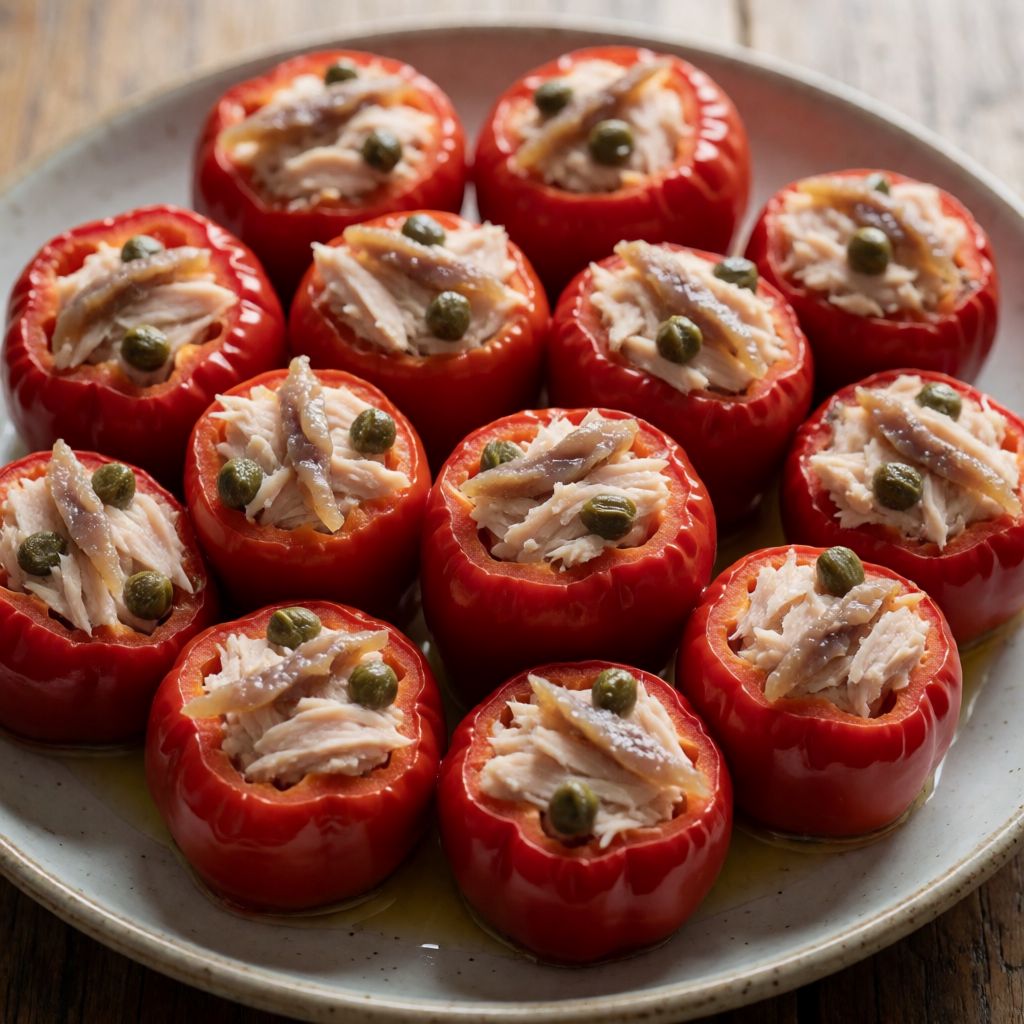
 AI photo
Chilli Peppers Stuffed with Tuna
Small chilli peppers filled with a tuna, caper and anchovy mixture, preserved in oil for a piquant antipasto.
Labels are worked out automatically from the ingredients and can be wrong. Check the packaging if it matters to you.
Ingredients
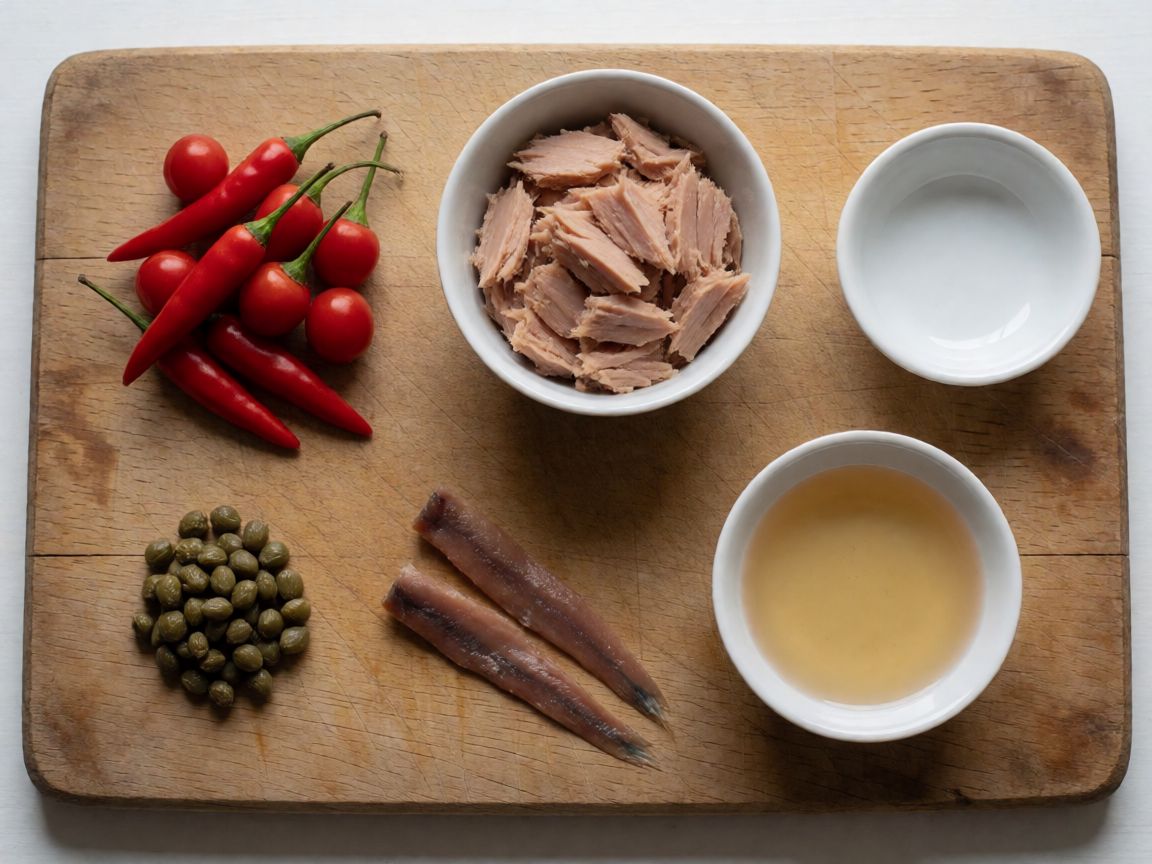
- 500 g cherry chilli peppers
- 200 g tuna in oil
- 1 tbsp capers
- 2 pcs anchovies
- 1 l white wine vinegar
- olive oil to taste
- 1 tsp salt coarse
- 1 l water








Steps
Check the chillies over, rinse them under water, cut off the stems and remove the seeds with a teaspoon.
Bring 1 l of water with 1 l of white wine vinegar and the coarse salt to the boil. Blanch the chillies for no more than 2 minutes.
2 minDrain and lay the chillies on a clean tea towel, openings facing down. Leave for at least 8 hours.
480 minMake the filling in a blender: combine the drained tuna in oil, capers and anchovies. Blend so the ingredients come together but do not turn into a purée.
Fill the chillies with the mixture using a teaspoon or a piping bag, packing the tuna in well.
Transfer the stuffed chillies into jars (preferably sterilised).
Pack the chillies into the jars without pressing too hard and cover with olive oil, leaving a couple of centimetres at the top.
Tap the jars or use a spatula to remove any air bubbles.
Wrap the jars in cloth and place them in a pot, then add water so it fully covers the jars.
Cover the pot, bring the water to the boil and simmer for at least 20 minutes to pasteurise.
20 minAfter pasteurising, check that a vacuum has formed: the lids should be slightly concave and make no sound when pressed.
This is a jar of patience disguised as an antipasto: cherry chillies, hollowed and scalded, packed with a rough tuna-and-anchovy filling, then drowned in oil and pasteurised until the lid pulls down and goes silent. Nothing here is cooked in the sense you're used to — the vinegar bath is a brief shock, the pasteurising is a slow safety measure, and the real work happens in the hours you do nothing at all.
What decides whether this works isn't the filling, it's the water. Three waters, really: the vinegar-and-salt bath the chillies are blanched in, the drip-dry on the towel, and the water bath the sealed jars sit in afterwards. Skip or rush any of these and you get either floppy, sour chillies, or a filling that weeps and sours, or — worse — a jar that looks sealed but isn't, sitting on a shelf as a small gamble.
Some say you can skip the vinegar blanch and just salt the chillies raw before stuffing. No — the acid isn't there for flavour, it's there to firm the flesh and start killing off what's living on the skin before the filling and the oil seal everything in together. A chilli that goes into the jar raw is a chilli that ferments on its own terms, not yours.
The chillies themselves want to be small and uniform — cherry peppers, round, roughly golf-ball size, with a cavity you can actually get a teaspoon into. If you can't find them fresh in a UK greengrocer's (they turn up seasonally, more reliably jarred raw or pickled at Mediterranean delis), Peppadew-style peppers work as a shape substitute, though they're usually already pickled sweet, which changes the character — you'd skip the vinegar bath and go straight to drying. What you're choosing for is wall thickness and a stem-end hole big enough to work through; thin-walled chillies split when stuffed, thick-walled ones won't cook through in the two-minute blanch.
Tuna in oil, not in water — the oil-packed tin holds together in flakes instead of falling apart stringy, and it already carries some of the fat the dish needs. Drain it, don't rinse it; you want the residual oil, just not a pool of it diluting the filling. If you only have tuna in water, drain it hard and add a spoon of olive oil back in by hand before blending, otherwise the mix goes dry and crumbly instead of pressing into the cavity cleanly.
Capers and anchovies are doing the same job from two directions: salt and sourness that a tin of plain tuna doesn't have on its own. Anchovies dissolve into savoury depth rather than announcing themselves — two fillets is restraint, not stinginess, because the chilli itself already carries heat and the vinegar has left its own trace. If anchovies aren't to hand, a teaspoon of their brine or a dab of good Worcestershire sauce gets you partway, though neither is the same animal. Capers in salt rather than brine need a quick rinse or they'll tip the whole filling too sharp; capers in vinegar are fine as they come.
Blend "so it comes together but doesn't turn into a purée" — that line matters more than it looks. Over-blend and you get fish paste, which slides out of the chilli and weeps oil in the jar; under-mixed and it won't pack, leaving air pockets that the oil can't always reach to fill. You're after something closer to a coarse spread, the texture of a good fish pâté before it's been pushed through a sieve.
White wine vinegar for the blanch, not malt — malt vinegar brings its own strong, brown-ale flavour that will sit inside every chilli and fight with the tuna. If white wine vinegar isn't in the cupboard, a light cider vinegar is close enough in acidity and neutrality; distilled white vinegar is sharper but will do in a pinch, since its job is acid strength, not taste.
Olive oil "to taste" really means: enough, and the right kind. You want oil with no flavour of its own strong enough to compete with the anchovy and caper — a basic, unassertive olive oil, not your good extra virgin saved for salads, because its peppery top notes will clash rather than round things off. Sunflower or a neutral vegetable oil would preserve the chillies just as well chemically, but you'd lose the one flavour note the dish is quietly built on.
On your hob, the pasteurising step is the one place a domestic kitchen shows its limits honestly — you're not running a water bath canner with a rack and a thermometer clipped to the side, you've got a pot, a cloth, and jars standing in simmering water for at least twenty minutes. Keep that water at a steady simmer, not a hard boil that knocks the jars together and cracks them, and make sure it genuinely covers the jars rather than leaving the top inch exposed to air, which is the part that needs sealing most. The proof is mechanical, not visual pretty-up: lid concave, no click when you press the centre. If a lid pops back with that metallic tock, it didn't seal — refrigerate that jar and eat it within the week instead of trusting it to the shelf.
This recipe, for six as an antipasto portion, isn't really a Sunday dish — it's a jar you make on a free afternoon so that some other Sunday, months later, you've got something ready on the antipasti plate before the roast even goes in. That's the whole economics of preserving: you spend the patience now so you don't have to spend the time later.