
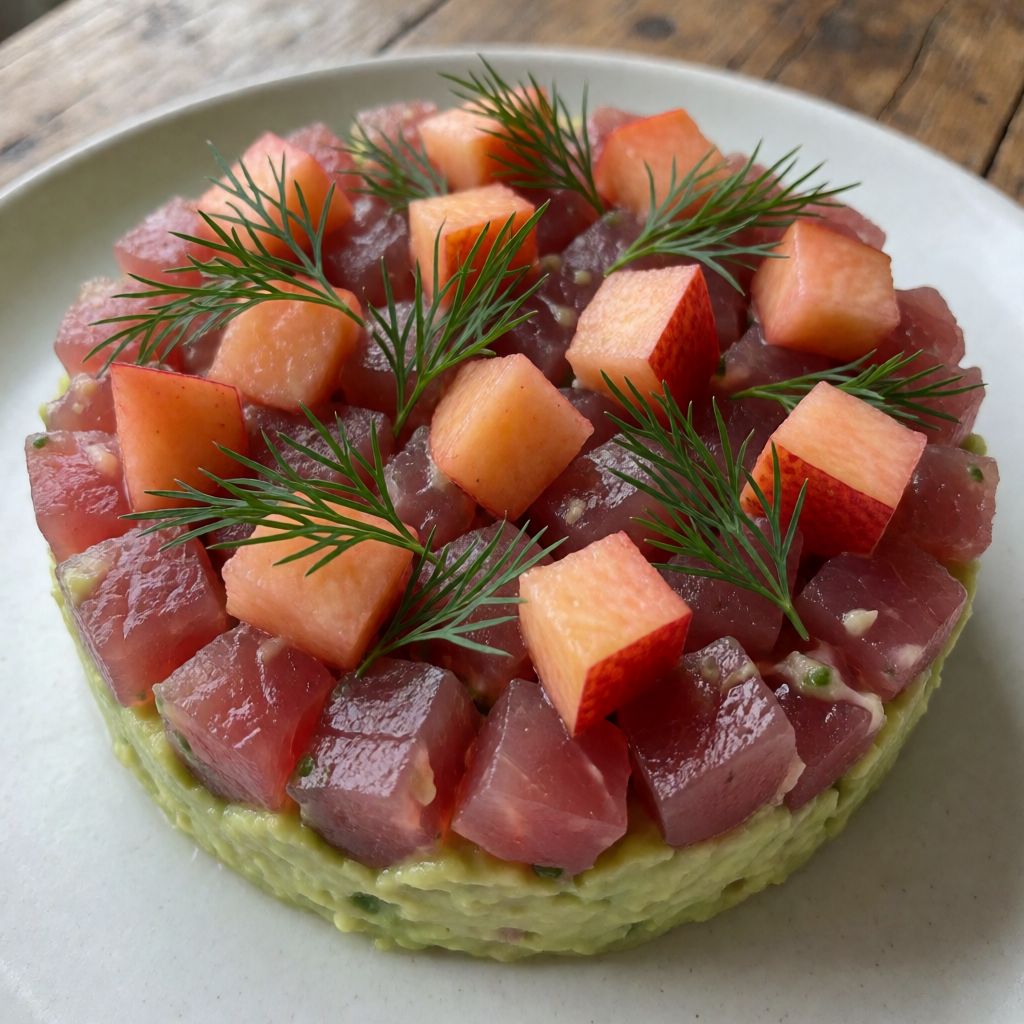
 AI photo
Tuna Tartare with Avocado and Nectarine
A fresh, no-cook tuna tartare with avocado, nectarine and lime, finished with a touch of dill.
Labels are worked out automatically from the ingredients and can be wrong. Check the packaging if it matters to you.
Ingredients





Steps
Cut the tuna into small cubes and mix with the lime juice and the finely grated lime zest.
Add the diced avocado and nectarine to the tuna, season with salt and pepper, and sprinkle with a little dill.
This isn't cooking, it's assembly under cold. Nothing here meets heat, which means every single ingredient has to be good enough to be eaten exactly as it is — there's no pan to hide behind. That's the whole mechanism of a tartare: it's built on trust, not transformation.
What decides whether it works is the tuna, full stop. Not the lime, not the avocado, not the dill — those are dressing for a fish that has to already be right. You want tuna sold for eating raw: deep-coloured, firm, smelling of the sea and nothing else. 'Sushi grade' isn't a real grade — there's no inspector stamping it, it's a promise your fishmonger makes you when he sells it to you cold and tells you to eat it today. Some tuna is previously frozen hard enough, long enough, to make it safe for this — that's the actual safety step, not the lime. The acid in the lime firms the surface of the fish and perfumes it, it does not sterilise it. Treat lime as flavour, not as a cooking method, and you won't be tempted to rescue tuna that's a day past its best with it.
The second thing that decides whether this plate is good or sad is your knife. A sharp knife slices the tuna clean; a dull one saws and bruises it, and bruised fish bleeds and goes grey and pasty at the edges within minutes. That greying you sometimes see on tartare in a bad restaurant — that's not age, that's a blunt blade.
Keep the kitchen cold, not the pan hot — that's the one adjustment a domestic flat needs here. Chill the bowl you mix in, chill the plates you serve on, and keep the tuna in the fridge until the moment you cut it, not out on the worktop while you dice the fruit. Room-temperature raw fish is where the clock against you starts running fast; fifteen minutes at a British kitchen's ambient temperature is not the same risk as fifteen minutes at fridge temperature, and nobody notices this because nothing is bubbling to remind them time is passing.
Tuna: buy it the day you're eating it, from someone who sells fish meant to be eaten raw and says so. Previously frozen (properly, commercially, not your home freezer which isn't cold enough) is actually the safer choice, because freezing is what deals with the parasites a live fish might carry — it's not a downgrade, it's the point. If you can't get tuna you trust, don't force it; a very fresh salmon from the same kind of counter works on the same principle, or a firm white fish your fishmonger specifically recommends for raw eating. What you're choosing for is texture that holds a clean cube and flavour that doesn't need rescuing.
Lime: juice for acid, zest for the oil that's actually where citrus smell lives — the juice alone gives you sharpness without much perfume, the zest brings the rest. Finely grated means the pale pith stays out of it, because pith is where the bitterness sits. Lemon will do the same job if lime isn't in the shop; the criterion is a citrus sharp enough to season, not so sweet it just adds sugar.
Avocado: pick one that gives slightly under the thumb's firmness but doesn't collapse — you need it diced into neat cubes, not mush. Too ripe and it turns to paste the moment the knife touches it, and then the tartare loses its texture — you want crunch of nectarine, give of avocado, and firm tuna all distinct in the same mouthful, not one soft mass.
Nectarine: here for sugar and a little brightness to cut the richness of the fish and the avocado both. A ripe peach is the same ingredient under a different name; if stone fruit isn't in season — and in Britain, most of the year it isn't — a crisp apple or even a few segments of orange will do the sweetness-and-bite job, though you'll lose the soft give nectarine has in the mouth.
Dill: fresh, chopped small, added at the end so it keeps its smell instead of bruising into a green smear. Its job is to lift the dish away from tasting only of fat and fish. Chives or a little fresh coriander will stand in if dill isn't to hand or not in the shop — same role, different accent.
Patience here isn't about waiting for something to happen, because nothing does — it's about not rushing the cutting. Cube the tuna evenly, by hand, slowly enough that the knife does the work instead of you forcing it, and the whole dish holds together instead of turning, twenty minutes in, into something that looks like it's already been eaten once.