
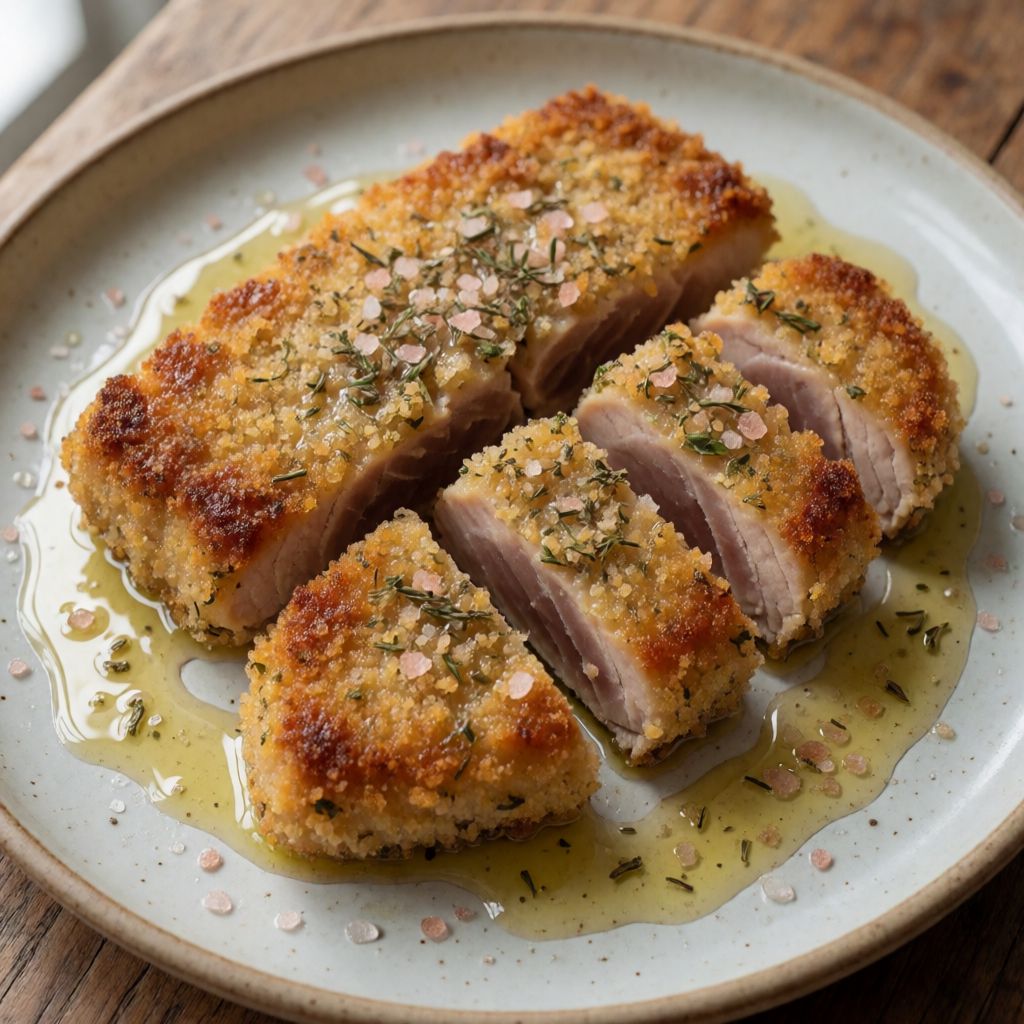
 AI photo
Tuna with Herbs and Lemon
A quick seared tuna dish finished with a herby lemon crust and a bright lemon-parsley dressing.
Labels are worked out automatically from the ingredients and can be wrong. Check the packaging if it matters to you.
Ingredients
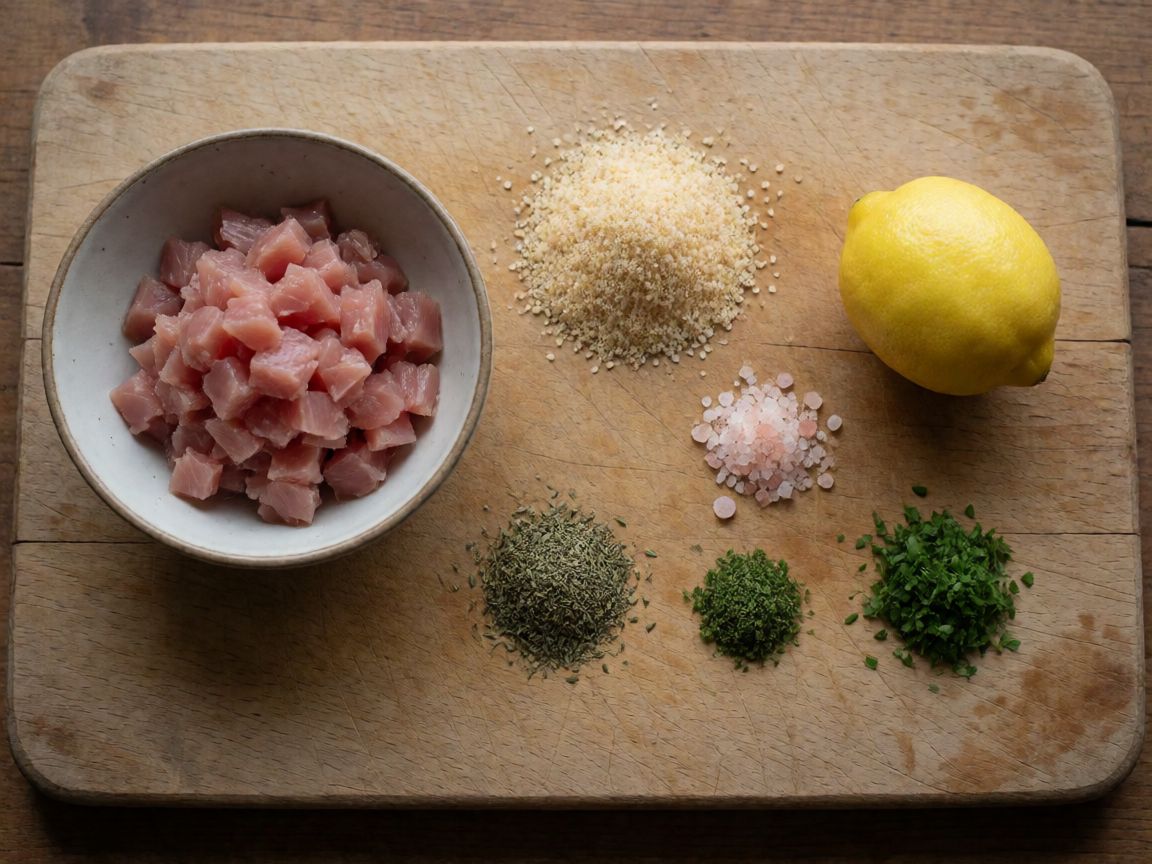
- 800 g Tuna cleaned and cut into chunks
- 2 tbsp Breadcrumbs dried
- 1 pinch Himalayan pink salt
- White pepper to taste
- Olive oil to taste
- 1 pcs Lemon
- 1 tbsp Dried herb mix finely chopped (marjoram, sage, thyme, parsley)
- 1 tbsp Parsley








Steps
Mix the breadcrumbs with the herb mix, lemon zest, a pinch of Himalayan pink salt and white pepper.
Brush the tuna chunks with olive oil, then coat them in the seasoned breadcrumb mixture.
Heat a dry pan or grill without oil and quickly sear the fish on all sides until it reaches a safe temperature of 63°C.
5 minServe the hot tuna pieces with a dressing of olive oil, lemon juice and freshly chopped parsley.
This is a fish dish built on the logic of a veal cutlet, not a fillet of cod. Tuna loin is dense muscle with almost no fat running through it, so it behaves like a steak: sear the outside hard, leave the middle rosy, and it stays moist. Treat it like cod — poke it, flip it four times, wait for it to flake — and you get something closer to tinned tuna, pale and dry, because the moisture has had time to walk out through every crack you opened up.
What decides whether this works is heat and your nerve to stop early. The pan has to be properly hot — dry, no oil in it — before the fish goes in, because the oil is already on the fish, brushed on, and its only job is to make the crumb crust stick and colour. Pour oil into the pan as well and you get smoke and a crumb that burns before the fish is even warm through — that's the defect, and the cause is always too much oil in the wrong place, not too much heat.
Some say fish must always be cooked right through to be safe, the way you'd treat chicken. No — because tuna loin is a solid, dense muscle, not a jointed bird with cavities and skin where bacteria can sit, and it's sold and handled with that in mind. The 63°C the recipe gives you is a floor, not a target — a point past which you're not doing the fish any favours, you're just drying it. Pull it the moment the crust has coloured and the sides have gone from translucent to matte; the centre finishes itself with the heat already stored in the meat while it rests on the plate.
Buy tuna loin, not tuna steaks cut from the belly — loin is the dense, deep-red muscle that holds together when you cut it into chunks and sears clean on every face; belly is fattier and softer and will fall apart under a crust. Smell it before anything else: it should smell of the sea, faintly metallic, never of 'fish' in the unpleasant sense — that smell is the first sign of age, not a property of tuna itself.
Breadcrumbs: dried and fine is the criterion, so they bind into a crust rather than a loose coating that drops into the pan. Shop-bought dried breadcrumbs work, but check the packet for added sugar, which some brands use to push browning — you don't need it here, the Maillard reaction happens fine on its own at pan heat. Stale bread, grated and left to dry out overnight on a plate, does the same job for nothing and tastes less of cardboard.
Himalayan pink salt is doing nothing here that ordinary fine salt wouldn't do — the trace minerals that give it colour don't season food any differently once it's dissolved into a crumb mix. It's sold on a story, not a mechanism. Use any fine salt that dissolves evenly; keep flaky sea salt for finishing a dish where you can see and feel each grain, which this isn't.
The herb mix is dried on purpose, not out of laziness — marjoram, sage and thyme dried concentrate their oils rather than losing them, and a pinch mixed straight into dry breadcrumbs spreads evenly through a crust that's about to hit high heat anyway, where fresh leaves would just scorch and turn bitter. Parsley stays fresh and goes in twice for two different jobs: a little chopped into the crumb for background, and the rest kept raw for the dressing, where you want its green, grassy brightness intact, not dulled by heat.
Lemon does two separate jobs too, and it's worth keeping them separate in your head. The zest goes into the crumb mix because the lemon's aromatic oil lives in the skin, not the juice, and it needs the dry heat of the sear to release it into the crust. The juice goes into the dressing at the end, raw, for acidity that cuts the richness of the seared fish — squeeze it only when you're about to serve, because lemon juice left standing loses its edge within the hour.
Olive oil appears twice and means two different things each time. Brushed onto the raw fish, its job is purely mechanical — gluing the crumb on and helping it crisp, so any oil with no smell of its own would do the same work, sunflower or a neutral vegetable oil included. In the dressing, poured raw at the end, you want the oil's own flavour to be part of the dish, so a decent olive oil earns its place there and nowhere else is it wasted.