
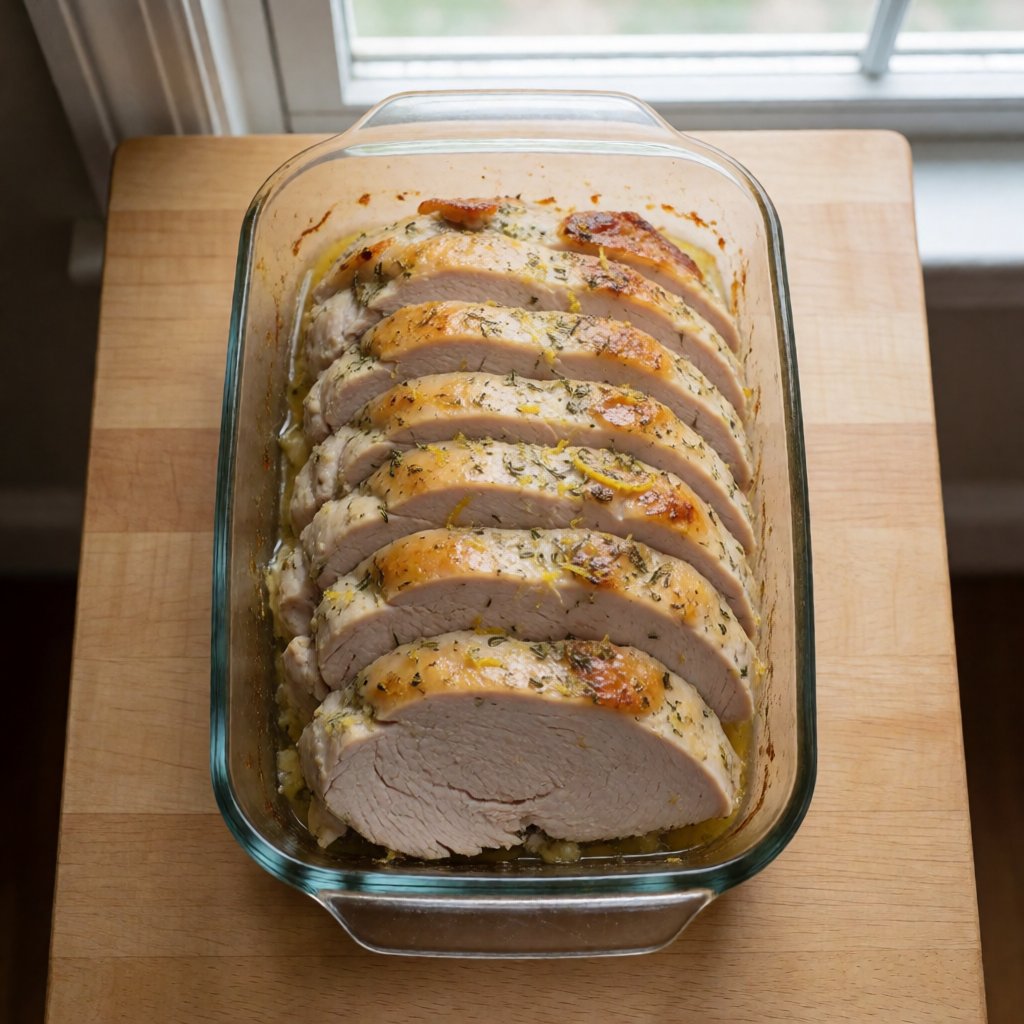
 AI photo
Roast Turkey Strips for Grain Bowls
Oven-roasted turkey fillet strips, perfect for building a hearty bowl.
Ingredients
- 400 g turkey fillet two ~200 g steaks, about 2 cm thick
- 1 tbsp sunflower oil
- 1 pinch herbes de Provence to taste
- 0.5 pcs lemon juice only
- 1 pinch salt to taste
- 1 pinch black pepper to taste





Steps
Rub the turkey with oil, herbs and salt, then drizzle with lemon juice.
Cover with foil and roast at 200°C for 25 minutes, until the centre reaches 74°C.
25 minRemove the dish from the oven and let it rest for 5 minutes.
5 minSlice into strips and serve.
This is a plain roasted turkey breast, cut into strips, meant to sit on a grain bowl and do nothing clever — the grains and the vegetables do the talking, the meat just needs to not be dry. That's the whole engineering problem here. Turkey breast carries almost no fat between the fibres, so there's no reserve to save you if you overcook it. A chicken thigh forgives you. This cut does not.
What decides whether it works is the gap between 74°C at the centre and the point where the muscle fibres clamp shut and push their water out — and that gap is small, maybe five or six degrees. The foil over the dish is standing in for a kazan lid: it traps steam so the top of the meat doesn't dry out and toughen while the middle is still catching up to temperature. Take the foil off and roast it bare at 200°C and you'll get a leathery crust before the centre is even warm.
Some say turkey breast is just naturally dry meat, nothing to be done about it. No — it's usually just cooked past its point. People go by the clock because a clock is easy and a thermometer means buying one more gadget, but 25 minutes in your oven and 25 minutes in mine can land ten degrees apart. The only honest answer to "is it done" here is a probe in the thickest part reading 74°C, not a number of minutes.
That 74°C isn't a style choice — it's the point where poultry is considered safe near-instantly, which is why the recipe doesn't ask you to hold it there, just reach it. Hit it, pull it, rest it. That's the entire discipline of this dish.
Two steaks of about 200g each, roughly 2cm thick — the thickness matters more than the weight. If one piece tapers to 1cm at the edge and bulges to 3cm in the middle, the thin end is dry by the time the thick part hits temperature. Even out the thickness before you season it — a light bash with the flat of your hand, or the bottom of a pan, is enough; you're not flattening a schnitzel, just levelling the playing field.
The oil is a carrier, nothing more — it lets the herbs and salt sit against the meat instead of sliding off, and it stops the surface sticking to the foil. Any oil with no smell of its own does this job: sunflower, rapeseed, a light olive oil. Save your good peppery extra-virgin for the bowl itself, where you'll actually taste it; here it's wasted under foil at 200°C.
Herbes de Provence is background music, not a solo — dried thyme, rosemary, oregano, whatever's in the cupboard works the same way, because its job is just to perfume the oil, not to define the dish. Don't go hunting for the exact blend.
The lemon juice does two things: a little surface tenderising from the acid, and brightness once it's cooked in. Drizzle it on and go straight to the oven — don't let it sit raw on the meat for twenty minutes thinking you're marinating, because acid left too long starts to firm the surface the same way heat does, and you'll have done half the toughening job before the oven even starts. Salt rubbed on just before roasting draws a little moisture to the surface first, then it's reabsorbed as the protein structure changes under heat — this is normal, not a leak, don't panic and add more salt to compensate.
The five-minute rest isn't a pause for your convenience, it's doing real work. Pull the meat at 74°C and the centre keeps climbing a few degrees on stored heat alone — that's carryover. At the same time the muscle fibres, which tightened and pushed juice inward during roasting, relax once the heat stops attacking them, and the juice redistributes instead of running out onto the board the second you cut it. Slice it straight off the oven and you'll watch the liquid pool and your strips end up drier than if you'd waited.
On a domestic hob and oven, be honest about the limits: your "200°C" and your neighbour's "200°C" are not the same temperature, especially fan versus conventional, and foil isn't a kazan lid, it's a reasonable substitute that traps less steam than a tight-fitting one would. That's exactly why the thermometer carries more authority here than the timer does — the 25 minutes is a floor, not a verdict.
·