
 AI photo
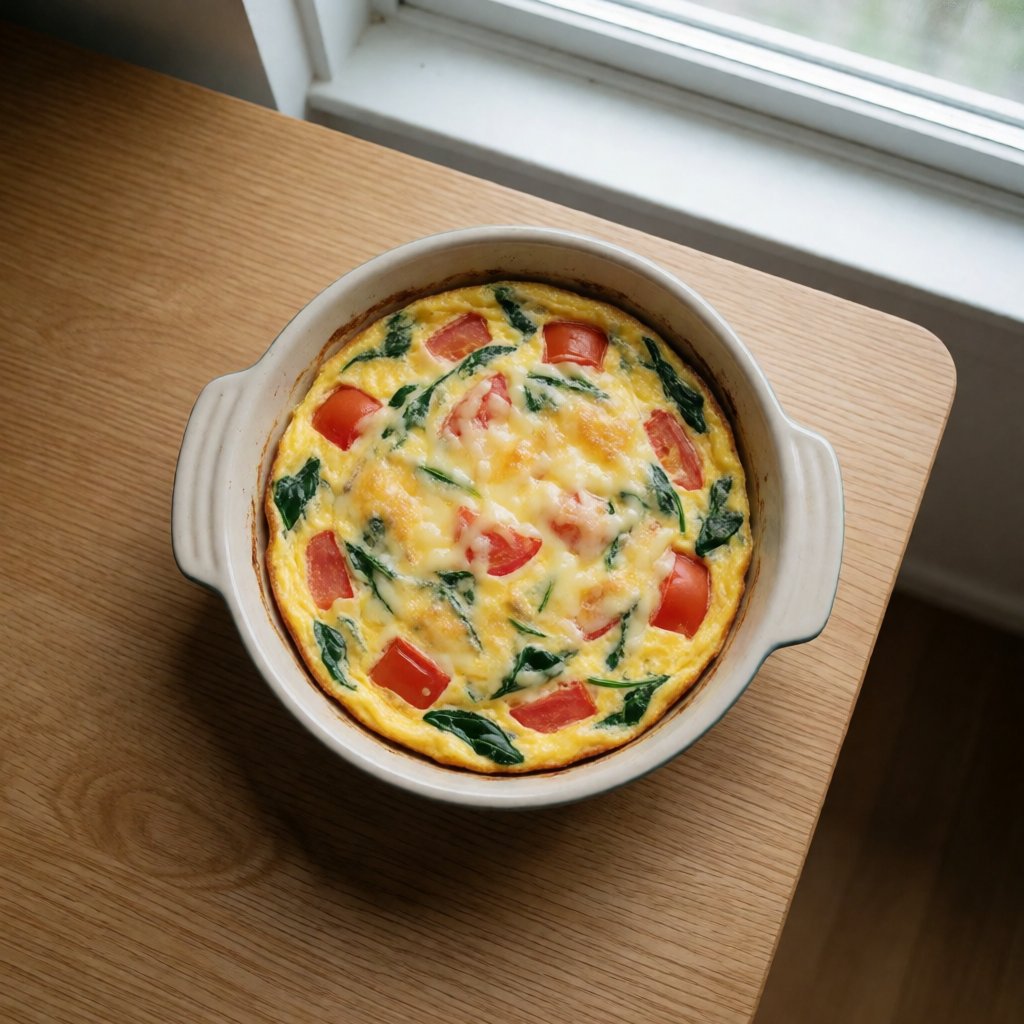
Baked Vegetable Omelette
A simple baked omelette with tomato, spinach and cheese, cooked in a dish until set.
Labels are worked out automatically from the ingredients and can be wrong. Check the packaging if it matters to you.
Ingredients
- 4 pcs eggs
- 80 ml milk
- 1 pcs tomato
- 1 bunch spinach or other leafy greens or other greens
- 30 g hard cheese
- 1 pinch salt to taste
- 1 pinch black pepper to taste







Steps
Whisk the eggs with the milk, salt and pepper.
Place the vegetables in the bottom of the dish, pour over the egg mixture, and sprinkle with cheese on top.
Put the dish into an oven preheated to 200°C for 25 minutes, until the eggs are set.
25 minRemove the dish from the oven.
This is not a soufflé and it is not a quiche. It is egg custard baked flat with vegetables buried in it, somewhere between a frittata and a savoury clafoutis. What decides whether it holds together or turns into scrambled egg floating in whey is the ratio of milk to egg, and how long you leave it in the heat once the centre stops being liquid.
200°C is dry oven heat — no water bath, no steam, the egg mix is on its own against radiant heat from all sides. That dryness is also doing the cooking for your vegetables: wilting the greens, driving water out of the tomato. The real work happens in the top couple of centimetres of egg — everywhere below that is just trying to set before it overcooks.
Some say baked eggs need a water bath to come out smooth — no, because that's for a dessert custard where you want silk all the way through and nothing solid anchoring the texture. Here spinach and tomato already break up the structure; it was never going to be uniform, so skip the bain-marie and the extra washing up.
Use a dish you'd happily put on the table — wide rather than deep. Egg sets from the outside in, and a shallow layer lets the middle catch up before the edges go leathery. 25 minutes is where you start checking, not where you stop: give the dish a gentle shake — if the centre still trembles like a soft yolk under the cheese crust, it needs a little longer; if it's dead still, pull it now, because it keeps firming for a few minutes outside the oven on heat still moving through it.
Four eggs to 80ml milk — about a third of a cup, if you measure that way — is doing one specific job: diluting the protein so it can't lock up tight. Eggs baked alone at 200°C turn into a hard yellow brick; milk's water and fat space the protein strands apart so they stay tender instead of clenched. Whole milk gives a richer, more unctuous set; skimmed gives something lighter and slightly more open-curded. Whatever milk is already in the fridge for tea will do — the dish doesn't need fat the way a sauce would.
A raw tomato will dump its water once it hits the heat — there's no way round that, the water came with the fruit. Slice it thin, so that water lands in egg that's still absorbing rather than pooling under a thick disc that stays wet while everything around it sets. If your tomatoes are the pale, watery supermarket kind, salt the slices and let them sit on kitchen paper for a few minutes first — it pulls some of that water out in advance and keeps the base from going soupy.
Spinach collapses to almost nothing in the oven — a full bunch looks comically small once wilted, and that's not a measuring error, water leaving a leaf is most of what a leaf is. Any thin leaf that wilts rather than chars works: chard with the ribs pulled out, baby kale chopped fine, even shredded leftover greens from Sunday's roast tray. Rocket wilts too fast and disappears before the egg has set, so add it late if that's what you have, or use double. If you reach for frozen spinach instead, squeeze it bone-dry in a clean tea towel first — it carries ice-melt water fresh leaves never had, and that water has nowhere to go but into your custard.
30g of hard cheese is a scattering, not a cheese course. Its real job is forming a browned cap that seals moisture in while the egg underneath finishes, and it gives you a second doneness cue alongside the wobble test: pale and sweaty means not yet, gold and a little blistered means the top is done. Use any hard cheese that melts and colours instead of just weeping — mature cheddar is the obvious UK choice, red Leicester does the same job with a different colour on top, a firm goat's cheese works if that's what's open.
Season the egg before it goes into the oven, not after — salt dissolved into raw egg distributes evenly through the mix; salt scattered on a set surface just sits there, doing nothing for the inside. And don't try to save ten minutes by turning the oven up — the edges will rubberise long before the centre catches up, because this sets on a schedule fixed by how fast heat moves through milk and vegetable, not by how high the dial goes. Patience here isn't virtue for its own sake, it's the only thing standing between a soft custard and scrambled eggs with extra steps.
·