
 AI photo
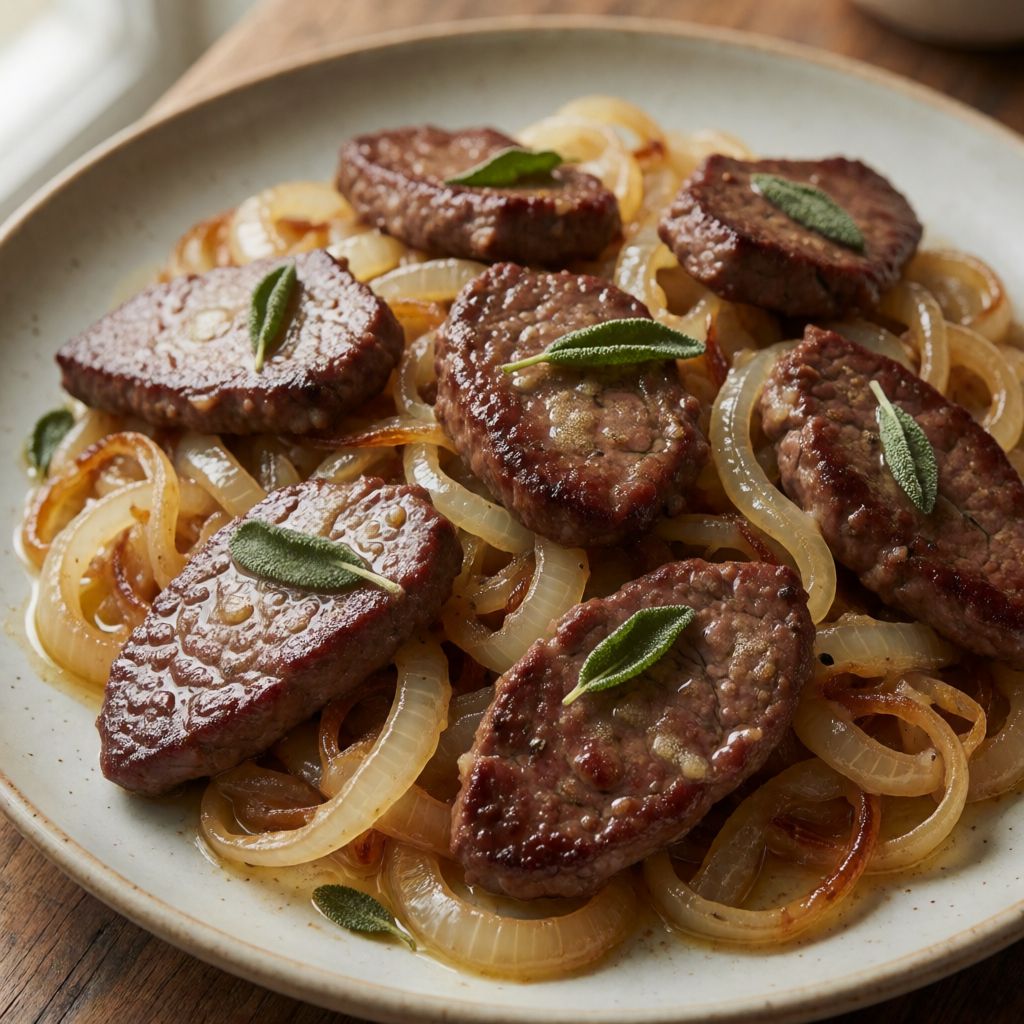
Venetian-Style Liver with Onions
Tender veal liver cooked with sweet onions, sage and white wine, prepared in the classic Venetian style.
Labels are worked out automatically from the ingredients and can be wrong. Check the packaging if it matters to you.
Ingredients
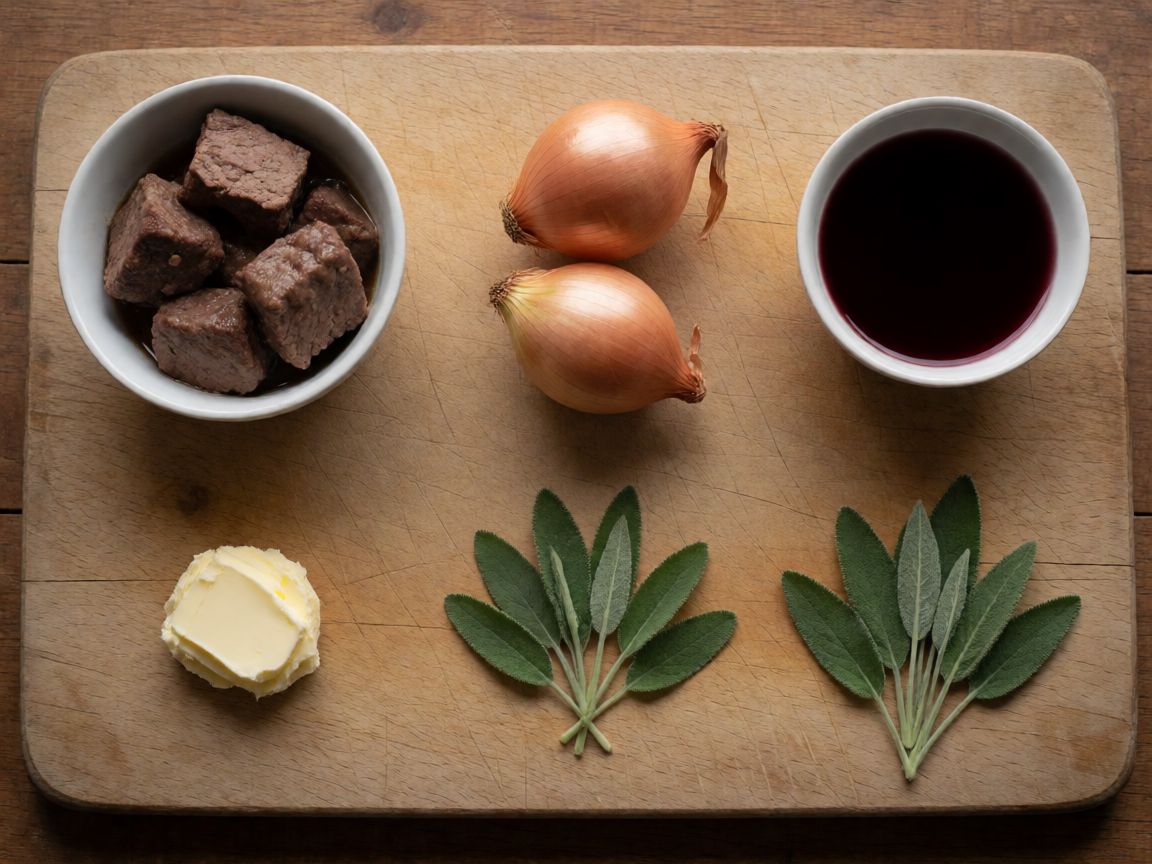
- 400 g Veal Liver
- 2 pcs Onion
- 50 g Olive Oil
- 20 g Butter
- 8-9 pcs Sage fresh leaves
- Salt to taste
- Black Pepper to taste
- 50 ml White Wine








Steps
Slice the onions into thin half-moons. In a wide frying pan, melt the butter with the olive oil, then add the onion.
Pour in about 100ml of water and simmer gently for 5 minutes.
5 minAdd the chopped sage and the white wine, then continue cooking for a further 5–7 minutes.
6 minRinse the veal liver well and pat it dry with a paper towel.
Add the liver to the onions and fry over high heat for 2–3 minutes on each side.
6 minSeason with salt and pepper, and serve immediately.
This is onions and liver, but really it's two opposite cooking logics meeting on one plate. The onion gets a long, gentle, almost lazy treatment — fat plus water, low heat, time. The liver gets the opposite: short, violent heat, in and out before it knows what happened. Get that contrast backwards — slow liver, fast onion — and you've made two separate failures instead of one dish.
The onion isn't fried to brown here, it's sweated to pale gold and silk. That's the point of the water you add in step two: it isn't there to boil anything, it's there to cap the temperature. Water boils at 100°C and fat happily goes past 150°C, so as long as there's water in the pan the onion can't scorch or caramelise hard — it just softens, loses its sting, turns sweet by melting rather than browning. Some people think onions for a liver dish should go dark and jammy, the way you'd do them for a burger. No — because dark caramelised onion is heavy and sweet in a way that fights the liver's iron note instead of lifting it. Venetian onion stays pale on purpose.
Veal liver is the mild end of the liver spectrum — that's why it's chosen here rather than lamb's or ox liver, which are stronger and more mineral. If veal liver isn't easy to find or costs more than you want to spend, lamb's liver is the honest substitute: same quick-sear method, just expect a bolder, more iron-forward flavour. Ox liver is a different animal entirely — tougher, needs trimming of membrane, and will not behave the same way in two minutes a side, so don't swap it in blind.
Rinsing the liver and patting it properly dry isn't fussiness — it's protecting the sear. Any surface moisture left on the liver turns to steam the instant it hits the hot pan, and steam cooks the surface gently instead of letting it brown. A wet piece of liver in a hot pan stews itself from the outside in; a dry piece sears. This is also the real argument for a wide pan rather than a crowded one: too much liver at once means the pan cools and the liver's own juices pool instead of evaporating, and you're back to steaming again. A domestic hob, even a good one, loses heat fast once you load it — better to sear in two batches than crowd one.
Butter and olive oil together isn't a flourish, it's a fix for a real problem: butter alone burns and turns bitter well before the onion is even soft, because its milk solids scorch at a relatively low temperature. Oil raises the ceiling — any neutral oil without a flavour of its own will do, olive oil here mostly for its own merits rather than necessity, but a light vegetable oil works the same job. The butter stays in for the taste it gives the onion; the oil is what lets you get there without burning it.
Sage goes in with the onion, not at the end, because its oils need the gentle heat and the moisture in the pan to release slowly rather than scorch and turn bitter and sharp. Fresh is what the aroma depends on — dried sage is dusty and one-note by comparison, so if you can't get fresh, use less dried and accept it's a stand-in, not an equal.
The wine does two things: it adds acid, which is what actually makes a rich, slightly metallic meat like liver taste clean rather than heavy, and its alcohol carries the sage's aroma through the onion while it cooks off. A dry white is right because a sweet one would push the dish toward the caramel-sweetness you're deliberately avoiding with the onion. No wine in the house — a splash of dry vermouth does the same acid-and-aromatic job; a teaspoon of wine vinegar loosened in a little water is the fallback, blunter but workable.
This dish has its roots in Venice's cheapness, not its grandeur — liver was the offal nobody fought over, onions were the one vegetable a port city could always get cheap in bulk, and sage grew wild. It's bar food, cicheti counter food, meant to be made fast between one round of errands and the next. It sits oddly next to a Sunday roast only because a roast is built around waiting — this one is built around not waiting, which is its whole personality. Four people, under half an hour, and the only patience it actually asks of you is letting the onion take its five slow minutes before the liver ever goes anywhere near the heat.