
 AI photo
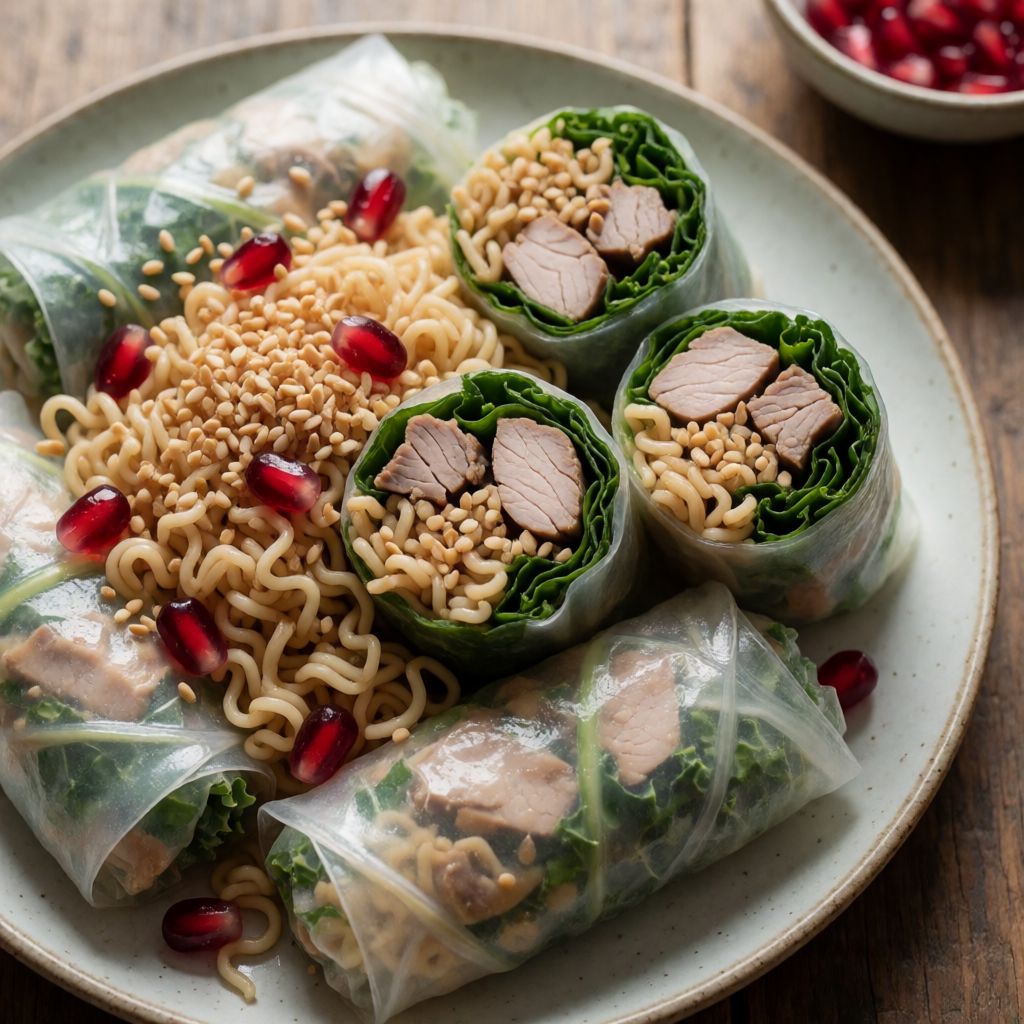
Vietnamese Spring Rolls with Duck
Vietnamese-style spring rolls filled with duck confit, kale, peanuts and pomegranate.
Labels are worked out automatically from the ingredients and can be wrong. Check the packaging if it matters to you.
Ingredients
- 400 g Duck confit thigh
- 8 pcs Rice paper
- 100 g Kale finely chopped
- 100 ml Peanuts salted
- 100 g Noodles cooked
- 100 ml Pomegranate


to serve
- 100 ml Sweet chilli sauce

Steps
Heat the duck confit in the oven at 220°C for about 20 minutes, until the skin turns crisp.
20 minDip the rice paper in cold water and lay it on a clean worktop.
Arrange a strip of the duck filling, kale, peanuts, noodles and pomegranate across the middle.
Fold in the edges and roll up tightly to seal the roll.
This is not a fried spring roll — it's the fresh, translucent kind the Vietnamese call goi cuon, wrapped cold around something already cooked. The duck does its hard work long before it meets the rice paper: confit means it was cooked low and slow in its own fat days or weeks ago, so the oven step here isn't cooking the meat at all — it's waking the skin up. 220°C for twenty minutes is a short, hard blast strong enough to blister and crisp fat that's already soft, without drying meat that's already tender. Go lower and you just warm it through limp. Push a home oven hotter and the skin can catch before the inside's even hot.
What actually decides whether the roll holds together isn't the duck — it's the rice paper. Dip it in cold water, never hot. Hot water swells the starch too fast: the sheet goes slack and sticky in two seconds, and by the time you've laid filling on it, it's already tearing at the edges. Cold water buys you a window — it softens evenly over the few seconds it takes to lift the sheet out and lay it flat, and you're still rolling while it's pliable, not fighting a disintegrating napkin.
Some say a spring roll has to be eaten within minutes or the paper goes rubbery. Only true if you stack them wet, touching — the skins fuse together and turn gluey where they meet. Lay them apart, under a damp cloth, and they'll sit and keep their bite for longer than people assume.
Duck confit is the whole point of calling this a duck roll rather than a chicken one, and the thing to understand is that confit is a preservation method before it's a flavour — meat salted, then submerged and cooked gently in fat until it falls apart, originally so it would keep for months without a fridge. That's why reheating it hot and fast doesn't ruin it the way it would a fresh piece of meat: it's already cooked through, you're only re-crisping a surface. If you've got leftover Sunday roast duck going soft-skinned in the fridge, that works here too — just give it the same hot, short blast to redo the skin. Any slow-cooked, fat-preserved meat that crisps on reheating will do the job; confit pork shoulder is the obvious stand-in.
Rice paper is rice flour and tapioca starch pressed thin and dried hard — brittle as glass until water gets into the starch and makes it flexible and clear again. There's no real substitute for that particular behaviour; nothing else goes from rigid to pliable to translucent in the time it takes to dip and lift. If you can't find it, you're not making a worse version of this — you're making a different dish, a lettuce wrap, and that's fine, just don't call it the same thing.
Kale here is doing a job that in Vietnam would usually fall to lettuce or a fistful of mint and perilla — something raw, with enough structure to push back against soft duck and slack noodle, so the roll isn't just one texture all the way through. The reason it's kale and not the traditional herb bundle isn't invention for its own sake, it's shopping: kale is what's cheap and reliably on a UK shelf in January, when mint and perilla aren't. The criterion for swapping it is simple — any raw leaf with enough bite to stay crisp for the few minutes between slicing and eating. Shredded cabbage or a crunchy lettuce both pass that test; spinach doesn't, it just goes limp and wet.
Peanuts and noodles are both there to fill the roll out without adding more rich meat — the peanuts for a dry, salty crunch against all that duck fat, the noodles for soft bulk that makes the roll feel like a meal rather than a snack. One thing that matters with the noodles: make sure they're properly cool before they go anywhere near the rice paper. Hot noodles throw off steam inside the roll, and that steam oversoftens the sheet from the inside exactly the way hot dipping water does from the outside — you get a tear nobody can explain later. Any thin noodle that cooks and cools quickly works; rice vermicelli is the usual choice because it's cheap and doesn't clump.
Pomegranate is the sour note that, in a lot of Vietnamese cooking, would come from the dipping sauce rather than the filling — nuoc cham is built on lime and vinegar precisely so the roll itself can stay rich. Putting fruit acid inside the roll is a shortcut that works because pomegranate seeds burst in the mouth rather than needing to be mixed through, so you get the sharp hit without diluting anything. Lacking it, a few threads of something pickled and sharp, or a squeeze of lime with a pinch of sugar scattered through, does the same job.
Sweet chilli sauce on the side is doing the easy version of what nuoc cham does properly — sweetness and heat instead of sweetness, heat, salt and sour all balanced against each other. It's the bottled shortcut, which is exactly why restaurants reach for it: nuoc cham made fresh every time a table orders rolls doesn't scale, a bottle does. Eight rolls here means one each as a starter, which is the right portion — duck confit is rich enough that a second one starts to feel like dinner rather than an appetiser. The rolling itself wants patience more than skill: fold the two side edges in first, like closing an envelope, before you roll from the near edge — that's what seals the ends so the filling doesn't push out and split the seam halfway through eating it.