
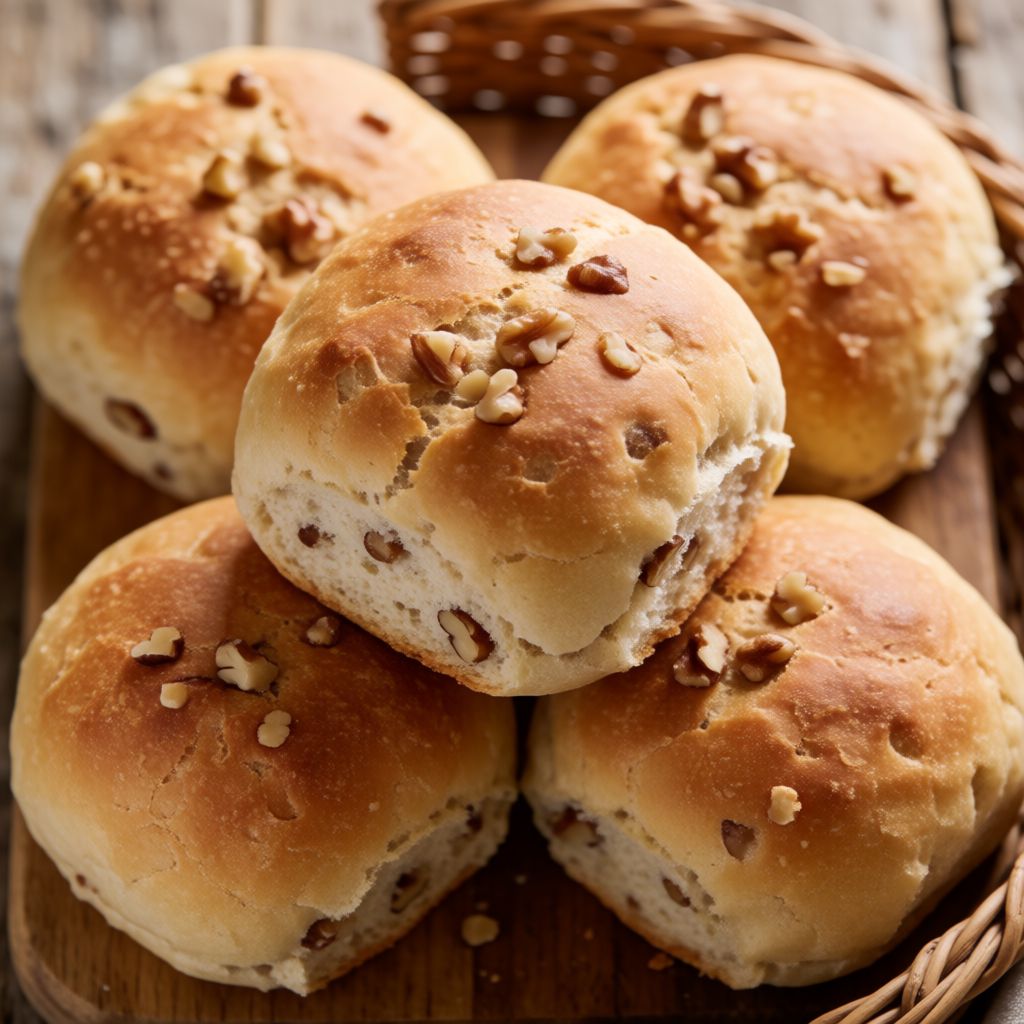
 AI photo
Walnut Bread Rolls
Soft savoury bread rolls studded with walnuts, finished with a sprinkle of poppy and sesame seeds.
Labels are worked out automatically from the ingredients and can be wrong. Check the packaging if it matters to you.
Ingredients
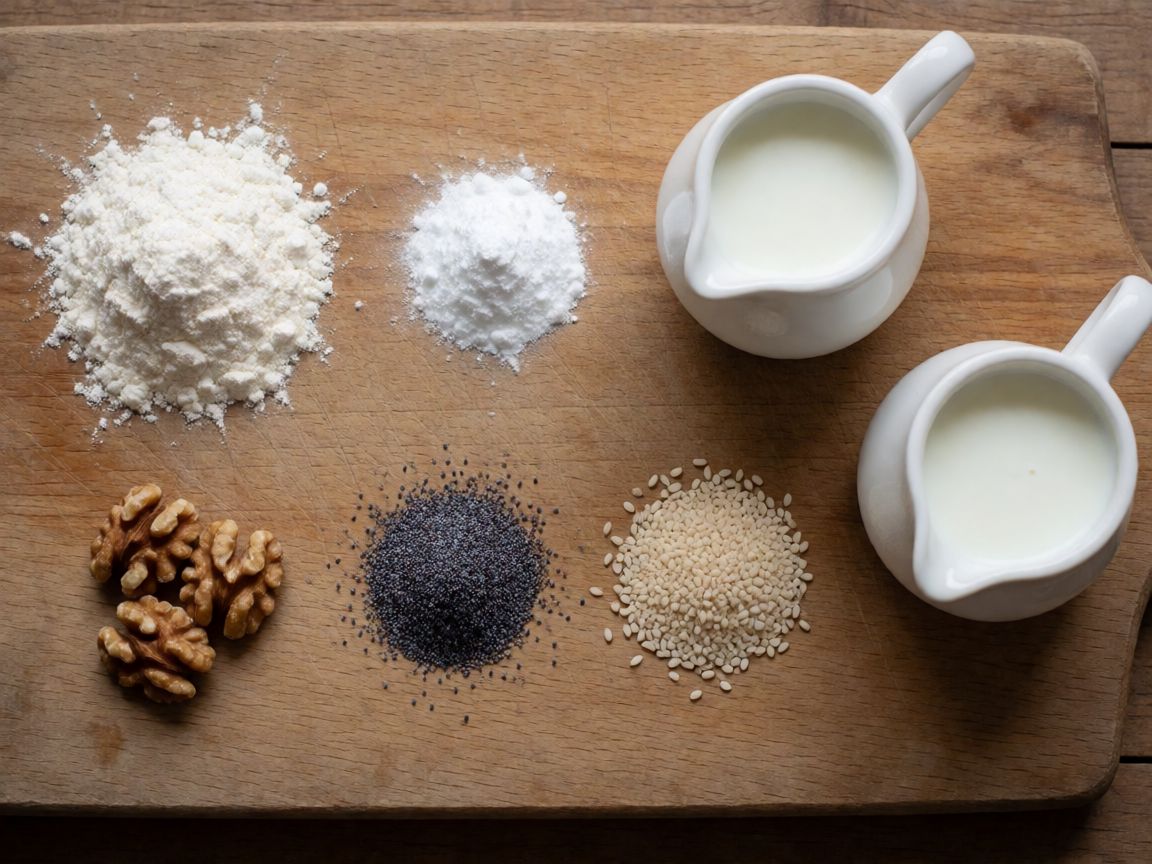
- 220 g Plain Flour
- 10 g Baking Powder for savoury baking
- 2 tbsp Olive Oil
- 150 ml Milk for the dough
- Milk for brushing, to taste
- 75 g Walnuts
- Salt to taste
- Poppy Seeds to taste
- Sesame Seeds to taste








Steps
In a bowl, whisk together the flour, salt and baking powder, then add the milk and olive oil.
Combine all the ingredients with a spatula or your hands until smooth.
Add the roughly chopped walnuts and mix until they are evenly distributed through the dough.
Shape the rolls: take a piece of dough, flatten it gently with your hands into a round shape, and place it on a baking tray lined with parchment paper. Repeat until all the dough is used.
Brush the rolls with milk, then sprinkle with poppy seeds and sesame seeds to taste.
Bake in a preheated fan oven at 200°C for about 15-20 minutes.
18 min
These are not bread in the yeast sense — they're a cousin of soda bread, risen by chemistry, not by fermentation. Baking powder is sodium bicarbonate paired with a dry acid; the moment it meets the milk, bubbles start, and the heat of the oven finishes the job a few minutes later. No waiting for dough to double, no drafts to avoid, no "is it dead" worry about yeast. Some say bread needs time to prove — no, because this isn't that kind of bread. It's a roll you can have on the table in half an hour, which is exactly why it suits a Sunday when the oven is already busy with the roast and you don't want to be nursing dough an hour before guests arrive.
What decides whether these work is restraint, oddly enough — restraint at two points. First, don't knead this dough the way you'd knead a yeast dough. You're not building gluten structure for a rise; you're just getting the flour wet and the fat distributed. Work it past "smooth" into "elastic" and the rolls go tough and chewy instead of short and tender, because you've built a gluten net that the chemical rise can't stretch. Second, chop the walnuts roughly, not fine. Ground to dust, they bleed oil straight into the dough and you get greasy patches instead of pockets of nut.
Plain flour, not strong bread flour, and that's deliberate. Strong flour is bred for gluten — for yeast bread that needs a stretchy net to trap long fermentation gas. Here the rise is quick and chemical, so you want a flour that gives you tenderness, not chew. If all you have is strong flour, it'll still work, just handle the dough a touch less.
Baking powder marked "for savoury baking" simply means it has no vanilla or sweetener dusted through it — fine, because you don't want a faint sweetness fighting the walnut and salt. Any plain baking powder does the same job; just don't swap in bicarbonate of soda alone, because soda needs a strong acid (buttermilk, yoghurt, lemon) to activate, and plain milk is too mild — your rolls would sit flat and taste faintly soapy.
Olive oil, two tablespoons, is there to coat flour particles and keep the crumb short rather than dense — fat gets in the way of gluten strands forming too tightly, which is part of why you can be a bit rough with the dough and still get a tender roll. Any oil with no smell of its own does the same work; sunflower or a mild rapeseed oil (common enough in a UK kitchen) will not announce itself the way a strong extra-virgin olive oil might. If the oil you have is peppery and assertive, that peppery note will turn up in the finished roll, for better or worse.
Milk does two separate jobs and it's worth knowing which is which. The 150 ml inside the dough is simply the liquid that lets the baking powder react and lets the flour come together — ordinary milk, whole or semi-skimmed, both work, and if you're out, water with a spoon of yoghurt stirred in will activate the powder just as well. The milk brushed on top afterwards is a different job entirely: it's there for colour. Milk proteins and sugars brown under heat (the same reaction that darkens toast), and a dry dough surface without that wash would bake pale and the seeds wouldn't stick to anything.
Walnuts, 75 g, roughly broken by hand or a rough chop with a knife — not a food processor, which pulverises some pieces to paste while leaving others whole, giving you an uneven, oily mess. If walnuts aren't to hand, pecans behave almost identically; a milder nut like cashew works but won't give you that slight bitterness walnut skin carries, which is part of what cuts through the richness of a Sunday roast plate.
Poppy seeds and sesame on top are not decoration for its own sake — they toast in the same heat that browns the crust, and that toasting is where their flavour actually comes from; raw, they're nearly tasteless. Salt, measured "to taste" here, is doing more than seasoning the crumb — without it the baking powder's own slightly metallic edge is more noticeable, so don't skip it even if the quantity feels vague. A rough half-teaspoon per 220 g of flour is a fair starting point if you want a number to hold onto, and you can always adjust the next batch.