
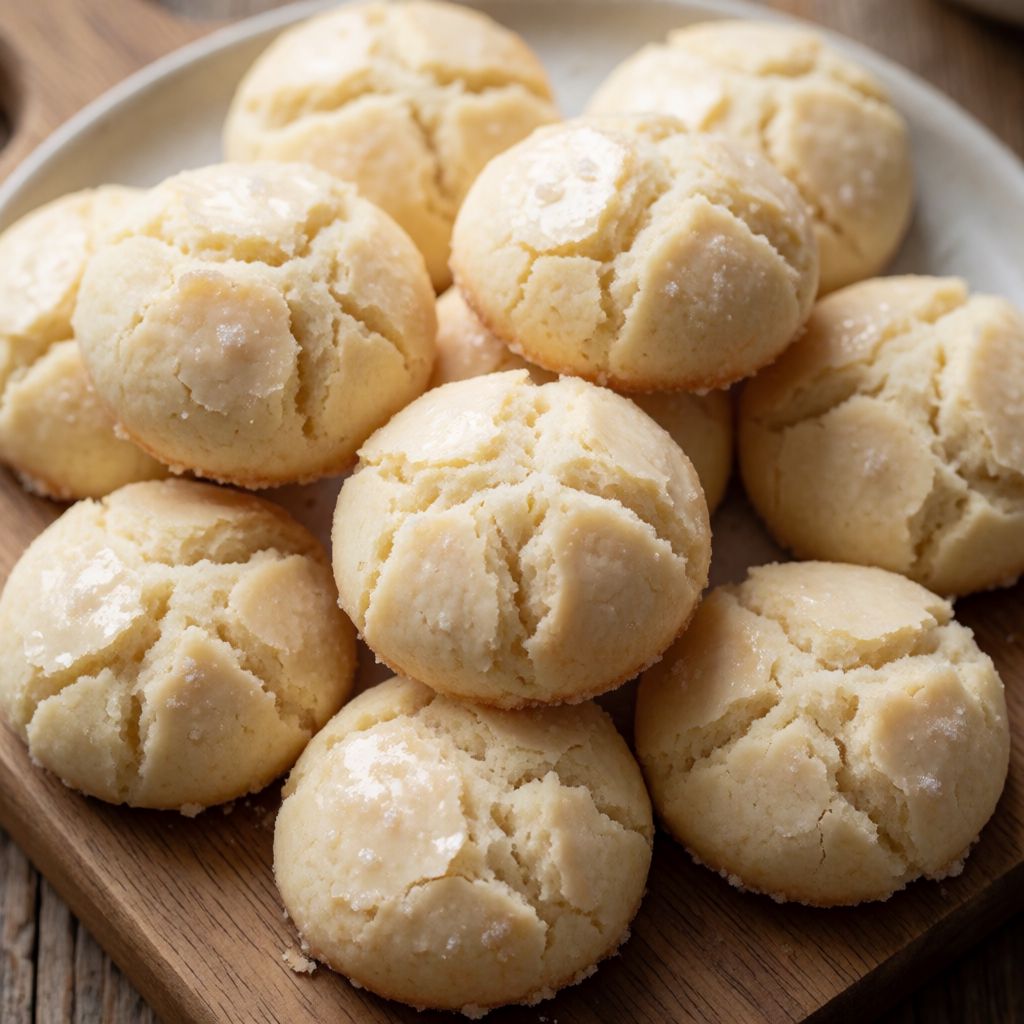
 AI photo
Almond Biscuits
Light almond biscuits with a crisp shell, piped onto a tray and baked until lightly golden.
Labels are worked out automatically from the ingredients and can be wrong. Check the packaging if it matters to you.
Ingredients
- 70 g almond flour
- 150 g icing sugar
- 50 g egg whites



Steps
Mix the almond flour and icing sugar in a mini food processor and grind until smooth and even.
Add the egg whites and process until the mixture is completely smooth.
Transfer the mixture to a piping bag and pipe small round biscuits onto a baking tray lined with baking paper, each about 3cm across, roughly the size of a £1 coin.
3 minBake in an oven preheated to 150°C (fan setting) for about 15-20 minutes, keeping an eye on them as baking time can vary a lot between ovens.
18 minLet them cool completely on a wire rack.
These three ingredients — almond flour, icing sugar, egg white — are the exact same shopping list macarons use, and that's where the resemblance ends. There's no meringue here, no folding egg whites in by thirds, no hour of resting the piped circles so a skin forms before the oven. You grind everything together in a processor and pipe it straight onto the tray. What comes out of the oven is a plainer, more honest biscuit: a thin crust, a chewy middle, no smooth dome, no frilled "feet" at the base. If you came looking for a Parisian macaron, this isn't it — don't be disappointed, be relieved, because this version asks far less of you and still earns its place next to the tea.
What decides whether it works is the grinding, not any folding. Step one does the real work: almond flour and icing sugar ground together until the mixture is fine and even. Skip that, or stop too soon, and you get biscuits with gritty patches and little oily spots — because almond flour holds its own oil inside each particle, and a particle left too big lets that oil pool rather than spread. Grind it fine enough and the oil distributes through the whole paste, which is exactly what gives you an even, pale biscuit instead of a speckled one.
Almond flour is the body of the thing. You want it pale, dry, and fine — almonds ground without their skins, not damp, not clumping when you pinch it. Old almond flour goes faintly rancid from its own oil and that shows up as a bitter edge under the sweetness, so buy it in small bags and keep it somewhere cool and airtight rather than sitting half-used in a warm cupboard for months. If you have none, any finely ground nut with enough natural oil to bind — hazelnut, for instance — will behave the same way structurally, though it will taste like itself, not almond, so don't expect a substitute without a cost.
Icing sugar is doing two jobs, not one. Obviously it sweetens, but UK icing sugar also carries a small percentage of cornflour as an anti-caking agent, and that cornflour isn't dead weight — it soaks up a little of the moisture from the egg white as the mixture bakes, which keeps the paste from turning gluey and helps the top set into that dry, slightly cracked crust rather than staying tacky. If you only have granulated sugar, blitz it in the processor first until it's powder-fine; coarse crystals won't dissolve into the almond flour and you'll feel them as grit in the finished biscuit.
Egg whites are the binder and, once heat hits them, the scaffolding. Fifty grams is roughly one and a half UK large egg whites — don't agonise over the half, a slightly wetter or drier paste just changes how easily it pipes, not whether it works. Their protein is what coagulates in the oven and turns a soft paste into something that holds its shape and snaps when cool. I haven't tried aquafaba or any egg-white substitute in this exact recipe, so I won't pretend one works here — if you need an alternative, test a small batch before you commit a whole tray to it.
The tray needs baking paper, not just because it's easier to clean. As the sugar in the mixture heats, it starts to caramelise at the edges, and caramelising sugar will weld itself to bare metal the way nothing else in your kitchen does — you'd be scraping a tray, not lifting biscuits. Paper also means you're not relying on a tray's non-stick coating, which thins with age and use, so the fix is cheap and permanent: always paper, every batch.
A piping bag makes even circles easy, but it isn't the only tool for the job — a strong sandwich bag with a corner snipped off does the same thing in an ordinary flat kitchen, and a teaspoon, used carefully, will get you close enough if precision isn't your priority. What matters is consistency from one biscuit to the next, because the oven doesn't adjust for size, you do, by piping them all the same.
The fan setting at 150°C is chosen because these are mostly sugar by weight, and sugar scorches long before the centre of a chewy biscuit has had time to set. A fan oven moves air evenly around the tray, drying the surface at a steady, moderate rate rather than blasting one side. But ovens lie about their own dial, often by ten degrees or more, so treat the 15–20 minutes as the point where you start checking colour, not a deadline: the edges should turn the palest gold, the top should look dry rather than wet-shiny. White and soft still means wait; deep brown means you've already lost it to bitterness, and no amount of cooling brings that back.