
 AI photo
Amaretti
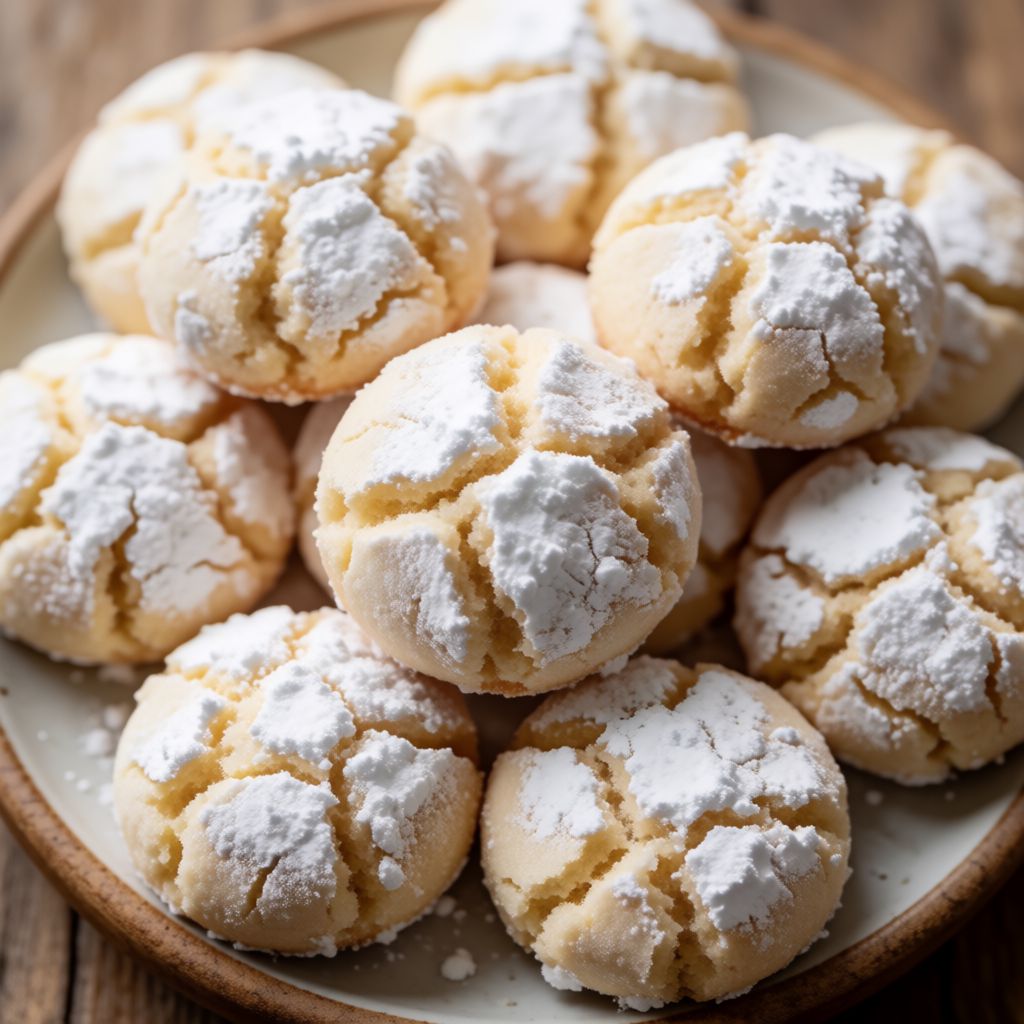
Classic Italian almond biscuits, chewy inside and lightly golden on top.
Labels are worked out automatically from the ingredients and can be wrong. Check the packaging if it matters to you.
Ingredients
- 150 g Caster sugar
- 50 g Ground almonds
- 1 pcs Egg white
- Almond extract a few drops
- 1 pinch Baker's ammonia (ammonium carbonate) roughly the tip of a teaspoon
- Icing sugar to taste






Steps
Put the ground almonds in a blender with about half the sugar and half the egg white, and blitz to a coarse, grainy mixture.
Add the remaining egg white, sugar, almond extract and baker's ammonia, and blend until smooth.
Spoon the mixture into a piping bag, line a baking tray with parchment and pipe small mounds a few centimetres apart.
Dust the amaretti with icing sugar.
Bake at 170°C for 22 minutes.
22 minRemove from the oven and let the amaretti cool and firm up.
What was changed
Deer horn was swapped for Baker's ammonia (ammonium carbonate), the baking ammonia that UK bakers can actually buy.
An amaretto is not a cake trying to be small - it is marzipan that has been asked to dry out and crack rather than stay soft. Almonds, sugar and egg white make a paste wet enough to pipe but dense enough to hold its shape - that's the whole structure, no flour, no butter, nothing to give it crumb. Everything that happens after is about turning that paste into something with a shell and a chew, not about baking a biscuit in the usual sense.
The mechanism that does the actual work is the baker's ammonia. As the mounds heat through, it breaks down into gas - ammonia, carbon dioxide, water vapour - and that gas has nowhere to go but out through the top. The icing sugar dusted on before baking sets into a thin crust early, and the gas escaping underneath cracks that crust open as it pushes past. That crackled, marbled surface you recognise on an amaretto isn't decoration and it isn't luck - it's gas finding the weakest point in a sugar shell. No baker's ammonia, no crack, just a smooth little dome.
Some people are wary of baker's ammonia because the name suggests the biscuit will taste of ammonia. It won't - not at 170°C for the time this recipe gives it. The compound needs heat to break down completely, and by the time these are out of the oven, all three gases are gone, nothing left behind but the lift and the crack. This is precisely why it suits small, thin things baked hot - a big cake at a lower heat might not drive it all off, and that's where the bad reputation comes from, not from the amaretti themselves.
Ground almonds are the body of the thing, and the two-stage blitz in the method is not fussiness - it's there to stop you turning them into almond butter. Almonds are oily enough that if you process all the liquid and all the almonds together from the start, friction and moisture together push the mixture past grainy straight into a smooth, slightly greasy paste, and you lose the texture that makes a bitten amaretto interesting - that faint grain under the chew. Blitzing half the sugar and half the egg white with the almonds first keeps things coarse on purpose; the rest goes in after, just to bring it together into something pipeable. If you only have whole almonds, blanch and grind them yourself and expect a coarser, oilier result - that's not a failure, that's closer to how these were made before pre-ground almonds existed in a bag.
Caster sugar dissolves into the egg white far more readily than granulated would - the crystals are smaller, so there's no grit sitting in the batter and spoiling the piping. If granulated is all you've got, blitz it for a few seconds on its own first to bring the crystal size down; icing sugar at this stage would be too fine and would make the paste slack.
Egg white is doing two jobs - binding the almonds and sugar into something you can pipe, and contributing a little lift of its own, though most of the rise is the baker's ammonia's work, not the egg's. One egg white, no yolk - the yolk's fat would soften the structure in a direction you don't want here, toward cake rather than biscuit.
Almond extract earns its place because of history, not habit. The original amaretti were made with bitter almonds, or sometimes apricot kernels, which carry a sharper, almost bitter almond flavour that sweet almonds simply don't have - the name itself comes from "amaro", bitter. Bitter almonds in any quantity are no longer something you'd want to eat raw and uncontrolled, so sweet ground almonds became the standard, and almond extract - traditionally distilled to concentrate exactly that bitter note - stepped in to put the missing sharpness back. A few drops is right; more doesn't make it more amaretto, just more medicinal.
Baker's ammonia, as above, is the leavening agent, and it's worth treating it as non-negotiable rather than reaching straight for baking powder. If you genuinely cannot find it, baking powder in a similar small quantity will still rise the mixture, but you'll lose some of that particular light, slightly crumbly crack - it rises on carbon dioxide alone, without the extra gas volume ammonium carbonate gives you, so the structure comes out a touch denser. It's a fair substitute, not an equivalent one.
Last thing, and it's not an ingredient but it behaves like one: patience, specifically at the cooling stage. These come out of the oven looking barely holding together, and they are - moving them off the tray hot will flatten or tear them. Leave them where they are until they've firmed up on their own. That waiting is doing exactly as much work as the oven did.