
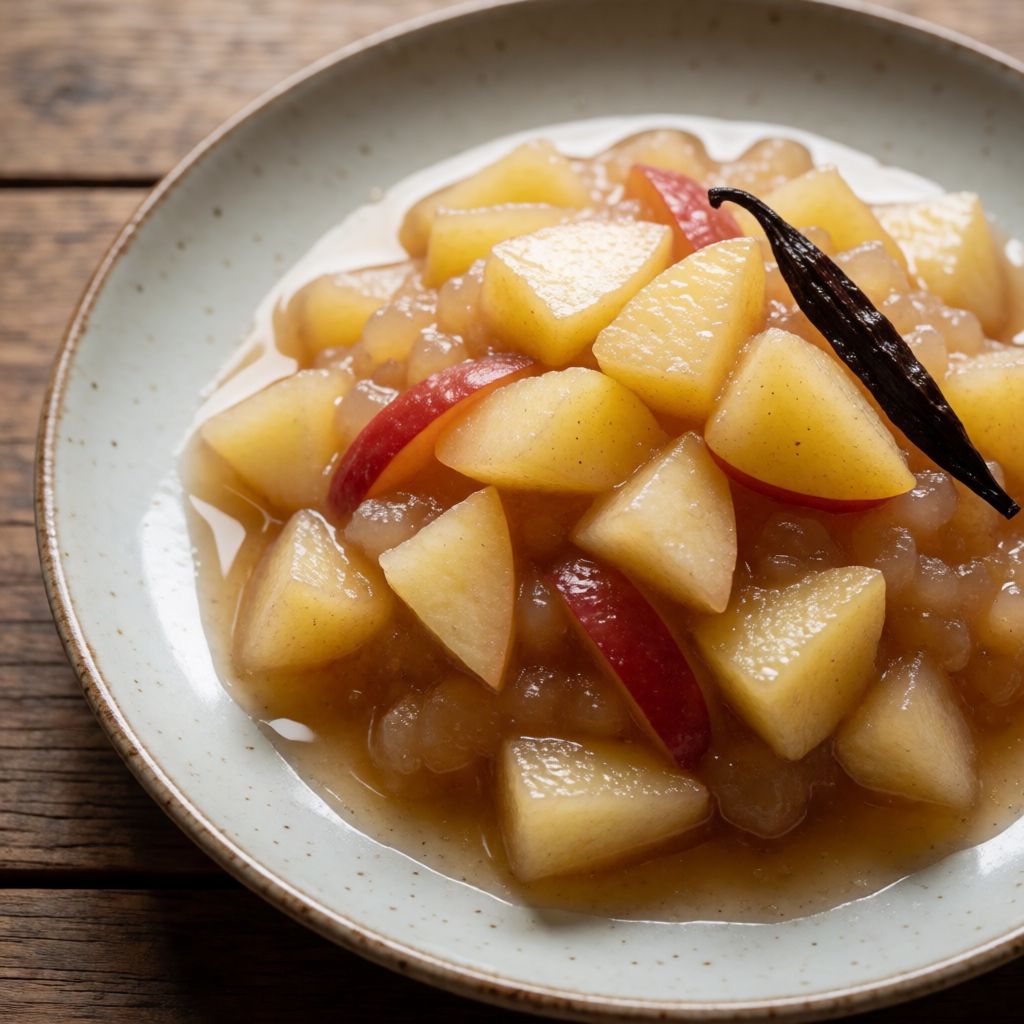
 AI photo
Apple Syrup
A simple apple syrup made from cloudy apple juice, sugar and vanilla, simmered until syrupy.
Labels are worked out automatically from the ingredients and can be wrong. Check the packaging if it matters to you.
Ingredients
- 300 ml Apple juice cloudy
- 100 ml Sugar
- ½ pcs Vanilla pod



Steps
Scrape the seeds from the vanilla pod and mix the vanilla with the sugar.
Cook everything together in a saucepan until it thickens to a syrup, checking with a teaspoon.
5 minIf needed, add a little more apple juice so the syrup doesn't set too firm.
Cool and store in a bottle or jar in the fridge.
This is not a sauce and not a jam — it is a reduction. You take apple juice, add sugar and vanilla, and boil off the water until what is left behaves like syrup instead of juice. Nothing else is happening in that saucepan. No chemistry trick, no setting agent you haven't put in — just water leaving and sugar concentrating behind it.
What decides whether it works is knowing where to stop. Some say more sugar makes a thicker syrup — no, it doesn't, not directly. Sugar sweetens; water leaving is what thickens. Add sugar without boiling long enough and you get sweet apple juice. Boil too long and the same batch turns into something closer to toffee once it cools, because sugar at high concentration sets hard, not syrupy. That's why the recipe tells you to check with a teaspoon rather than trust a clock: dip it, let it cool a few seconds on the spoon, and look at how it runs. Time here is a lower bound, not an instruction — five minutes is where you start checking, not where you stop cooking.
The cooling step matters more than it looks. Syrup is always thinner hot than it will be cold — this catches people out the same way custard does. Judge it in the pan while it's warm and you'll pull it off too early; judge it only after it's properly cool and you'll know what you've actually made. If it sets too firm once cold, that's not a failure to throw out — loosen it with a splash more juice and warm it through again. The recipe already tells you this, and it's the right fix, because you're adjusting the ratio, not fighting the chemistry.
Apple juice — cloudy, specifically. Clear juice has been filtered until it's essentially apple-flavoured sugar water; cloudy juice still carries the fruit's own pectin and fine pulp in suspension. Reduce the clear kind and you get a thin, one-note sweetness. Reduce the cloudy kind and the pectin helps give the syrup body, and the flavour holds up because there's more actual apple left in the glass to begin with. If cloudy isn't on the shelf, a juice described as 'with sediment' or 'unfiltered' does the same job — the test is whether it looks a bit murky in the bottle, not the brand.
Sugar does two jobs, not one. It sweetens, obviously, but it's also what the syrup is made of once the water's gone — this is why the proportion matters more than it looks like it should for 'just a syrup'. 300ml juice to 100ml sugar is a strong but not overwhelming ratio; don't be tempted to add 'a bit more for safety', because that pushes you towards the toffee problem above. White sugar is the honest choice here because it has no flavour of its own to compete with the apple and vanilla — any plain sugar with no aroma works, which rules out things like dark muscovado unless you actually want a caramel note fighting the fruit.
Vanilla pod, half of one, seeds scraped out. The seeds are where almost all the flavour sits — the pod itself is mostly fragrant fibre. Mix the seeds into the sugar before it goes in the pan so they distribute through the syrup rather than clumping. Don't throw the scraped pod away: drop it into your sugar jar at home and it'll perfume the next batch of sugar for free, which is the entire economic logic of why vanilla pods have always been used this way — nothing about the plant is wasted if you can help it, because whole pods were never cheap. If you've no pod at all, a small amount of real vanilla extract stirred in at the end works, though you lose the little black flecks that tell you it's the real thing and not flavouring.
Equipment-wise, there's nothing here that needs a kazan or anything special — an ordinary small saucepan on your hob is exactly right, because you're reducing a modest 300ml, not a potful. What you do need is to actually watch it near the end: once juice and sugar are properly cooking down, the volume drops fast and the window between 'syrup' and 'too far' is short. A teaspoon left by the hob for testing costs you nothing and saves you starting again.
Once it's cooled and bottled, keep it in the fridge. It's a store-cupboard basic rather than a dish in its own right — the kind of thing you make once and then spoon into porridge, over pancakes, or swirl through yogurt for a week or two. It has no place in a Sunday roast and no business near a cup of tea with milk, but as a small sweet reserve sitting at the back of the fridge, it earns its jar.