
 AI photo
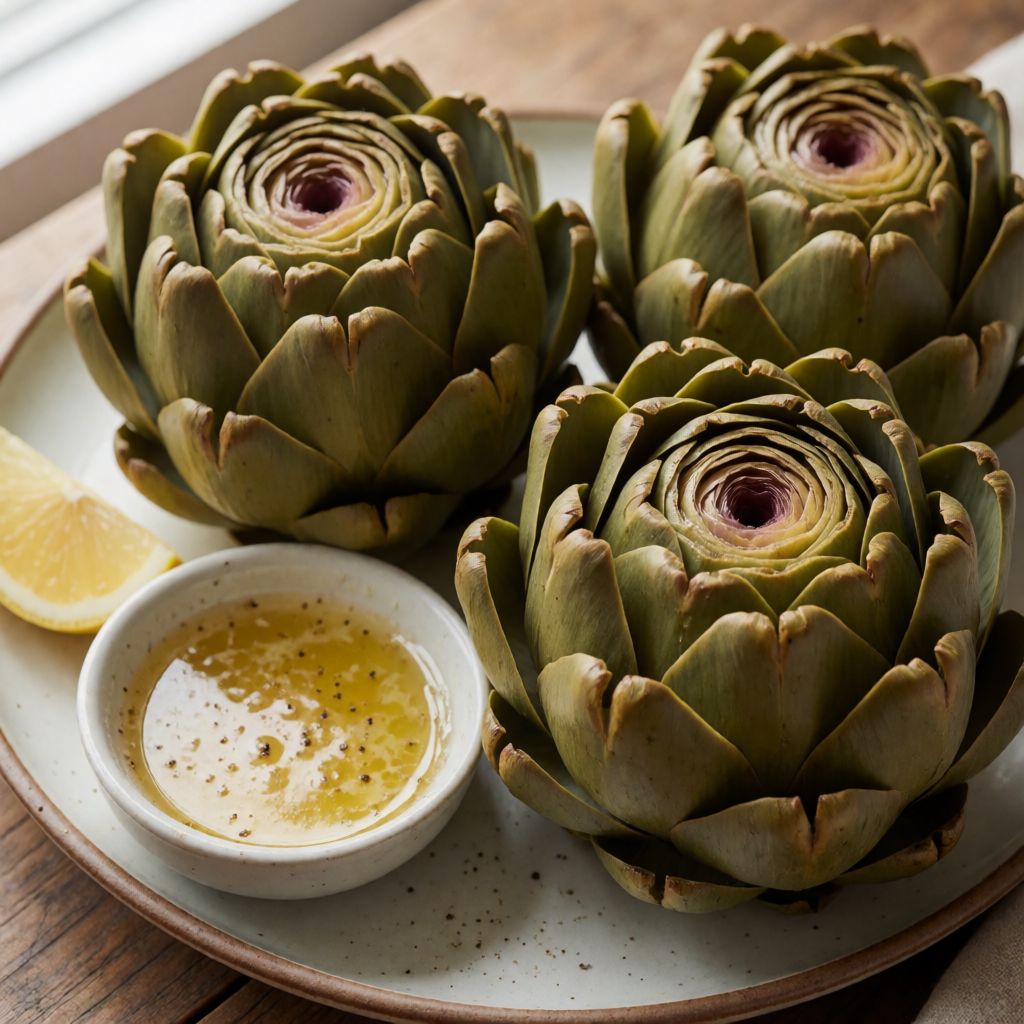
Artichokes with Melted Butter
Whole globe artichokes served with a soft, buttery dip for everyone to share at the table.
Labels are worked out automatically from the ingredients and can be wrong. Check the packaging if it matters to you.
Ingredients
- 4 pcs Globe artichoke
- ½ pcs Lemon
- 75 g Butter softened, at room temperature
- 3 tbsp Crème fraîche
- Salt flaky salt
- Black pepper to taste






Steps
Mix the softened, room-temperature butter with the crème fraîche, and season with salt, pepper and perhaps a few drops of lemon juice.
Put the butter mixture in the fridge while the artichokes cook.
Bring a large pot of water to the boil with the sliced lemon and some salt.
Trim the stems of the artichokes and lower them into the boiling water.
Cook for 20 minutes.
20 minLift out the artichokes and let them drain briefly.
Serve the artichokes whole at the table, where everyone pulls off the leaves and dips the fleshy base into the whipped butter.
At the centre of the artichoke are many fine hairs (the choke), which should be carefully scraped out with a spoon.
Underneath lies the artichoke heart, which tastes wonderfully delicious.
This is not really a recipe, it's a ritual with a vegetable at the centre of it. You boil a thistle bud whole, then everyone sits at the table pulling off leaf after leaf, dragging each one through their teeth for the sliver of flesh at its base, until what's left is small enough to call the heart. Nobody grew up doing this at a Sunday roast in this country, and that's fine — it isn't that kind of meal. It's slower, closer to peeling sunflower seeds than carving a joint, and it wants a whole evening given over to it, not a side-dish slot between the potatoes and the gravy.
What decides whether it works has almost nothing to do with seasoning and everything to do with water. An artichoke floats — it's mostly air trapped between fibrous leaves — so if it isn't held fully under the surface, the top half steams gently while the bottom actually boils, and you end up with one vegetable cooked two different ways. You need a proper depth of water at a real rolling boil the whole time, not just at the start: drop four heavy vegetable heads into a pot and the temperature drops hard. If it doesn't climb straight back to a boil and stay there, the fibrous base never properly softens — it just goes limp without the fibre breaking down, and tastes of raw stalk however long you leave it. Twenty minutes is where you start checking, not where you stop.
Pick the artichoke by weight and feel, not by looking pretty on the shelf. You want leaves held tight and close, with a bit of resistance when you squeeze — almost a squeak — and it should feel heavy for its size. Heavy means it's still full of moisture; a light one has been sitting in storage drying out from the inside, and no amount of boiling brings that back.
The lemon does two separate jobs and it's worth knowing which is which. In the pot, sliced, it flavours the water that the outer leaf flesh will pick up a little of while cooking. But the real reason it's there is the cut stem: artichoke flesh browns the instant it's exposed to air, the same enzyme reaction that blackens a cut apple or a peeled potato, and the acid in lemon juice slows that reaction down. Rub the cut surface, don't just hope the water deals with it. Trimming the stem itself isn't fussing — that outer layer of the stem is as stringy and inedible as the bottom of the outer leaves, and taking it off lets the vegetable sit flat and lets heat into the cut face faster.
Butter has to be properly soft, at room temperature, not cold and not melted — cold won't blend evenly with the crème fraîche, melted has already started to split into fat and water and you can't put that back together by whisking. Any unsalted butter does the job; salted just makes seasoning harder to judge. Crème fraîche's role is acidity plus body: something cultured and thick enough to hold together once mixed with fat. If you haven't got it, soured cream is the closest stand-in; thick natural yoghurt works in a pinch but gives a thinner, less luxurious result. Double cream on its own won't do — no tang, and it thins the butter instead of steadying it.
Use two kinds of salt and know why. The flaky salt at the table is for scattering just before eating, so it stays as little bursts of crunch on your tongue rather than dissolving invisibly into the butter — a fine table salt would vanish into the dip and you'd never taste it as salt, just assume the butter was slightly odd. In the boiling water, any coarse salt is fine, since it's fully dissolved long before the artichoke goes in.
One piece of folklore is worth knowing rather than dismissing: artichoke contains a compound called cynarin that briefly dulls the tongue's sweet receptors, which is the real reason wine tastes strange and metallic straight after eating one — not an old wives' tale, an actual chemical effect. So don't fight it by pouring good wine alongside; it's wasted on this course. Something plain and cold to drink, and the wine afterwards, once your palate's back.
And don't rush the eating. Scraping out the choke with a spoon before you get to the heart isn't an optional flourish — those fine hairs are the vegetable's unopened flower parts, inedible and unpleasant in the mouth, sitting directly on top of the best bit. Four artichokes feed four people as a starter, one each, and the whole point of the dish is that it takes longer to eat than it took to cook. That's not a flaw to fix. Patience is the ingredient that makes this worth doing at all.