
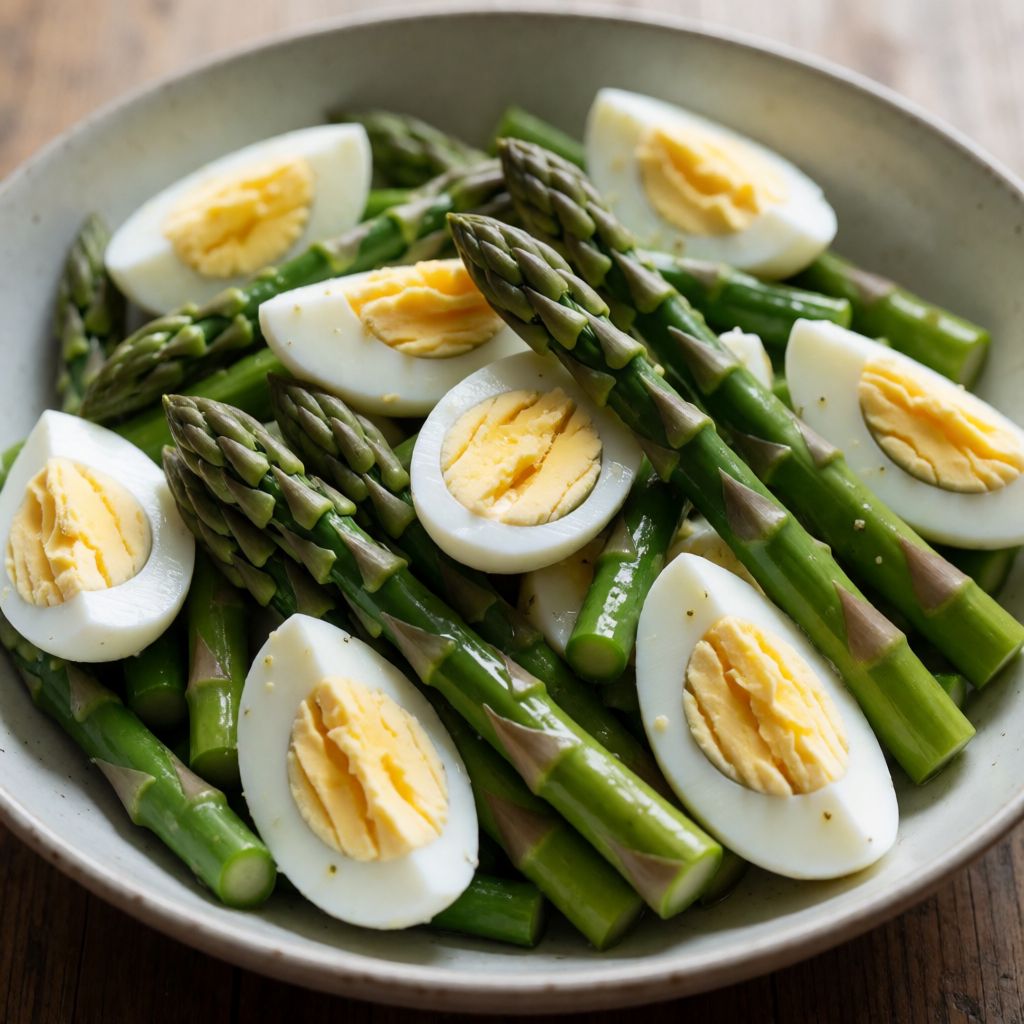
 AI photo
Asparagus and Egg Salad
A fresh salad of tender asparagus and boiled eggs, finished with a creamy egg dressing.
Labels are worked out automatically from the ingredients and can be wrong. Check the packaging if it matters to you.
Ingredients
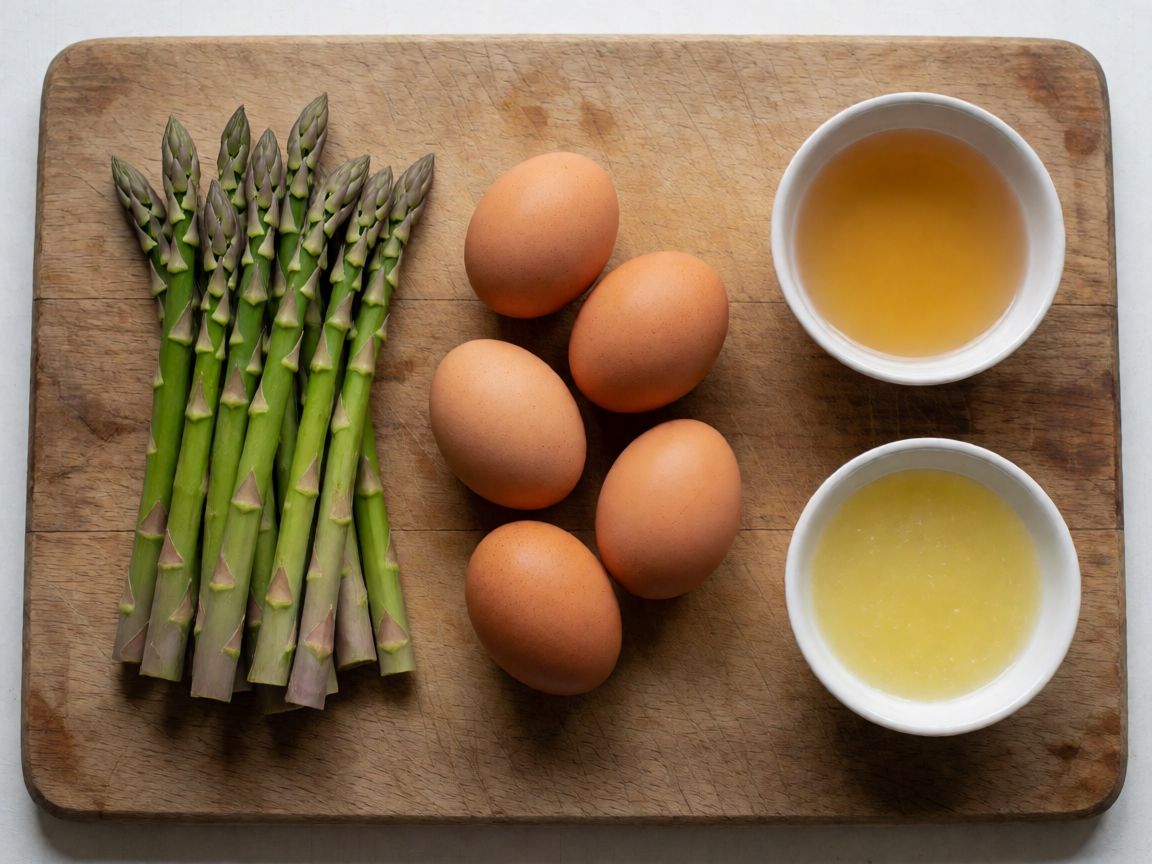
- 600 g Asparagus
- 5 pcs Eggs
- 2 tbsp Olive oil
- 1 tbsp Apple cider vinegar
- 1 pinch Salt
- 1 tbsp Lemon juice
- 1 pinch Black pepper







Steps
Pour water into a saucepan and add the whole eggs. Once it boils, cook for 10 minutes.
10 minTransfer the eggs to cold running water to stop the cooking, then let them cool.
Peel the eggs and place them in a bowl.
Wash the asparagus thoroughly and trim off the tough ends of the stalks.
Bring a pot of water to the boil, add salt and cook the asparagus for about 10 minutes.
10 minDrain the asparagus and arrange it on a serving plate.
Slice two of the boiled eggs and arrange them around the asparagus as a garnish.
Mash the remaining boiled eggs and dress them with the olive oil and apple cider vinegar to make a creamy mixture.
Dress the asparagus with the creamy egg mixture.
Sprinkle with black pepper and add the lemon juice.
This is not really an asparagus salad with egg on the side — it's asparagus dressed with a crude, honest mayonnaise you make by crushing hard-boiled yolk and white into oil and vinegar. That's the whole trick of the dish. Get that dressing wrong — too thin, too lumpy, not emulsified — and you just have boiled vegetables with egg crumbs on them. Get it right and the yolk's fat binds the oil, the vinegar cuts through it, and you have something closer to a sauce than a garnish.
The asparagus itself has one job: stay green and give a little resistance, not go limp. Forget the ten minutes as a rule — it's a starting point, nothing more. The real test is the stalk: lift one out, let it hang — it should bend, not flop, and the skin should look matte-bright, not grey-khaki. If your spears are thick as a finger, they'll want longer; thin ones, pencil-width, can be out in half that time. Watch the vegetable, not the clock.
There's an old habit of peeling asparagus stalks before cooking, as if the skin were the problem. It isn't — the fibre runs lengthwise up the stalk, and it's thickest and toughest at the cut end, not in the skin. That's why you trim or snap off the base instead: hold the spear and bend it, and it will break naturally where the tough part ends and the tender part begins. Peeling just wastes a vegetable and your patience.
Proportions: this is built for four as a starter or a light side, not a main — 600 g asparagus is roughly one full bunch from a supermarket, five eggs, two spoons of olive oil, one of vinegar, one of lemon juice, a pinch each of salt and pepper. Nothing here needs scaling up by much; asparagus salad is meant to be eaten the day you make it, not stretched across the week.
Asparagus: buy it tight-tipped, stalks firm enough to squeak slightly when rubbed together, cut ends that look freshly cut rather than dried and splitting. In Britain the proper season is short — May into June — and that's when it's cheapest and best, because it's grown close rather than flown in; out of season you're paying a premium for a vegetable that's travelled further than you have this year. Out of season, don't force it — a good leek or a bundle of young green beans, cooked the same bend-not-snap way, will carry the same salad structure if asparagus isn't worth the price.
Eggs: five, boiled whole from cold water so the shell doesn't crack from thermal shock, then the full ten minutes once it's properly boiling — that's a hard yolk, no soft centre, because a soft yolk won't mash into a dressing, it'll just smear. Fresher eggs peel worse, oddly enough — the air pocket inside an older egg is bigger, which helps the shell separate — so if peeling is always a fight for you, that's the egg's age talking, not your technique.
Olive oil: here it's doing the job mayonnaise's oil does — carrying flavour and binding with the yolk. Any oil with no smell of its own works as a substitute in terms of mechanism — sunflower or rapeseed, both easy to find on a British shelf — but olive oil adds its own bitterness and grass-note on top, which this simple dressing can use. Don't reach for a strongly flavoured oil like walnut or sesame; it will fight the egg instead of supporting it.
Vinegar and lemon juice: apple cider vinegar in the dressing, lemon juice spooned over at the end — they're doing two different jobs, not one repeated. The vinegar's acidity helps the mashed egg and oil hold together as an emulsion rather than separate into a greasy puddle; the lemon at the end is there for brightness on the tongue, added last so it doesn't cook or dull in the heat. If you're out of cider vinegar, any mild vinegar without a heavy smell of its own will do the binding job — white wine vinegar, for instance — just keep the lemon for the finish regardless.
Patience is the ingredient nobody lists: don't rush the asparagus off the heat the second a timer beeps, and don't skip the full cold-water plunge on the eggs because you're hungry. Both shortcuts show up later — one as mushy, grey-tinged spears, the other as a dressing with a chalky grey fleck through it. A wide domestic pan and a sieve to lift things out is all you need; no kazan, no special kit, just water at a proper boil and the willingness to look at the food instead of the clock.