
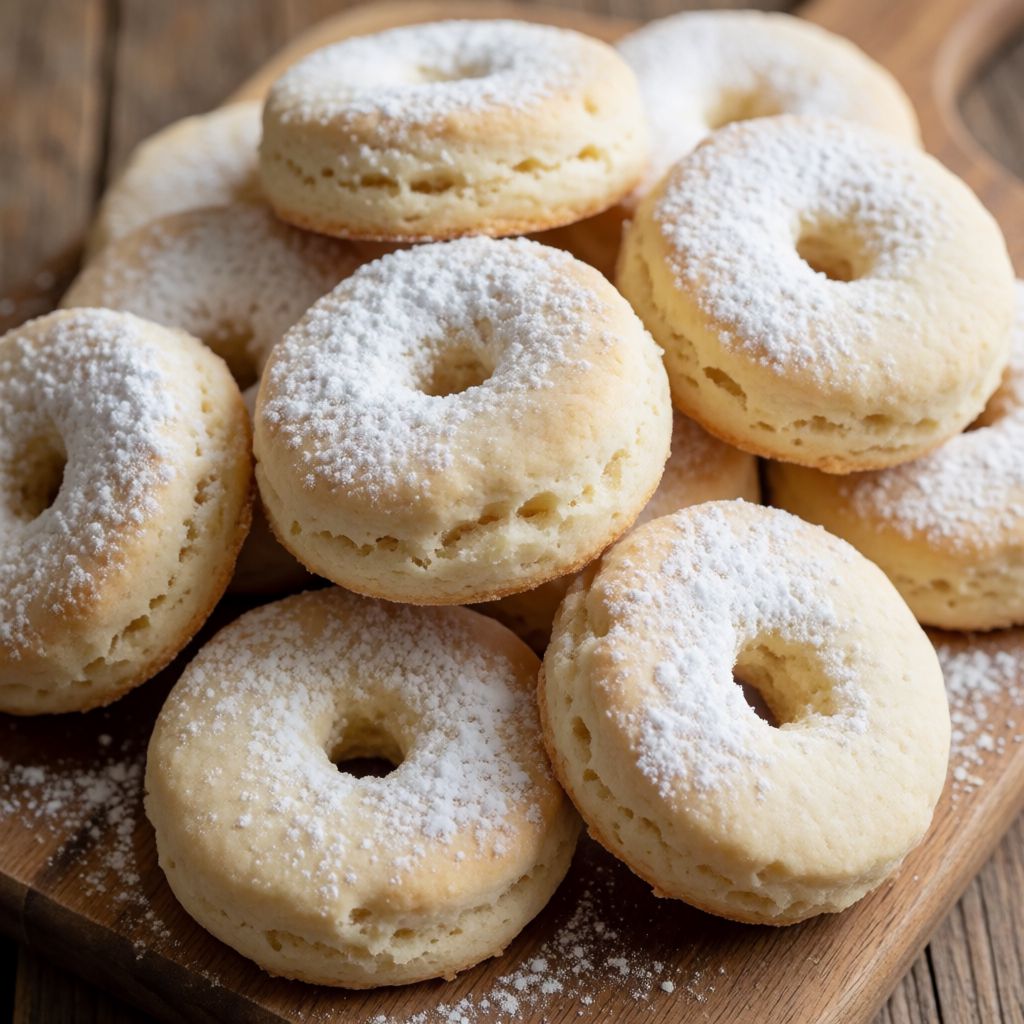
 AI photo
Baked Carnival Biscuits with Icing Sugar
Crisp carnival biscuits, baked and dusted with icing sugar for serving.
Labels are worked out automatically from the ingredients and can be wrong. Check the packaging if it matters to you.
Ingredients
- 400 g Plain Flour
- 1 pcs Baking Powder
- 1 pcs Vanilla Sugar
- 50 g Butter at room temperature
- 30 g Caster Sugar
- 3 pcs Eggs
- 1 pinch Salt
- 125 ml Rum optional
- Icing Sugar to taste









Steps
Sift the flour and tip it onto the worktop in a mound, making a well in the centre.
Into the well put the baking powder, vanilla sugar, softened butter (cut into pieces), caster sugar, eggs and salt.
If you like, add the rum for a brighter flavour.
Knead the dough energetically until smooth and even.
Shape into a ball, cover with a tea towel and leave in the fridge.
60 minRoll out the dough to a thickness of 3-4 millimetres.
Using a fluted cutter, cut pieces into any shapes you like (diamonds, triangles, squares, strips).
Place the pieces on a baking tray dusted with flour or lined with baking paper.
Bake for 10-15 minutes in the oven at 170°C.
12 minCool the biscuits and dust with icing sugar to serve.
What was changed
The oven temperature range was narrowed to a single value . Vanillin was replaced with vanilla sugar Vanilla Sugar, as vanillin sachets are not easy to find locally.
This is the Italian carnival biscuit — chiacchiere, bugie, whatever your grandmother called them in whichever region she was from — reimagined for the oven instead of the fryer. Normally this dough gets fried in hot oil until it blisters and bubbles, giving those characteristic air pockets under a glass-like crust. Baking it instead is a different animal: no blisters, no bubbles, just a crisp, dry biscuit with a short, sandy bite. If you came here expecting the fried original, you'll be disappointed — but judged as what it actually is, a rolled butter-and-egg biscuit, it's a fair, low-fuss version of the carnival treat, and nobody's standing over a pan of hot oil in a small flat worrying about a fire.
What decides whether this works is the dough's structure, not the baking. You're building what's essentially a short pastry with egg instead of extra fat for binding — flour, a little butter, eggs, sugar — and the gluten in that flour needs to be worked hard and then allowed to rest. Knead it "energetically" because this isn't bread, where you're coaxing a slow rise; you're forcing butter, egg and flour into one smooth mass fast, before the butter softens into grease and the dough turns short and crumbly rather than elastic and rollable. Then the rest in the fridge isn't optional comfort — it's the gluten relaxing after that rough handling, so when you roll it to 3-4mm it doesn't spring back and tear or shrink on the tray.
On the ingredients: plain flour here, not strong bread flour — you want enough structure to roll thin without crumbling apart, but not so much elasticity that it fights you and shrinks back every time you roll it. 400g plain flour with a UK "strong" bag will give you a tougher, less snappable biscuit; if that's all you've got, rest the dough a touch longer so the gluten has time to give up some of that fight.
The butter is there for shortness, not for flavour you'll taste directly — 50g against 400g flour is a modest amount, this isn't a rich shortbread. It must be at room temperature, properly soft, because cold butter won't distribute through the dough evenly when you knead by hand on the worktop; you'll get streaks of fat instead of a uniform crumb, and those streaks show up later as blotchy, uneven baking. If your kitchen's cold (not unusual in a British winter), give the butter real time out of the fridge — ten minutes isn't enough, you want it to yield to a light push, not just look matte.
Eggs do the real binding work here, standing in for the water a simple pastry would use. Three eggs against 400g flour is generous — this is what makes the dough workable without extra liquid, and what gives the baked biscuit its slight chew-then-snap rather than pure sandiness. Use whatever eggs you'd normally buy; size matters more than you'd think in a dough this dry, so if yours are small, the dough may need a splash more liquid (a spoon of milk) to come together — don't force it with more egg and throw the ratio off.
Caster sugar, not icing or granulated, because you want it to dissolve into the dough as you knead, not sit as grit or clump unevenly. Vanilla sugar is just vanilla flavouring carried in sugar — if you don't have the sachet, a few drops of vanilla extract stirred into the eggs does the identical job; don't buy a separate product for this if you've already got extract in the cupboard.
The rum is doing two things if you use it: a little acid and alcohol, which tenderises the dough further and burns off in the oven leaving a warm note behind, and tradition — carnival biscuits across Italy often carry a spirit, grappa, Marsala, whatever the house had open. It's genuinely optional; skip it for a plainer, cleaner biscuit, or swap in a tablespoon of any spirit you have, brandy works fine, it's not sacred ground.
On the oven: 170°C with fan convection in most UK ovens runs hotter than a traditional static oven at the same number, so if you've got a fan oven, treat 170°C as a ceiling and check at 10 minutes, not 15 — these biscuits go from pale gold to properly dry quickly, and because they're thin, they don't forgive a few extra minutes the way a thick cake would. Pull them when the edges have gone a shade past gold at the very tips of the scalloped cuts; the centre firms up as it cools on the tray, so a biscuit that feels slightly soft straight out of the oven is usually right, not underdone. Dust with icing sugar only once they're properly cool — on warm biscuits the sugar melts into a wet glaze instead of sitting as a soft white layer, and that's a fix nobody wants to be making twice.