
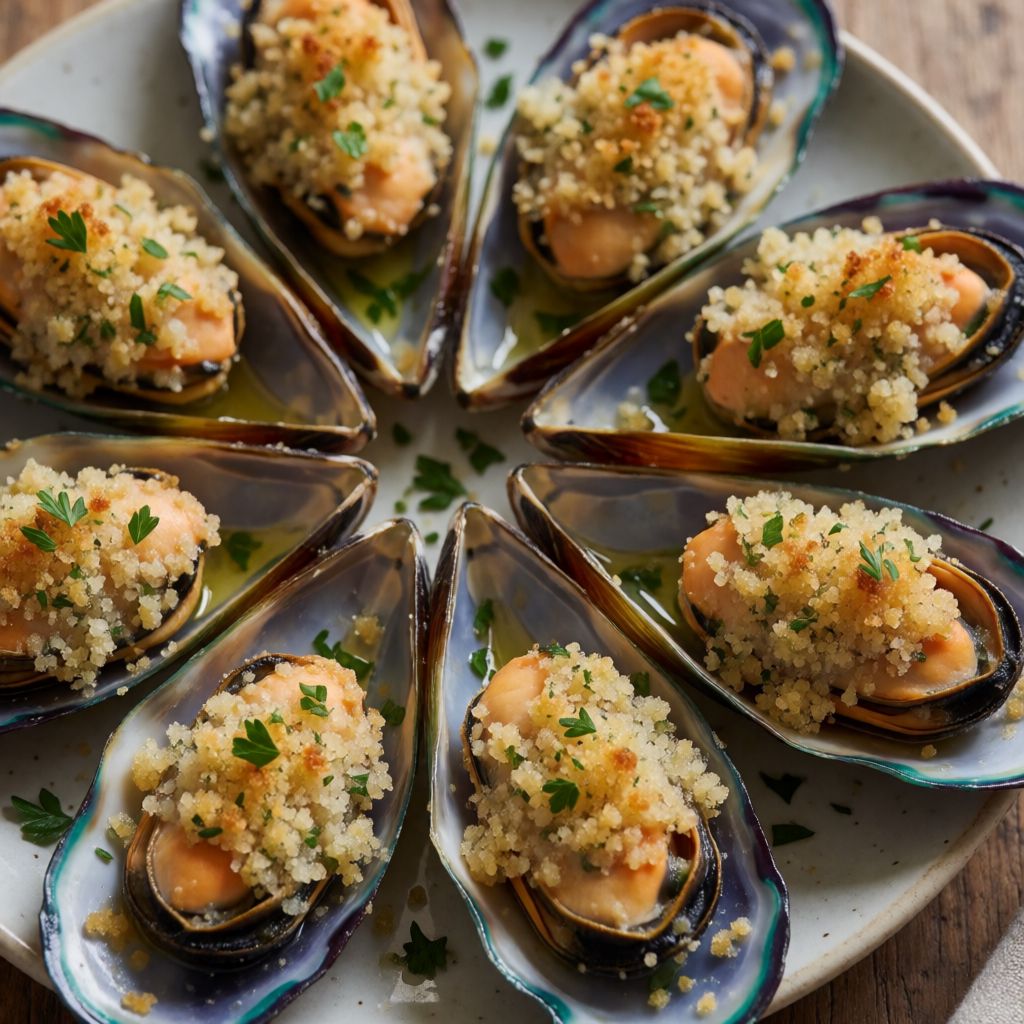
 AI photo
Baked Mussels with a Breadcrumb Crust
A simple baked mussel dish finished with a crisp, golden breadcrumb topping.
Labels are worked out automatically from the ingredients and can be wrong. Check the packaging if it matters to you.
Ingredients








Steps
Thoroughly clean and rinse the mussels, open them and leave the mussel meat in one half of the shell.
Finely chop the parsley together with the garlic and chilli.
Layer the mussels in a baking dish, alternating with the chopped mixture, drizzling with olive oil, adding a little salt and lemon juice.
Make 3 layers of mussels, and on the final layer sprinkle over a handful of breadcrumbs.
Bake for about 15 minutes at 180°C.
15 min
This is not really a mussel dish you cook from raw — it's a mussel dish you dress and brown. The mussels are already open and cooked by the time they go in your dish; what the oven does afterward is warm them through, let the garlic-parsley oil soak in, and turn a scatter of crumbs into a crust. Three layers of shells, each one dressed again, then crumbs only on top. That's the whole architecture.
Some people try to pry mussels open with a knife, the way you'd do an oyster. Don't. A live mussel's hinge muscle holds the shell shut with real force, and a raw mussel won't let go without tearing — you'll lose the juice and half the meat along with the top shell. Heat is what makes the muscle release cleanly. Steam them briefly, covered, in a pan with a lid or even a plate over it if that's what you've got, just until the shells gape on their own. That's the actual "opening" in step one, even though the recipe doesn't spell it out.
Mussels, 1.5 kg for four, is a starter portion — a small plateful each, not a main the way your Sunday roast is a main. That's worth saying because the whole dish belongs to a different economy of eating: mussels were cheap coastal food, breadcrumbs were a cheap way to stretch them and soak up every bit of the oil and juice so nothing ran to waste in the dish. There's no magic in the breadcrumb crust — it's a poor kitchen's way of making a little shellfish look and feel like more.
Buying and cleaning the mussels is where the real work and the real patience go, more than in the oven. Live mussels should be shut tight; tap the ones that gape and if they don't close, they're dead — out they go. Scrub the shells under a cold tap, pull off the little dark thread (the beard) sticking out of the hinge — that's the mussel's anchor rope, and it'll char and taste of nothing good if it's left on. Rushing this step is where grit ends up on your plate later; it doesn't come from the recipe, it comes from skipped scrubbing. If buying and cleaning live mussels isn't practical, frozen half-shell mussels — already opened, meat sitting in one half — do the same job; just skip the opening step and dress them straight away.
Parsley wants to be bright and fresh, leaves springy not wilting — its job is a clean green top note that cuts through the iodine, mineral taste that shellfish carry. Garlic goes in minced fine with it, mostly so it spreads evenly through the dressing rather than sitting in one scorchable lump; garlic that's too coarse and exposed is what turns bitter under heat, not garlic in general. Chilli is yours to judge — fresh red gives clean heat and a fleck of colour, dried flakes do the heat without adding any extra moisture, so they're a fair swap if that's what's in the cupboard.
Lemon does two jobs with two fruits: juice worked into the dressing while the mussels are layered, cutting the richness of the oil and brightening the sea taste, and a second lemon cut into wedges for the table, because a squeeze at the very end wakes the dish up again after the oven's warmth has settled it. Use an olive oil you'd actually want to taste on its own — this oil isn't a cooking medium here, it's part of what you eat, so a flavourless one is a wasted choice. Any oil with real character of its own will do the same job if olive isn't to hand, but a neutral frying oil defeats the point.
Breadcrumbs need to be dry — stale bread grated down, or a shop packet, or panko if you want more crunch — never fresh breadcrumbs, which carry their own moisture and turn the top gluey instead of crisp. Salt lightly and taste as you go: mussels already carry the sea's salt in them, and the easiest way to overdo this dish is to season it as if it had none.
For the baking dish itself, you don't need anything special — a wide ovenproof dish or roasting tin, foil over it if you're worried about drips, is the kitchen equivalent of what a proper gratin dish would do. Just keep the shells close together rather than scattered thin across a dish that's too big; too much empty space means the juice spreads out and dries before the crumb has a chance to brown.