
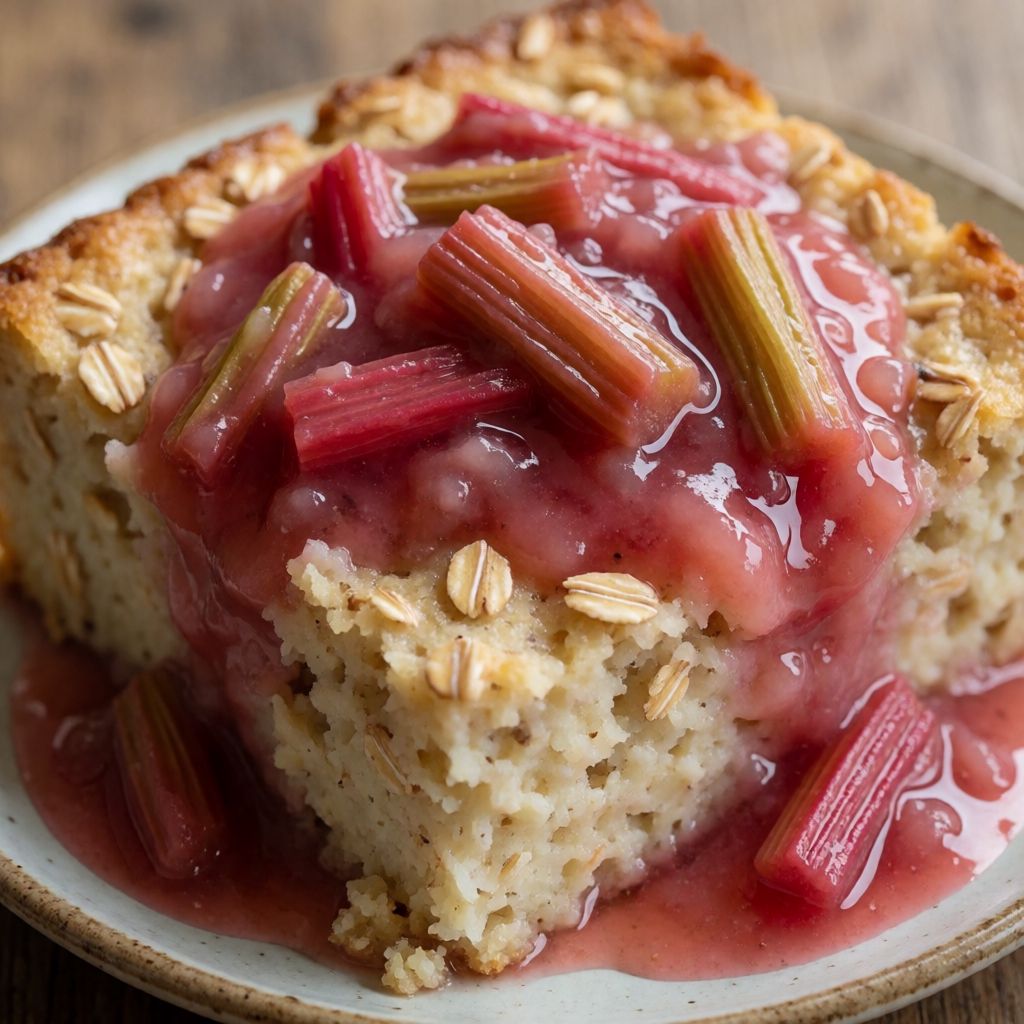
 AI photo
Baked Oat Pudding with Rhubarb Compote
A cosy baked oat pudding topped with a tangy rhubarb compote and a buttery crumble.
Labels are worked out automatically from the ingredients and can be wrong. Check the packaging if it matters to you.
Ingredients
- 200 g Rhubarb cut into small cubes
- 50 g Sugar
- 1 tsp vanilla sugar
- 50 g Plain flour
- 50 g Sugar
- 50 g Butter
- 1 tsp Butter
- 300 ml Rolled oats large flakes
- 600 ml Water
- 0.5 tsp vanilla sugar
- 300 ml Milk
- 40 g Almonds finely chopped
- pinch Salt








Steps
Put the rhubarb compote ingredients into a saucepan and stir. Leave for 30 minutes without heat so the rhubarb releases its juice.
30 minBring the compote to the boil, stirring, then simmer gently for 5–10 minutes.
7 minRub the butter, sugar and plain flour together into crumbs until even.
Put the rolled oats, water and salt into a saucepan and bring to the boil, stirring.
Cook the porridge until tender. Stir in the milk, vanilla sugar and almonds.
10 minSpoon the compote into the bottom of a greased heatproof dish, then spoon the porridge over the top. Sprinkle with the crumble.
Bake in a preheated fan oven at 175°C for 10 minutes.
10 min
This is a porridge that goes to the oven instead of a bowl. Underneath, rhubarb has been coaxed into a compote; in the middle, oats cooked soft in milk and water; on top, a crumble that was never meant for a pastry case but for exactly this. Bake it ten minutes and the crumble sets into a shell while everything underneath stays wet and soft — that contrast of textures is the whole point of the dish, and it's what separates this from "porridge with stuff on it".
What decides whether it works is patience with the rhubarb before any heat touches it. You leave the raw cubes with sugar for thirty minutes, doing nothing. That's not a filler step — rhubarb is almost entirely water held in rigid cell walls, and sugar pulls that water out by osmosis before you ever put a flame under it. Skip the wait and you go straight to boiling rhubarb in its own small amount of juice, which means longer cooking, more stirring, and a softer, wetter compote with sugar still sitting on the surface instead of dissolved through it. Thirty minutes of sitting on the counter buys you five to ten minutes of actual cooking.
Some say rhubarb is a fruit and you treat it like one. No — botanically it's a stalk, a vegetable, and it behaves like one: fibrous, sour, no natural pectin to speak of. That's why it needs the sugar-and-wait trick that strawberries don't, and why it collapses into compote rather than holding its shape the way a baked apple does.
Go through what's actually doing work here. Rhubarb: look for stalks that are firm, not limp — limp means it's already losing water and your thirty-minute maceration will do less. If rhubarb isn't in season or isn't to hand, tart cooking apples or gooseberries behave similarly — sharp, high-water, no pectin — and take the same osmosis treatment kindly. Don't substitute a sweet fruit here without cutting the sugar, or you lose the sharp edge that's balancing a dish otherwise built on butter and oats.
Rolled oats, large flake, not the instant kind. Large flakes keep some structure after cooking — the instant ones dissolve toward paste, and this dish wants the porridge layer to hold together when you spoon it, not slump. If all you've got is a smaller flake, it'll still work, just cook it a touch less and expect a softer middle layer.
Butter appears twice doing two different jobs. The 50g rubbed into flour and sugar is for the crumble — rubbing, not melting, keeps pockets of fat distinct from the flour so it bakes into crumb rather than a flat biscuit sheet. The 1 tsp is just for greasing the dish, so the baked base doesn't weld itself to the dish — a small thing, but skip it and you'll be scraping instead of serving. Any flavourless fat does the greasing job; butter does the crumble job best because it's the fat that's meant to be tasted here, not just present. If you need a substitute for the crumble fat, use something solid at room temperature — margarine works, but a liquid oil won't rub into crumbs, it'll make a paste.
Almonds, finely chopped, go into the porridge itself rather than onto the crumble — that's deliberate. Scattered on top they'd toast and possibly burn in a short ten-minute bake at 175°C; stirred through the oats they add texture without needing their own cooking time. Any chopped nut with a mild flavour — hazelnut, for instance — will do the same job; just keep them out of harm's way, under the crumble, not on it.
Vanilla sugar twice, in small amounts, isn't decoration — it's seasoning the two components separately so neither tastes like it's borrowing flavour from the other. If you don't have vanilla sugar, plain sugar with a few drops of vanilla extract does the same, dissolved in rather than relying on, since extract needs liquid to spread evenly.
The oven step is short and the temperature matters more than the time: 175°C in a fan oven is enough to firm the crumble's surface and heat everything through without drying the porridge out, which is the real risk here — oats already cooked soft lose moisture fast under dry heat. Ten minutes is your lower bound; what you're watching for is the crumble turning from pale and loose to golden and set, holding together when you touch it with a spoon. If your oven runs cool, give it longer rather than hotter — pushing the temperature up to save time dries the top before the inside's had the chance to catch up.
For four people this fills one baking dish, roughly a 20cm one — nothing exotic, the kind of ovenproof dish most kitchens already own for a crumble or a gratin. No kazan, no special kit; a saucepan for the compote, a saucepan for the porridge, one dish, one oven. It's a pudding built for a Sunday when the roast is already using the oven's attention and this just slips in alongside it toward the end.