
 AI photo
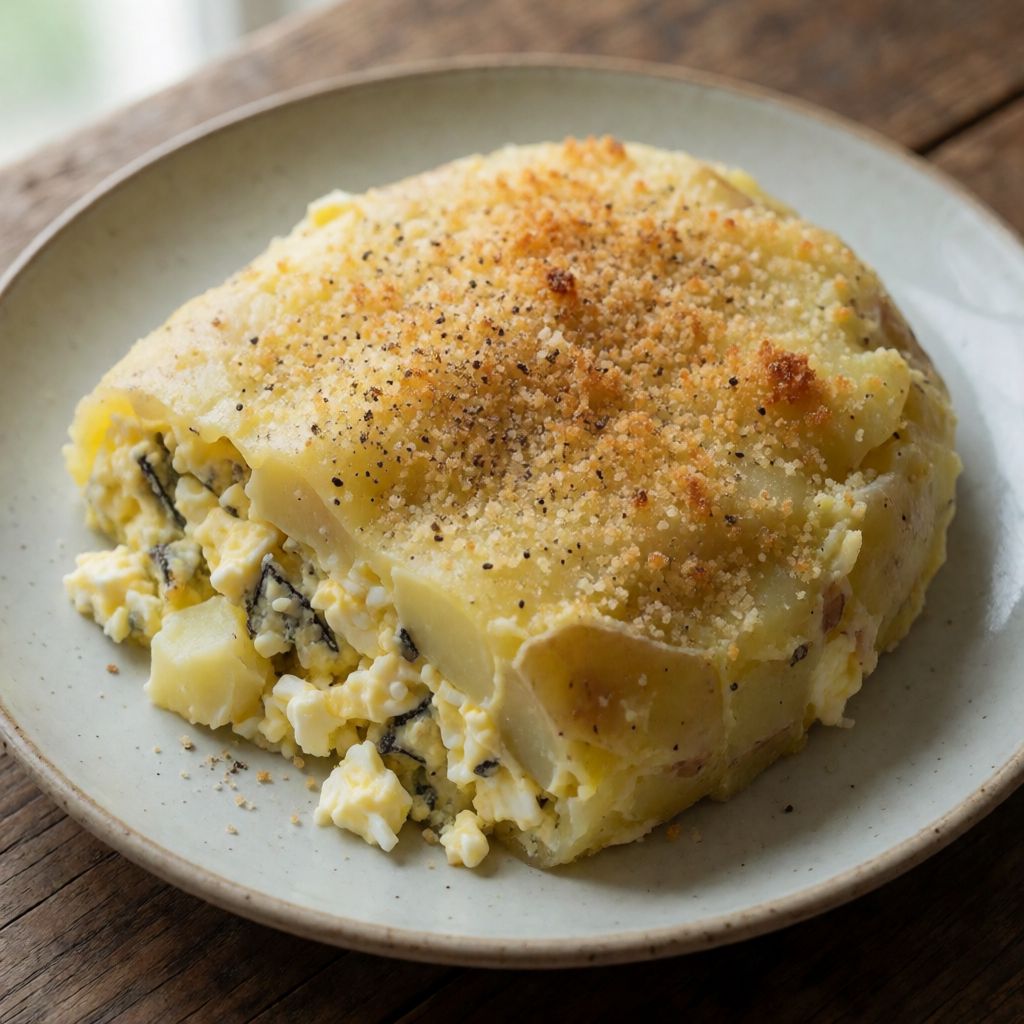
Baked Potato Roll with a Stretchy Filling
A baked potato roll filled with melted ham and cheese, served as a comforting side dish.
Labels are worked out automatically from the ingredients and can be wrong. Check the packaging if it matters to you.
Ingredients
- 700 g Cooked potato
- 2 pcs Eggs
- 100 g Parmesan
- 40 g Breadcrumbs
- Salt to taste
- Black pepper to taste
- Olive oil to taste
- Ham to taste
- Mozzarella or provolone, scamorza or mature Cheddar, to taste







Steps
Boil the potatoes in lightly salted water.
30 minPeel the potatoes and mash them into a smooth purée.
Add the eggs, salt, pepper, Parmesan and breadcrumbs, and mix until smooth.
Line a baking tray with parchment paper and dust it with breadcrumbs.
Spread the potato mixture into an even rectangular layer.
Lay the ham and mozzarella over the potato layer.
Roll it up using the parchment paper and seal the ends.
Drizzle the roll with olive oil and bake in an oven preheated to 180°C.
28 min
What was changed
The cheese was swapped for Mozzarella, since the original is rarely found in UK shops.
This is not a potato bake — it is a roulade. You are asking cold mashed potato to behave like a sheet of dough: to take a filling, to roll around it without splitting, and to hold that shape once it comes out of the oven. The egg, the Parmesan and the breadcrumbs are not seasoning here — they are the structure. Leave any of them out and you have good mash, which is lovely on a plate and useless on a roll.
What decides whether it works is how dry the mash is before you touch the parchment. The mash your nan makes for a Sunday roast — loosened with butter and a splash of milk until it's soft and a bit slack — is exactly wrong for this. Wet mash tears when you roll it and weeps when you bake it. This mash has to be stiffer: potato, egg, cheese, crumb, and nothing added to soften it further. Some say you need a potato ricer to get it smooth enough — no, a fork and a bit of elbow work does it, smoothness isn't the issue, dryness is.
The oven's 180°C has two jobs happening in the same few centimetres of roll: the ham-and-cheese centre has to go properly molten and stretchy, and the thin potato skin around it has to firm into something you can slice without it collapsing. Too fierce an oven colours the outside before the inside has caught up; too gentle and the centre stays stubbornly short of melted no matter how long you leave it in. Watch the surface, not the clock — pale gold going slightly crackled at the seam is your cue, and the seam itself matters: seal it badly and the cheese finds that gap exactly where it's weakest, and leaks instead of stretching.
The potato itself decides more than people think. You want a floury variety — Maris Piper or King Edward are the obvious ones in a British kitchen — because a floury potato breaks down into dry, separate starch cells that mash into something you can actually dry out further with egg and crumb. A waxy one, Jersey Royals or a salad potato, holds onto its water stubbornly and no amount of breadcrumbs will fully fix that; you'll be fighting a wet mash from the start.
The eggs bind the mash into something that sets rather than just sitting there loose, the way a custard sets rather than staying cream. But add them to hot mash and you don't get a smooth binder — you get little scrambled threads running through the purée, because the egg started cooking the moment it touched the heat. So let the potato cool a bit before you mix it in; that's the whole trick, no equipment needed, just a few minutes of not rushing.
Parmesan here isn't doing what the mozzarella does later — it's not meant to melt and stretch, it's meant to salt the mash and firm it slightly while it bakes, the way a hard aged cheese always behaves under heat rather than going liquid. Any hard, aged grating cheese works on the same principle — Grana Padano, pecorino, even a very mature Cheddar grated fine. The breadcrumbs do two separate jobs: inside the mix, they soak up spare moisture so the roll holds its shape; on the tray, dusted under the parchment, they stop the underside sweating into a soggy patch while it bakes, which is the usual reason a potato bake ends up wet-bottomed. Stale bread crumbed at home does the same thing — no need for the bagged kind.
For the ham, the criterion is low moisture and thin slices — a wet or thick-cut meat just adds more liquid to a roll that's already fighting liquid. Cooked ham, prosciutto cotto, or honestly leftover sliced gammon from a roast dinner all meet that criterion; this is, after all, the kind of dish built to use up a Sunday's leftovers, which is most of why rolled, stuffed potato dishes like this exist at all — cheap starch stretched around whatever cured meat and cheese was already in the fridge.
The cheese inside is chosen on one rule: it has to melt long and pull into strands rather than splitting into a puddle of oil and water. Mozzarella does that cleanly; provolone, scamorza and a good mature Cheddar all do it too, each with a different sharpness, so pick by what you fancy eating rather than by rarity. The olive oil at the end isn't for flavour so much as for the skin — any oil with no smell of its own helps the surface colour and crisp slightly rather than steam in its own moisture; a flavourless vegetable oil does the same job if that's what's open in the cupboard. One roll from 700g of potato feeds six as a side — thin slices, since this is rich enough that nobody needs a thick one.