
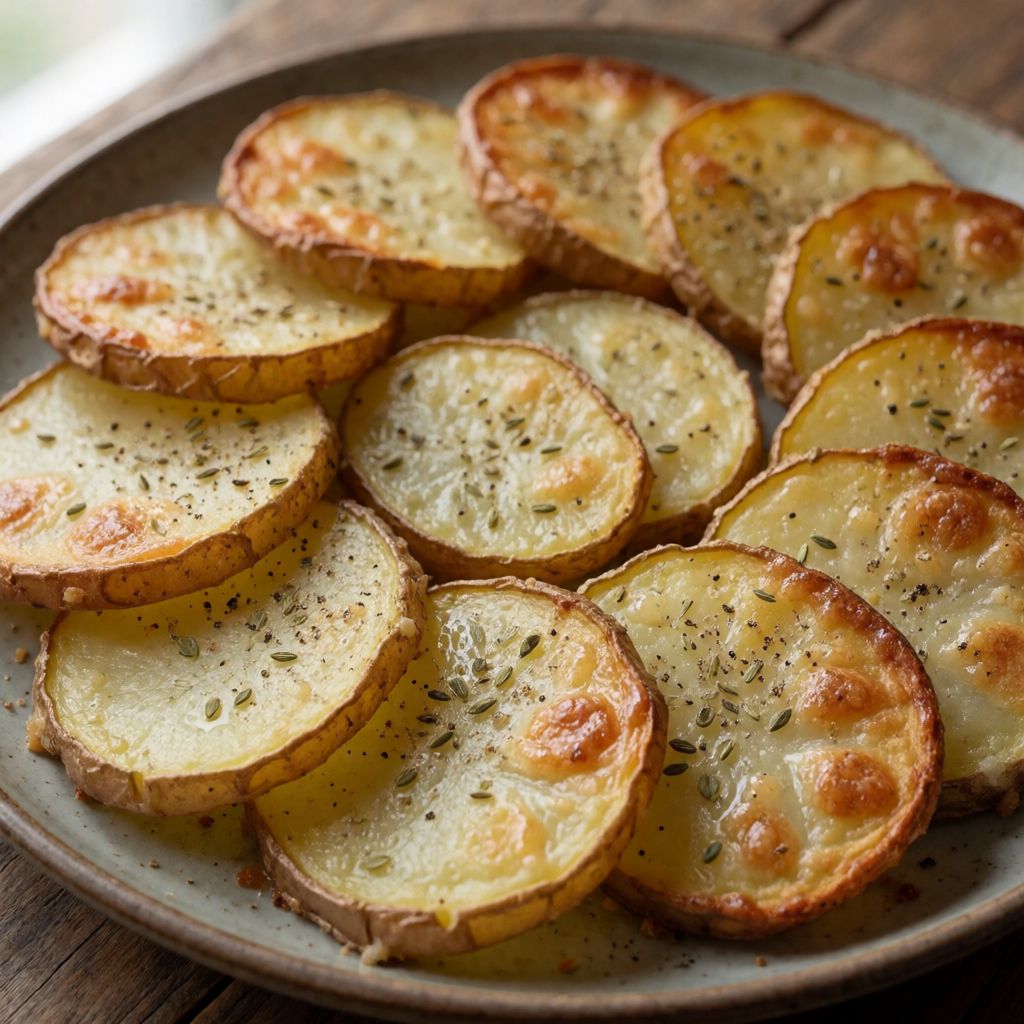
 AI photo
Baked Potato Slices
Thin potato slices baked with olive oil, parmesan and oregano until golden and tender.
Labels are worked out automatically from the ingredients and can be wrong. Check the packaging if it matters to you.
Ingredients







Steps
Peel the potatoes and cut them into thin slices using a knife, a mandoline or a food processor.
Place the potato slices in a large bowl with the olive oil, parmesan, oregano, salt and pepper. Mix well.
Grease a heatproof baking dish with the butter and carefully arrange the potato slices in a neat pattern.
Bake in a preheated fan oven at 180°C for 60 minutes.
60 minCover with a heatproof plate if the slices are browning too quickly before becoming tender.
What was changed
The oven temperature was rounded to the nearest UK setting .
This is potato cooked in its own starch, not boiled first and not drowned in cream — just thin raw slices, oil, parmesan and oregano, going into a hot oven for an hour and coming out somewhere between a gratin and a crisp bake. No stock, no béchamel. The potato has to make its own glue, and the only way it does that is slowly.
What decides whether it works is thickness, and it has to be uniform, not just thin. A knife gives you roughly even slices if your hand is steady; a mandoline or the slicing disc on a food processor gives you consistency without the steadiness. In an hour at 180°C fan, heat only gets so far into a potato. A slice that's twice as thick as its neighbour is still raw in the middle while the thin ones around it have gone past tender into crisp. Uneven slicing is the real cause of a dish that's crunchy at the edges and chalky in the centre — people blame the oven, but the knife did it.
Some say raw potato has to be parboiled before it goes in the oven, or it won't cook through. No — because an hour of steady, moderate oven heat does the same job boiling does, breaking down the starch and softening the cell walls, except it does it inside the dish instead of down the sink. That starch stays where it's useful: binding slice to slice, soaking up the oil and cheese, thickening instead of washing away. Skip the boil. That's the whole point of baking it raw.
Start with the potato itself. You want a floury, starchy variety — Maris Piper or King Edward do the job well, Desiree at a push — not a waxy one like Charlotte or Jersey Royals. The reason is chemical, not snobbery: starchy potatoes break down and release their starch into the dish as they cook, and that starch is what glues the slices and the cheese and the oil into one cohesive bake. A waxy potato holds its shape and stays separate from its neighbours — fine for a potato salad, wrong here, because the slices will just sit next to each other rather than becoming a dish.
Olive oil is doing two jobs: carrying heat evenly to every surface of every slice, and stopping the potato and cheese welding themselves to the dish rather than to each other. The criterion for the oil is simple — no strong smell of its own, because at 180°C it isn't there to be tasted, it's there to work. Rapeseed oil or a mild sunflower oil will do exactly the same job if that's what's in the cupboard; save the good peppery extra virgin for drizzling after, not for this.
Parmesan goes into the mixing bowl with everything else, not scattered only on top, for a reason: mixed through, every slice gets a little crust-forming cheese on it, not just the lucky top layer. Grate it finely — coarse shards melt into separate little pools of fat rather than into a web that holds the slices together. If you haven't got parmesan, any hard, aged cheese that melts into crumbs rather than a slick will do — grana padano is the obvious stand-in, and a mature cheddar, grated fine, gets you most of the way there with a flavour that's more at home on a Sunday table anyway.
Oregano here is dried, and that's deliberate, not a shortcut. Fresh oregano is mostly water with a little oil in the leaf; dried has lost the water and concentrated the oil, and a dry oven heat over an hour draws that oil out slowly rather than boiling it off in the first five minutes the way it would with fresh herbs in a sauce. Thyme does the same job if that's what's in the rack.
The teaspoon of butter greasing the dish isn't just there to stop sticking — oil could do that. Butter browns the surface it touches a shade further than oil does, and the bottom layer of slices, the one hidden from the oven's direct heat, needs any help it can get to pick up some colour and flavour of its own.
Last thing — the plate. A proper gratin dish comes with a lid; most kitchens don't have one that fits an oven dish, so an upturned heatproof plate stands in for it. All it does is block direct radiant heat from the top layer, slowing the browning without slowing the cooking underneath — useful if your oven runs hot or your dish is shallow and the top is colouring before the centre has had its hour. Doneness isn't the timer; it's a knife going through the centre slice without resistance. The hour is the least amount of patience this dish asks for, not the most.