
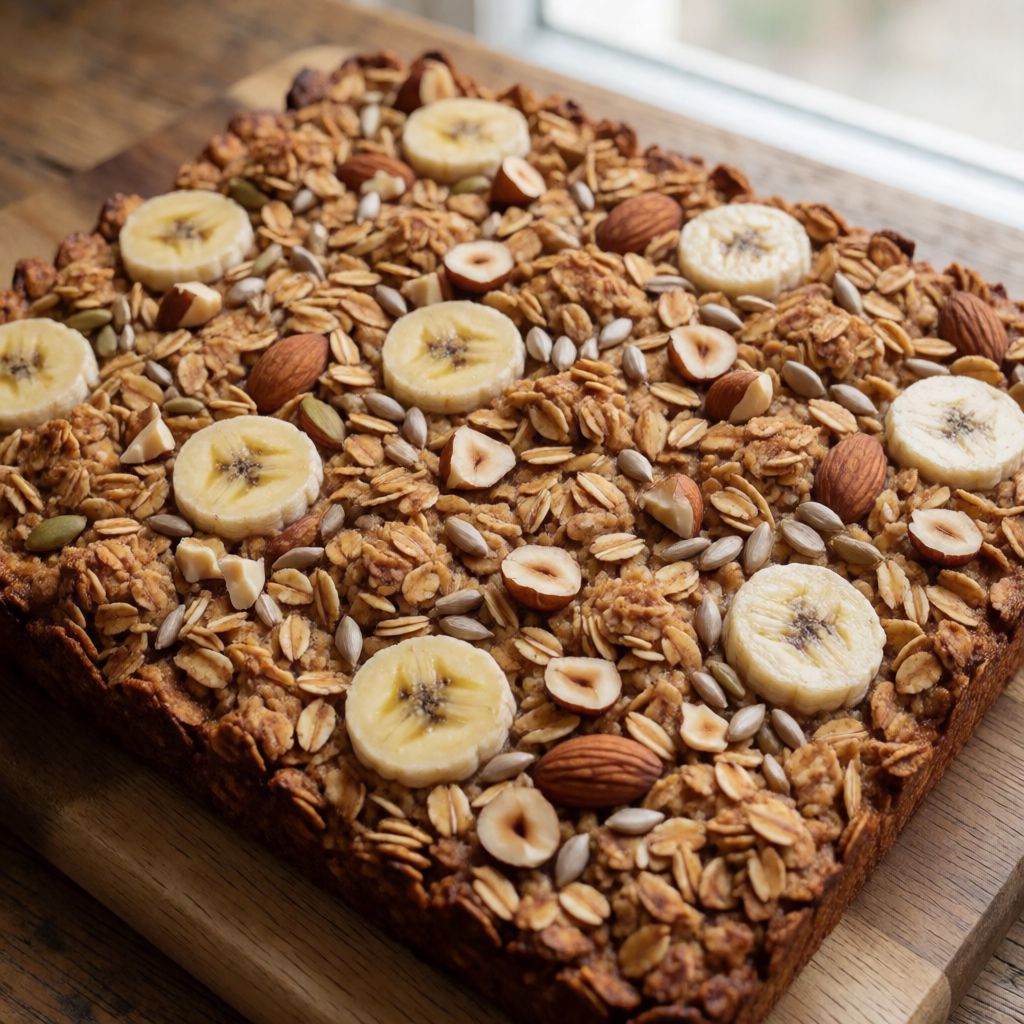
 AI photo
Banana Granola
A simple homemade banana granola with nuts, seeds and maple syrup, baked until golden and crunchy.
Labels are worked out automatically from the ingredients and can be wrong. Check the packaging if it matters to you.
Ingredients
- 2 pcs Banana ripe
- 25 g Butter
- 150 g Porridge oats
- 75 g Hazelnuts roughly chopped
- 75 g Almonds roughly chopped
- 50 g Sunflower seeds
- 25 g Maple syrup
- 1 tbsp Cinnamon
- 0.5 tsp Vanilla powder
- 0.5 tsp Salt




Steps
Mash the bananas with the butter using a fork until you get a smooth, even banana purée.
Mix the banana purée with the remaining ingredients and spread onto a baking tray lined with baking parchment.
Bake in a fan oven preheated to 150°C for about 30-45 minutes, until the granola is golden and crunchy, stirring a few times during baking.
38 minLet the granola cool, then transfer it into a jar.
This is not really granola in the shop-bought sense — it's oats held together by banana instead of the usual oil-and-sugar syrup. Mash ripe banana with butter and you get something sticky and fatty enough to coat every oat flake and nut piece, which is exactly what syrup does in a commercial recipe, just cheaper and without the squeeze bottle. The banana brings its own sugar; the butter brings the fat that lets things brown instead of just drying out.
What decides whether this works is the banana's ripeness. A green or barely-yellow banana has starch, not sugar — mash it and you get paste, not glue, and the oats will come out of the oven pale and sandy no matter how long you leave them. You want the kind of banana with brown speckles, soft enough to squash with a fork without a fight. That's not a shame to use — it's the whole point. Overripe bananas are usually heading for the bin; this is where they're worth more than a firm one.
Some say granola has to come out of the oven already crunchy, and if it doesn't, something went wrong. No — because the crunch sets as it cools. Hot sugar is soft sugar; it only hardens once the moisture it was holding has a chance to leave and the caramel stiffens on the tray. Pull it too early thinking it needs more oven and you risk burning the edges while the middle is still soft. Give it the cooling time and judge it then, not straight out of the heat.
Banana: two, ripe to the point of speckling, mashed with a fork — not because a fork is traditional, but because a food processor would turn it to liquid and you'd lose the texture that helps it cling to the oats rather than just soak into them. If you don't have a banana ripe enough, don't force it — a tablespoon more maple syrup will patch the sugar gap, though you lose some of the flavour the banana actually brings.
Butter: 25 grams, melted into the mash, there to brown and to crisp. Any fat that's solid at room temperature and has no strong smell of its own will do the same job — coconut oil is the obvious stand-in if you want this dairy-free, though it carries its own faint sweetness, which isn't a flaw here. Don't reach for a liquid oil instead; it won't coat the oats the same way the mash does, it'll just pool at the bottom of the tray.
Oats: 150 grams, and it has to be porridge oats — the whole or lightly rolled kind — not quick or instant oats, which are already broken down to cook fast in hot water and will simply turn to crumb in the oven, giving you banana-flavoured dust instead of granola. The oat's job here is structural: it has to survive thirty-odd minutes of heat and come out as a flake you can still see.
Hazelnuts, almonds, sunflower seeds: three different textures and three different reasons to eat the same spoonful twice. Roughly chopped nuts matter for the same reason whole oats matter — fine crumbs burn before the centre of the tray even smells toasted. Any raw, unsalted nut you have works on the same logic; pumpkin seeds will do what sunflower seeds do here, which is add crunch without competing for attention.
Maple syrup, cinnamon, vanilla, salt: the syrup is a second, smaller dose of sugar and stickiness, backing up the banana rather than replacing it — honey will do the same job but burns faster, so watch the tray a little sooner if you swap it in. A full tablespoon of cinnamon looks like a lot on paper, and it is meant to; oats and nuts are bland on their own, and this is what gives the whole jar a flavour you can place with your eyes closed. The salt isn't seasoning in the savoury sense — it's there to stop all that sugar tasting flat. Leave it out and the granola will taste sweet in a dull, one-note way, even though nothing else has changed.
Granola itself has a fairly unglamorous history — it was invented as a cheap, shelf-stable health food, oats and nuts baked hard enough to survive weeks in a jar. The oil-and-syrup version most people know is the industrial answer to binding large batches fast. This banana version is the domestic answer to the same problem: use what's about to go to waste, cut down on how much sugar and fat actually goes in, and still end up with something that keeps in a jar for your tea-and-cereal mornings rather than a Sunday-only treat. Twelve servings means you're not making breakfast once — you're stocking it, the same way you'd batch-cook for the week rather than cook from scratch every morning.