
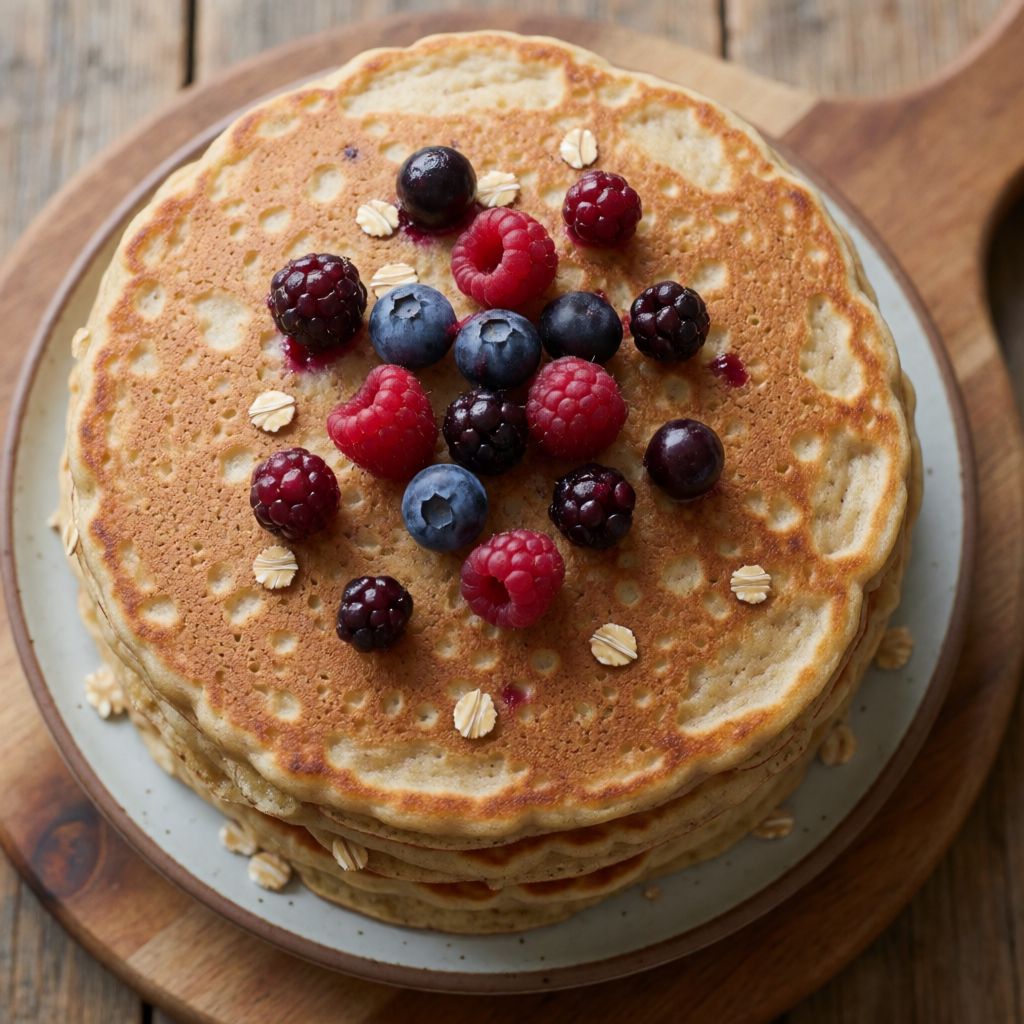
 AI photo
Banana Pancakes with Berries
Soft banana pancakes with oats, warm spices, Greek yogurt and fresh berries.
Labels are worked out automatically from the ingredients and can be wrong. Check the packaging if it matters to you.
Ingredients
- 2 pcs Banana ripe
- 3 pcs Eggs
- 30 g Oats finely rolled
- 60 g Wholemeal flour wholemeal
- 0.5 tsp Baking powder
- 0.5 tsp Cardamom ground
- 0.5 tsp Vanilla sugar
- 1 pinch Salt
- 1 tbsp Butter
- 100 ml Greek yogurt 10%
- 100 g Strawberries
- 75 g Blueberries
- 4 pcs Mint fresh sprig






Steps
Mash the bananas with a fork and whisk together with the eggs. In a bowl, mix the oats, wholemeal flour, baking powder, spices and salt, then stir this into the banana mixture.
Heat a frying pan over medium heat and add a knob of butter.
Spoon the batter into the pan in small portions and fry the pancakes for 2-3 minutes on one side.
3 minFlip the pancakes once golden and fry on the other side.
Serve on plates or a platter with Greek yogurt, fresh berries and mint.
This is a pancake that doesn't need sugar because the ripeness of the banana does the sweetening, and it doesn't need much flour because the egg and the mashed fruit are already a kind of glue. What decides whether it works is how ripe your bananas are. A green-tipped banana gives you starch, not sugar — it fries pale and tastes of nothing. You want the skin freckled, almost embarrassing to put in a fruit bowl. That's when the starch has turned to sugar and the flesh mashes to a paste instead of a lump, which is what lets it bind the eggs into something you can actually spoon.
The second thing that decides it is restraint with the pan. Some say you can tell a pancake's cooked by counting to three minutes and flipping. No — you flip when the edges have gone matte and little bubbles stop rising through the batter, because that's the sign the egg underneath has set enough to hold its own weight. Flip too early, on a timer alone, and the top layer tears away and sticks to the pan — not because your pan is bad, but because raw egg is glue and cooked egg isn't.
These are thick, cakey discs, closer to a drop scone than a crêpe, because there's no milk loosening the batter — only egg and mashed banana. That means they spread less and need slightly longer, gentler heat than a thin batter would. A hob turned up high just burns the outside while the inside stays wet; this is a dish that rewards an unhurried cook more than a skilled one.
Bananas: this is the engine of the recipe, not a flavouring. As a banana ripens, enzymes break its starch down into fructose, glucose and sucrose — which is why an underripe one tastes starchy and chalky, and an overripe one tastes almost like it's been candied. For this batter you want the second kind: soft enough to mash with a fork with no resistance, skin well spotted. If yours are still firm, don't force them in — you'll end up compensating with more sugar and still get a gluey texture, because unripe banana doesn't break down into a smooth paste, it stays lumpy and starchy under heat.
Eggs do two jobs here: they're the only liquid in the batter (there's no milk) and they're what sets the pancake from a wet mash into something that holds together when flipped. This is why the flip matters more than the clock — egg protein coagulates with heat, and until it has, the pancake is structurally just warm banana mush with a coating of char. Three eggs for two bananas is a fairly rich ratio; if you only have two eggs, the pancakes will be a touch softer and more fragile to flip, not a disaster, just handle them gently.
Oats and wholemeal flour are doing different things. The oats add bulk and a slight chew without much gluten, so they soak up moisture from the banana rather than fighting it. The wholemeal flour brings a little gluten, enough to give the pancake structure once cooked, and a nuttier taste than white flour would. If you've only got plain white flour, use it — you lose a bit of flavour and fibre, not function. If you've no oats at all, more flour will do, though the texture turns slightly denser, less porridge-like.
Baking powder is there because this batter, unlike a yeasted dough, has no time to rise on its own — you're cooking it minutes after mixing. It gives you lift through a chemical reaction rather than fermentation, which is the only option when patience for proving isn't built into the recipe. Cardamom and vanilla sugar are perfume, not structure: use them because banana on its own, cooked, can taste a little flat and one-dimensional, and warmth from a spice lifts it the way cinnamon would in a British kitchen, though cardamom reads cleaner, less like a bake-sale.
Butter in the pan isn't just for not-sticking — a bare pan on a domestic hob, without a kazan's even heat, will scorch a sugar-rich batter like this before it sets through. The fat spreads the heat and browns the surface gently instead of blistering it. Any neutral fat with no smell of its own will do the practical job — a flavourless vegetable oil, for instance — but butter also browns and adds a savoury note that plain oil can't, so unless you're avoiding dairy, don't swap it lightly.
Greek yogurt, strawberries, blueberries and mint are the finish, and none of them are negotiable the way the batter ingredients are, because they're correcting a flaw rather than building one. Banana pancakes without something sour and bright taste heavy and samey after two bites — the yogurt's acidity and the berries' tartness are what stop the plate becoming one long note of sweetness. If strawberries and blueberries aren't in season or in budget, any berry with real acidity will do the same job — raspberries, blackberries, even stewed rhubarb if you want to go properly British about it. Mint is cheap theatre with a genuine use: it cuts through the richness on the nose before it even reaches your tongue.