
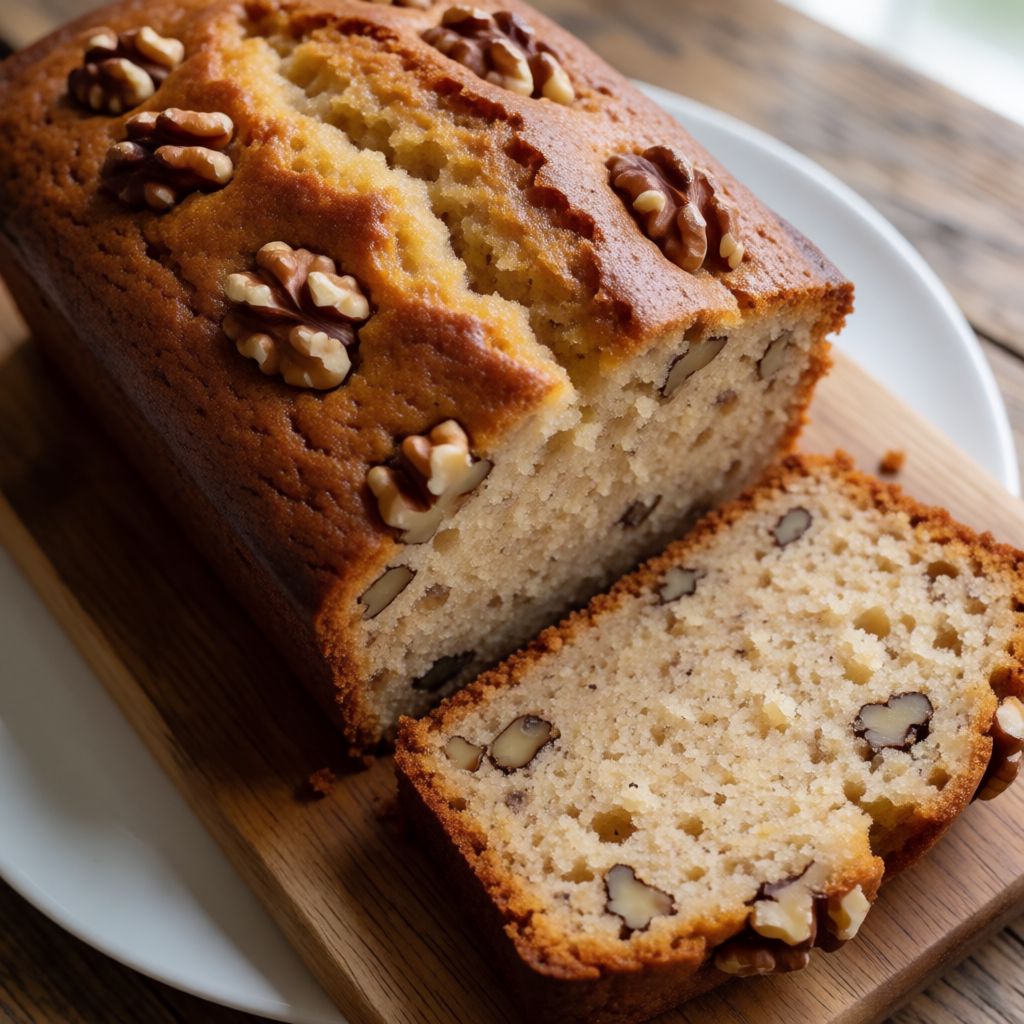
 AI photo
Banana Cake
A moist banana cake studded with walnuts and finished with melted milk chocolate.
Labels are worked out automatically from the ingredients and can be wrong. Check the packaging if it matters to you.
Ingredients
- 150 g Butter softened, at room temperature
- 175 g Caster sugar
- 1 tsp Vanilla extract
- 4 pcs Eggs
- 5 pcs Banana very ripe
- 40 g Walnuts chopped
- 175 g Plain flour
- 1 tsp Baking powder
- 1 pinch Salt
- 50 g Milk chocolate finely chopped
- 40 g Walnuts finely chopped








Steps
Cream the butter, sugar and vanilla extract until light and fluffy. Beat in the eggs one at a time, continuing to whisk.
Mash the bananas with a fork and fold them into the batter along with the walnuts.
Mix the flour, baking powder and salt, sift into the batter and stir until smooth.
Line the base of a 20cm springform tin with baking parchment, grease the sides with butter and pour in the batter. Bake in a preheated fan oven at 175°C for 45-50 minutes.
48 minCool the cake on a wire rack. Scatter the chocolate over the hot cake so it melts directly onto it, then sprinkle with walnuts.
What was changed
Vanilla extract was swapped in, as vanilla sugar is not commonly sold in UK shops.
This isn't a sponge dressed up as banana bread — it's the other way round. The banana isn't flavouring here, it's structure: five very ripe bananas bring enough moisture and natural sugar that the cake stays dense and damp for days, the way a proper teatime cake should, not dry out by Tuesday like a fridge-forgotten Victoria sponge.
Three things decide whether it rises evenly or sulks in the middle. First, the butter has to be soft enough to take air — press your thumb in and it should give, no resistance, no oil pooling. Second, the eggs go in one at a time because butter and egg are an emulsion fighting each other: fat wants to stay fat, egg-water wants to stay water, and dumping all four in at once overwhelms the mixture before it's had the chance to hold them. You'll see it split — a curdled, grainy batter — before you taste it going wrong. Third, doneness is not a stopwatch question. A skewer in the centre coming out clean, the top springing back under a light finger press, the edges just pulling from the tin — that's your answer, and 45-50 minutes is only where to start checking, not where to stop paying attention.
Some say a banana still has a trace of green in it should be binned for baking. No — the opposite. The riper it looks to a greengrocer, the better it is to a baker: the starch has converted to sugar, the flesh has gone soft and intensely sweet, and a banana you'd never eat out of hand is exactly the one you want mashed into this batter. Black-speckled skin is not decay here, it's readiness.
Butter is the air-carrier, not the fat for fat's sake. Creaming works because sugar crystals, dragged through soft fat by a whisk or wooden spoon, cut thousands of tiny pockets into it — and those pockets are what the baking powder later inflates in the oven. Melt the butter to save time and you lose that structure entirely; a melted-butter cake is a different, flatter animal. Any dairy fat that creams will do — a British baking margarine will cream faster, actually, because it's softer at room temperature, but it brings more water and less flavour, so the cake tastes thinner for it.
Caster sugar is chosen because the crystals are small enough to dissolve into the butter without leaving grit — you want the mixture to turn pale and fluffy, not stay yellow and heavy. Granulated will work, it just needs longer at the creaming stage and more patience than most people give it standing at a worktop on a Sunday morning with the roast already needing attention in the other oven.
Eggs do double duty — they're part of the emulsion that holds fat and sugar together, and they're the main source of structure once the oven's heat sets the proteins. Beating them in one at a time, fully absorbed before the next, is what prevents the batter from splitting; a split batter still bakes, but it bakes heavier, with less lift, because you've lost some of the air you worked to put in.
Flour and baking powder are sifted together not for ceremony but so the baking powder — which only works evenly if it's evenly distributed — doesn't clump in one corner of the tin and leave you with a lopsided rise. Plain flour here, not self-raising, because the recipe wants to control its own leavening rather than borrow someone else's calculation of how much.
Walnuts appear twice doing two different jobs. The 40g chopped into the batter break up as they bake, going slightly soft, adding bite without taking over a mouthful. The 40g finely chopped on top stay raw and crunchy, a textural contrast to the melted chocolate sitting next to them. If walnuts aren't to hand, pecans do the same job with a milder flavour; avoid anything very oily like macadamia, which will turn soft and lose its point entirely.
Milk chocolate for scattering should be real chocolate with cocoa butter in it, not a compound bar — compound chocolate (the kind that doesn't need tempering) goes dull and waxy rather than glossy when it melts, because it's made with vegetable fat instead of cocoa butter, and vegetable fat doesn't set the same way once it cools back down. Dark chocolate works too if you want the sweetness cut back a notch.
On the tin: line the base only, grease the sides only. This isn't fussiness — the batter needs to grip the bare, buttered sides a little as it climbs in the oven, the same reason you don't flour a soufflé dish right to the rim. Parchment under the base is purely so the finished cake lifts off cleanly, since that's the one surface that takes the most weight and the most risk of tearing on release. In a fan oven, which most UK kitchens have, air moves and cooks more evenly than a conventional oven, which is why 175°C is stated as the fan figure rather than the higher number you'd use without a fan — don't add 20 degrees on top of what's already written, that's solving a problem the oven doesn't have. Cool it on a wire rack, not on a plate, so the steam coming off the base has somewhere to go instead of condensing back into the sponge and softening the bottom into something closer to pudding than cake.