
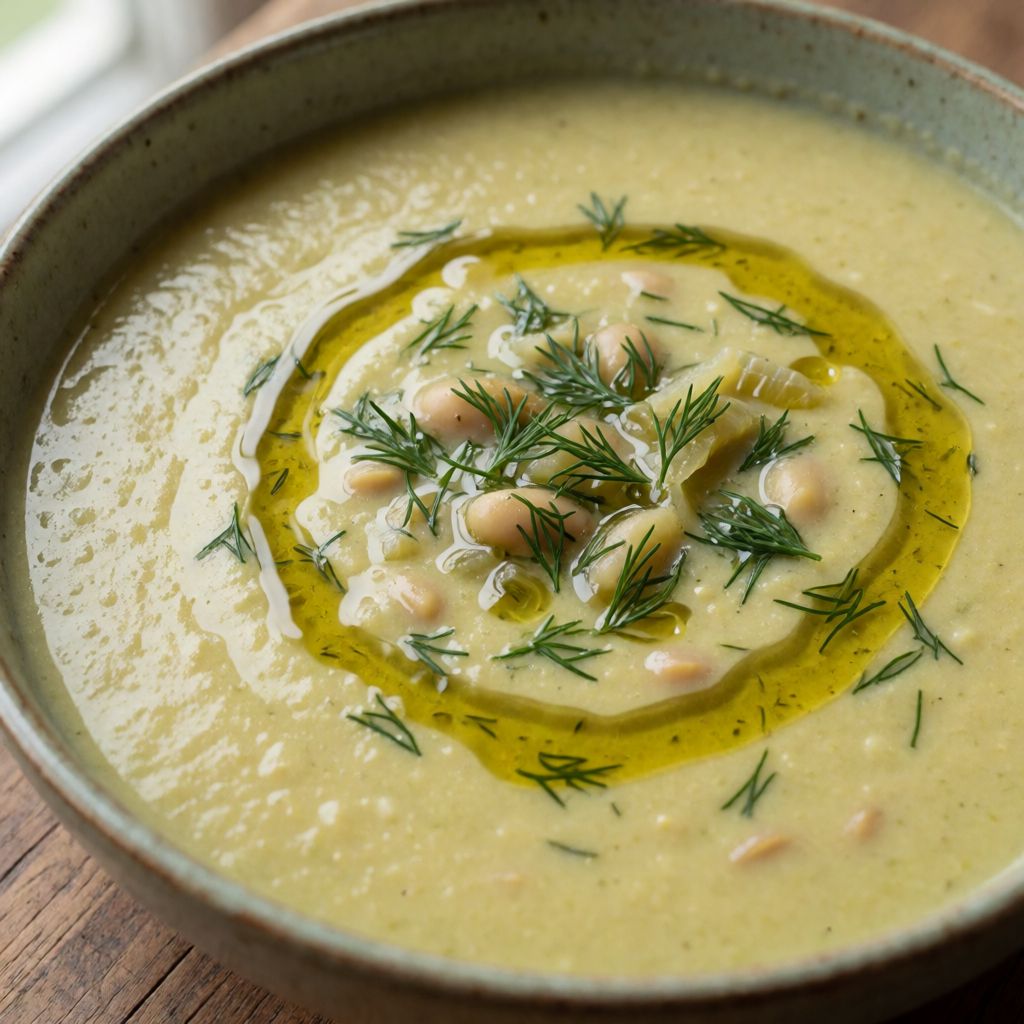
 AI photo
Broad Bean Macco: A Velvety, Aromatic Soup
A creamy Italian-style broad bean soup, slowly simmered with fennel and olive oil until velvety smooth.
Labels are worked out automatically from the ingredients and can be wrong. Check the packaging if it matters to you.
Ingredients
- 1.5 kg Fresh broad beans shelled
- 1 pcs Onion
- 1 bunch Fennel fronds the leafy tops from a bulb of fennel
- 1 tbsp Dill chopped, to echo the aniseed note of wild fennel
- 4 tbsp Olive oil
- Salt to taste
- Black pepper to taste
- 2 l Water








Steps
If using dried beans, soak them in plenty of water for 8–10 hours, then drain and rinse. If the beans are fresh, shell them.
Finely chop the onion and sauté it in olive oil over low heat until translucent.
Add the beans, fennel fronds and chopped dill, stir well, then pour in the water.
Bring to a gentle boil, then simmer covered over low heat for about 2 hours.
120 minStir occasionally during cooking and top up with hot water if needed.
Mash the cooked beans with a wooden spoon or blend partially for a velvety texture.
Finish with a drizzle of good extra virgin olive oil, salt and freshly ground black pepper.
Optionally add chilli oil, a pinch of chilli flakes or diced cherry tomatoes.
Serve hot with croutons or toasted bread, drizzled with olive oil.
What was changed
Wild fennel isn't sold here, so Dill is added with fennel fronds to keep the same herbal note.
Macco isn't a soup with beans in it — it's beans that happen to have water around them. Sicily made this during the broad bean season because it needed to feed people cheaply, and the way to feed many people on a kilo of beans is to cook them until they give up their shape and thicken the water into something you can eat with a spoon and a lot of bread. Bread, by the way, was never a garnish here. It was the calories the beans alone couldn't stretch to.
What decides whether this works is whether the beans actually collapse — not just soften, collapse — into that grainy, velvety mass the name promises. That's a function of a slow, low simmer held for a long time, not a rolling boil that finishes faster but leaves the skins tight and the inside chalky. Two hours is the floor, not the target. You know you're there when a bean pressed against the side of the pan smears rather than holds its shape, and the broth around it has gone thick enough to coat the spoon instead of running off it.
Some say you have to peel every broad bean before it goes in the pan. No — because two hours of gentle heat, followed by a pass with a wooden spoon, does that work for you, provided the beans are properly fresh. Peeling earns its keep only when the beans are old and the skins have toughened past what simmering can fix. Fresh ones surrender on their own.
And don't chase a perfectly smooth purée here — that's a different dish, a velouté, made with a blender and cream logic. Macco wants some texture left, a few beans that kept their nerve. Mash partially, taste, stop before it goes uniform.
Start with the beans, because the whole dish is really an argument about them. 1.5 kg shelled means you'll be shelling something closer to 4 kg in the pod — the economics of this recipe sit in the podding, not the shopping bill. Fresh broad beans in the UK have a short window, roughly June into August; outside it, frozen podded beans are a fair substitute and need no soaking at all, they're already blanched soft. Dried beans are a different animal: their skins have hardened over months of storage, and if you throw them straight into the pot without the 8–10 hour soak, you get a bean that's mushy on the outside and stony in the middle by the time two hours is up — the soak isn't tradition for its own sake, it's rehydrating the skin so heat can actually reach the centre before the outside falls apart.
The onion goes in on low heat until translucent, and that word matters more than it looks. Translucent means the cell walls have softened and released their water — no browning, no caramel sugars. Push it further, to gold or beyond, and you introduce a sweetness and a bitterness at the edges that has no business sitting next to the plain, mild flavour of broad beans. For the oil here, any fat with no smell of its own does the job during cooking — a light sunflower or a mild olive oil, saving your good extra virgin for the finish, where its smell is actually the point.
Fennel fronds and dill are doing the same job from two directions. Wild fennel, the kind this dish grew up with in Sicily, has a much sharper aniseed note than the fronds off a cultivated fennel bulb you'll find in a UK supermarket — which is why the dill is there, to push the aroma back up to where the dish expects it. If you've got neither, a small pinch of fennel seed, lightly crushed, will do it — go easy, seeds are concentrated where fronds are not. Chervil is a fallback of last resort: no aniseed, but at least some green lift.
On water and salt — this is where UK kitchens vary more than people expect. Tap water hardness differs by region: hard in the south-east and London, soft in much of Scotland and Wales. Calcium in hard water binds to the pectin in bean skins and keeps them firmer for longer, so if your beans are stubbornly unyielding well past two hours, suspect your water before you suspect your beans. Salt is better added towards the end rather than at the start, simply to keep it from slowing the early breakdown of the skins. When you need to top up the liquid mid-simmer, use hot water, not cold — cold water knocks the pot's temperature back down and stalls the very process you've spent an hour building.
In an ordinary flat kitchen, forget the kazan — a wide, heavy-bottomed pan holds a gentler, more even simmer than anything round and deep. If you don't have a lid that fits, a plate sitting over the pan does the same work: keeping steam in without you fussing over it. And when it comes to serving, don't treat the croutons or toast as decoration on top of a finished soup — they're the second half of the dish, there because a bowl of mashed beans alone was never meant to be dinner, it was meant to be dinner stretched.