
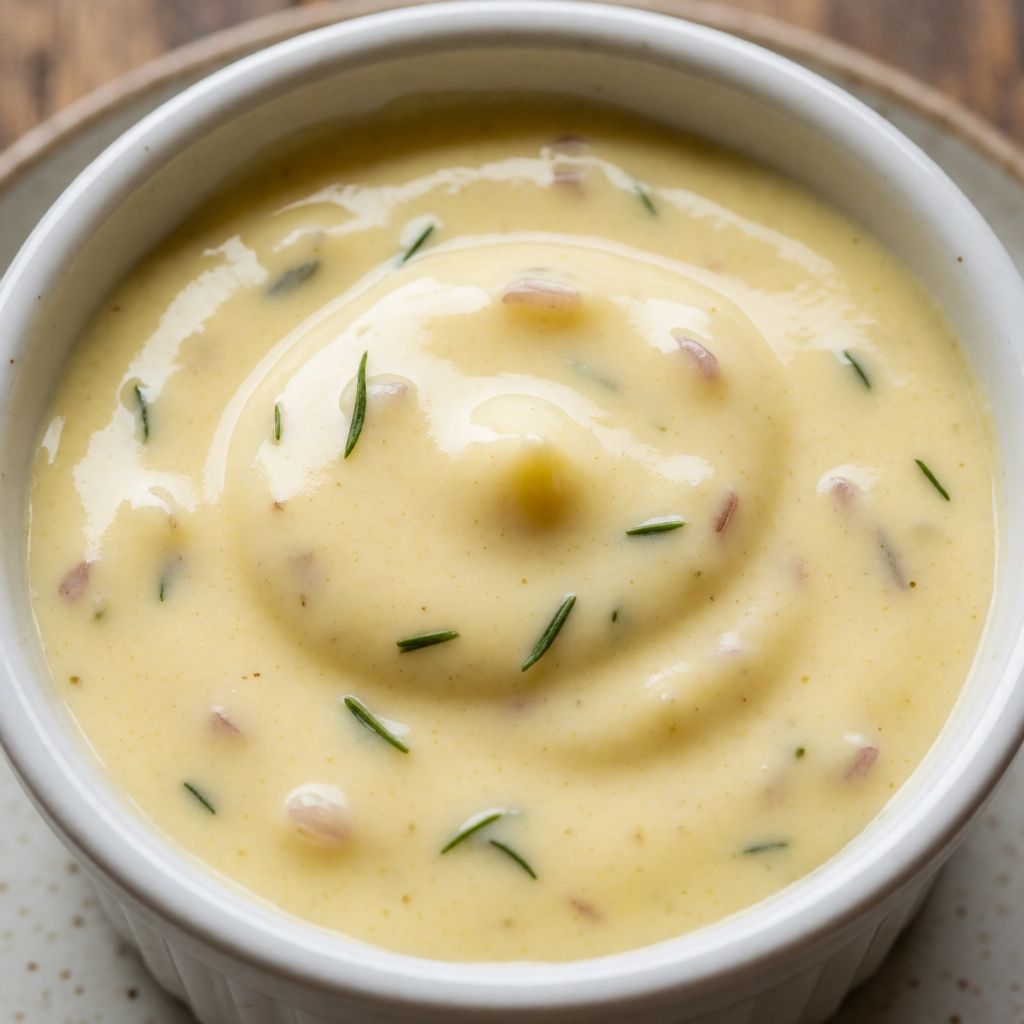
 AI photo
Béarnaise Sauce
A classic French butter and herb sauce flavoured with tarragon and shallots, lovely with steak or fish.
Labels are worked out automatically from the ingredients and can be wrong. Check the packaging if it matters to you.
Ingredients
- 250 g Butter
- 4 tbsp White wine vinegar
- 100 ml Water
- 2 pcs Shallots finely chopped
- 1 bunch Tarragon leaves and stalks, fresh
- 4 pcs Egg yolks
- 1 pcs Lemon about 1 tbsp juice
- to taste Salt
- to taste Black pepper freshly ground





Steps
Melt the butter over the lowest heat. Pour the clear butter into a jug and discard the white sediment.
5 minPut the tarragon stalks, vinegar, water, chopped shallots, salt and pepper in a saucepan. Bring to the boil and reduce to about 3–4 tablespoons.
10 minStrain the reduction. Pour it into a clean saucepan and set it over the lowest heat.
1 minAdd the egg yolks to the saucepan and whisk until they thicken.
3 minWhisk in the butter, 1 tablespoon at a time for the first 10 spoonfuls, then pour in the rest in a thin stream.
8 minSeason the béarnaise with lemon juice, salt, pepper and tarragon leaves before serving.
2 min
Béarnaise is hollandaise that went to the south-west of France and came back smelling of tarragon and shallots. Strip away the fancy name and you have one mechanism: egg yolk holding melted butter in suspension, the way it holds oil in mayonnaise, except here the butter is warm and the acid is a reduction instead of raw lemon. Everything that can go wrong does so at two exact moments — when the yolks thicken in step 4, and when the butter goes in in step 5 — and nowhere else.
The reduction is not decoration. Boiling vinegar, water, shallot and tarragon stalks down to three or four spoonfuls is how you get a whole bunch of herb and two shallots into a sauce that's mostly fat, without drowning it in liquid. Skip the reduction, add raw vinegar instead, and you get a thin, sour butter sauce that never holds together — because there's too much free water for the yolks to grip.
The moment people fear is "the sauce split." Some say béarnaise is simply temperamental, a diva that breaks for no reason — no, because it breaks for a very exact reason: the yolk proteins got too hot, seized solid before they could spread themselves thin around the butter, and you ended up with butter sitting on top of scrambled egg. Low heat in step 4 isn't caution for its own sake — it's the only thing standing between a glossy sauce and sweet omelette with butter on the side.
Butter: you clarify it because whole butter is roughly 80% fat and the rest water and milk solids. Those solids are what burn, what turn gritty, and what fight the egg's emulsion instead of joining it. Clarifying removes the sediment the recipe tells you to throw away — do throw it away, it's done its job of browning slightly and giving you that nutty smell, but it has no place in the finished sauce. If you keep ghee in the cupboard, which is clarified butter already, you can skip step 1 entirely.
Vinegar and water: this is the acid that makes the yolks set rather than just warm up, and the acidity that cuts the richness of all that butter later. "White wine vinegar" is a description of character, not a brand loyalty — any vinegar with a clean, light sourness and no flavour loud enough to shout over the tarragon will do. A dry white wine reduced the same way gives a softer, winier acidity if you'd rather.
Shallot: milder and sweeter than onion once it's simmered down, which is why French sauces lean on it instead. If you've only got a small onion, use less of it and expect a slightly rougher edge — not wrong, just blunter.
Tarragon, used twice and for two different reasons. The stalks go into the boiling reduction because their flavour is tougher and needs heat and time to give itself up — that's the backbone. The leaves go in at the very end, off the heat, because their anise-green smell is carried by oils that cook off fast; boil them and you lose exactly the thing tarragon is for. Fresh is worth hunting down — it isn't always on the shelf in a British greengrocer's, but most supermarkets now stock it in the herb section near the basil. Dried tarragon is a different, duller herb; use half the amount and add it earlier, with the stalks, since it needs the simmer to wake up at all. Chervil, if you're really stuck, gives a related but softer note.
Egg yolks: the emulsifier and the thickener in one. This is the whole sauce's spine — everything above exists to flavour and season what the yolk is doing mechanically, which is coating tiny droplets of butter and keeping them from finding each other and pooling. Four yolks for 250g of butter is a working ratio; don't be tempted to add a fifth for safety, more yolk just makes the sauce taste more of egg and less of tarragon.
Lemon: added right at the end, after all that butter, because its job is contrast, not cooking. The reduction already gave you deep, cooked acidity; lemon at the finish gives a bright, raw one on top of it, which is why it goes in last and never near heat. On a British gas hob, "lowest heat" in steps 3 to 5 often still runs hotter than French recipe-writers assume — don't be shy about lifting the pan off the flame for ten seconds if the yolks look like they're moving too fast, and setting it back down. You don't need a bain-marie set bought specially for this; a thick-bottomed saucepan and your own attention does the same job, as long as you treat patience as an ingredient and not an inconvenience. Nothing here fails from lack of skill — it fails from rushing the two minutes that actually matter.