
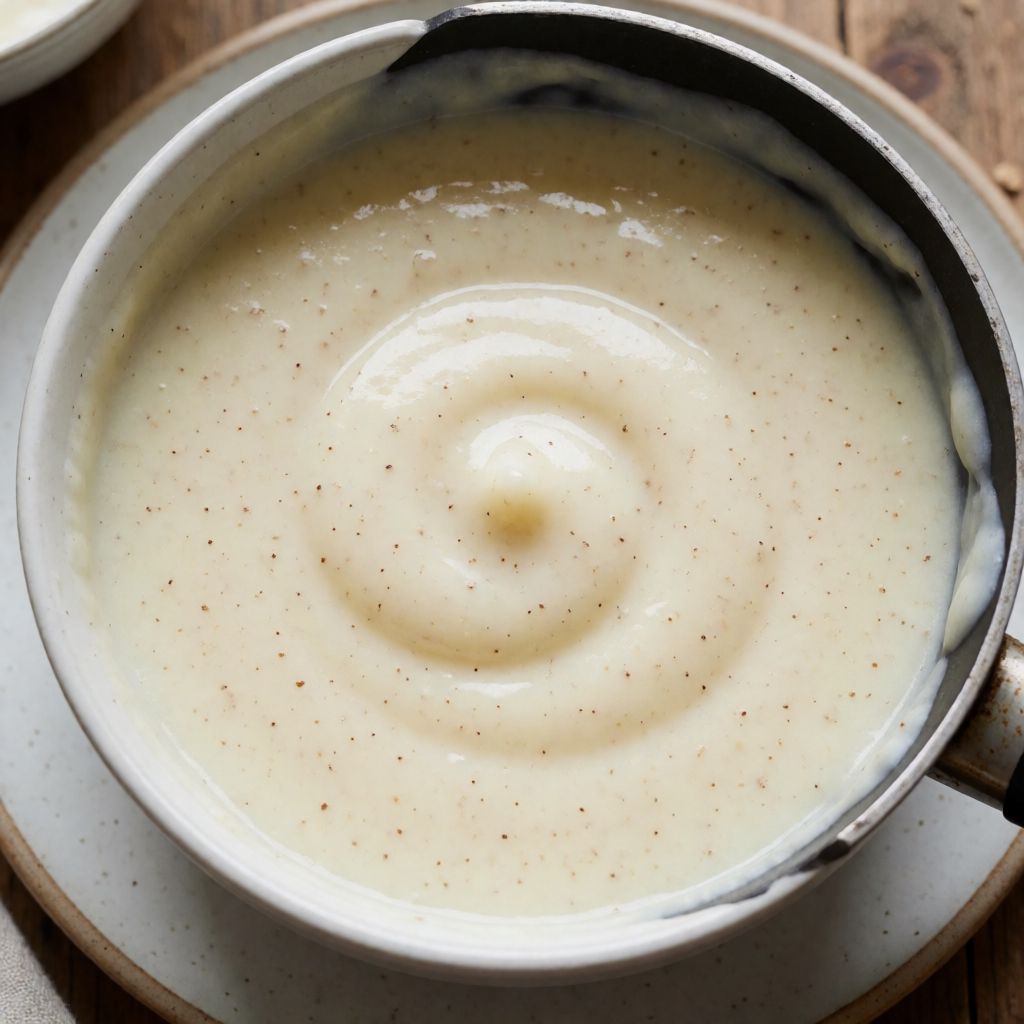
 AI photo
Dairy-Free Béchamel
A creamy béchamel sauce made without milk, perfect for dairy-free cooking.
Labels are worked out automatically from the ingredients and can be wrong. Check the packaging if it matters to you.
Ingredients
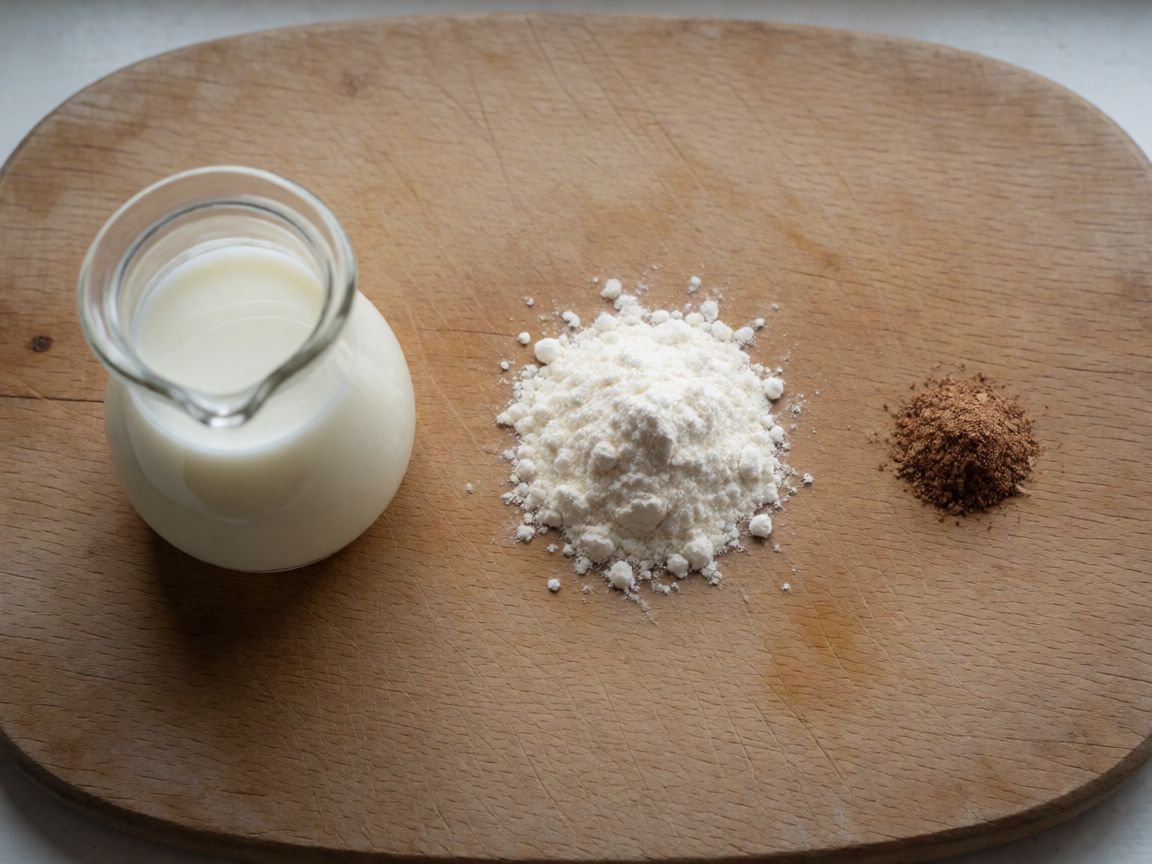
- 500 ml Soy Milk unsweetened and unflavoured
- 50 g Sunflower Oil
- 50 g Plain Flour
- pinch Salt to taste
- pinch Nutmeg to taste




Steps
Pour the soy milk into a saucepan. Make sure it is unsweetened and unflavoured. Season with a pinch of salt and generously grate in the nutmeg.
Place the saucepan over heat and bring the milk to the boil.
Pour the sunflower oil into a sauté pan. Heat the oil over low heat and gradually add the flour, sifting it in.
Whisk the mixture until smooth and creamy. Cook for 1-2 minutes, until lightly golden.
Pour in the hot soy milk in a thin stream, continuing to whisk the béchamel to avoid lumps.
Continue cooking for about 10 minutes, until the sauce is thick and rich.
10 minTransfer the béchamel to a bowl. Let it cool to room temperature, about 10 minutes. Cover with cling film pressed directly onto the sauce.
10 min
Béchamel isn't a sauce you season into existence — it's starch chemistry you manage. Flour cooked in fat first, hot liquid added after, whisked until the granules swell and lock the liquid into a paste. Get the order wrong and what you get isn't a cooking mistake, it's a chemistry one: cold liquid thrown at a hot roux, or a roux cooked unevenly, means some starch gelatinises before it's properly suspended, and that's your lump.
This version swaps butter for sunflower oil and cow's milk for soy milk, and the engine runs exactly the same way, because thickening is the flour's job, not the dairy's. Butter's only real contribution to a classic béchamel is flavour — fat with a buttery smell. Take it away and you lean harder on the nutmeg to carry that job. Some say béchamel needs butter and milk to be béchamel — no, because what it actually needs is a roughly equal weight of fat to flour, cooked together, then loosened with a hot liquid. The dairy was never the engine, just the passenger.
What decides whether it works: cooking the roux long enough that it smells faintly toasted and turns the colour of pale honey rather than staying the colour of raw paste, pouring the hot soy milk in slowly while you keep whisking rather than dumping it in, and then simmering until the sauce holds a ribbon off the whisk instead of running straight off it. Patience is the ingredient nobody writes on the list — the ten minutes of gentle simmer is a floor, not the whole truth of it. You're done when it coats the back of a spoon and stays there, not when the clock says so.
Soy milk here needs to be unsweetened and unflavoured for a reason beyond taste: added sugar scorches faster against the base of a hot pan, and vanilla or similar flavourings fight the nutmeg instead of sitting quietly under it. The criterion for a substitute isn't "a plant milk" in general — it's a plant milk with enough protein to hold together smoothly under heat without splitting. Oat milk will do it, though it runs thinner and you may want to simmer a touch longer to compensate. Almond milk is the one to be wary of: thin, slightly sweet even unsweetened, and prone to a grainy result because it has so little protein to work with. Soy is the reliable choice because its protein content is closest to dairy milk's.
The oil's criterion is simpler: any oil with no smell of its own, because here the oil is structural, not a flavour — it's there to coat the flour and carry the roux, and anything with its own strong character (olive oil, sesame oil) will argue with the nutmeg instead of staying out of the way. Sunflower oil, rapeseed oil, a neutral vegetable oil — any of them does the job identically.
The flour is doing the actual thickening, through its starch, and the 1:1 ratio by weight to the oil is the proportion that matters more than any step instruction. This is not something you can eyeball loosely: too little flour and the sauce stays thin no matter how long you simmer it; too much and you get paste rather than sauce, however much milk you pour in. If you only have gluten-free flour to hand, it will still thicken — starch doesn't care about gluten — but don't expect quite the same silkiness, since part of béchamel's particular smoothness comes from gluten proteins as well as starch.
On a domestic hob, the sauté pan is doing the work a wider, heavier pan would do in a professional kitchen, and the honest limit is that your heat is less even underneath it. That's exactly why you whisk the roux constantly rather than occasionally — a thin domestic pan base develops hot spots, and an unwhisked patch of roux will catch and turn bitter before the rest has coloured at all. The same logic carries into the simmer: keep the heat low enough that it's a gentle bubble, not a boil, because a hard boil on an uneven hob will scorch the sauce against the base while the surface still looks underdone.
Nutmeg's place in béchamel isn't sentimental, it's practical: it's an aromatic strong enough to register through a mild starch-and-fat base, which is exactly what you need once you've taken butter's flavour out of the equation. Grate it fresh if you can — pre-ground nutmeg loses its aromatic oils to the air within weeks of grinding, and what's left by the time it reaches your shelf is mostly a memory of nutmeg rather than the thing itself. Salt goes in lightly, because this sauce is almost always going under cheese, into a bake, alongside something else already seasoned — you can always add more at the final dish, you can't easily take it out.
The cling film pressed onto the surface at the end isn't fussiness, it's prevention: a sauce this starchy, left open to the air while it cools, forms a skin where the surface loses moisture and the starch there sets differently from the body beneath it. Press the film flat against the sauce, no air gap, and that skin simply has no surface to form on.