
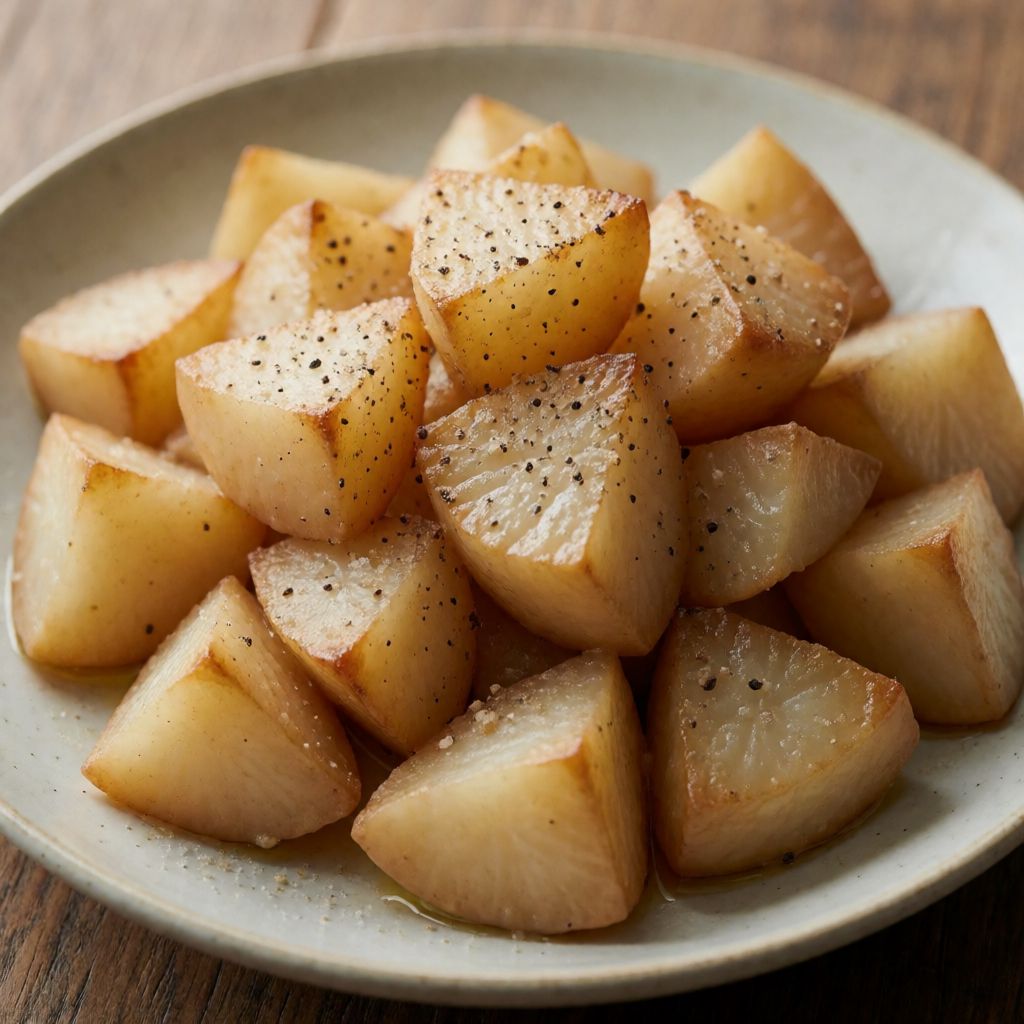
 AI photo
Pan-Stewed Turnips
A simple side dish of turnip wedges gently stewed in olive oil until tender.
Labels are worked out automatically from the ingredients and can be wrong. Check the packaging if it matters to you.
Ingredients
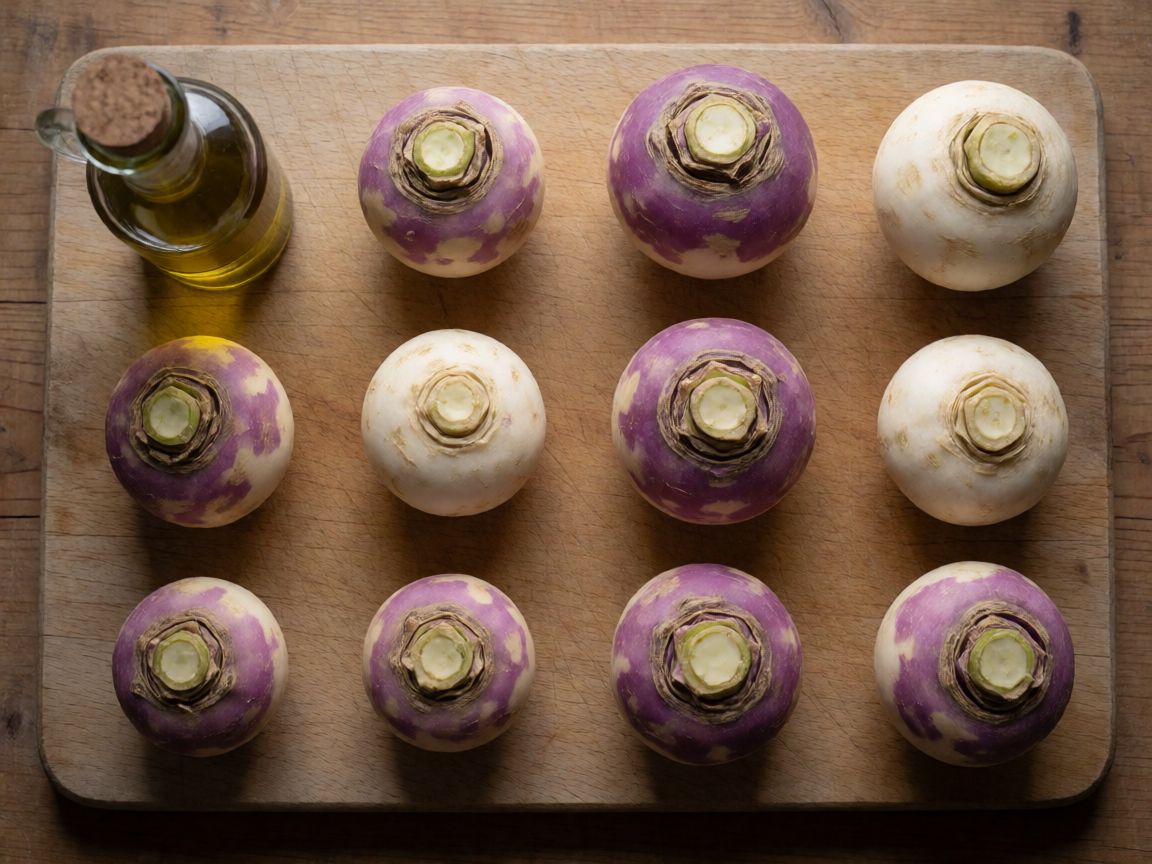
- 10 pcs Turnip
- 4 tbsp Olive Oil
- Salt to taste
- Black Pepper to taste




Steps
Wash the turnips thoroughly, removing any traces of soil. Cut them into large wedges about the thickness of a little finger, or into cubes.
Pour a little olive oil into a frying pan and place it over the heat. Add the chopped turnip and cook over medium heat.
15 minShortly before serving, season with a pinch of salt, remove the pan from the heat and sprinkle with black pepper.
Ten turnips, four tablespoons of oil, salt and pepper — this is about as plain as a side dish gets, and that plainness is exactly where it can go wrong. What decides whether it works is not the ingredients, there's nothing to hide behind here, it's the size of the cut and the patience to let the turnip stew rather than fry.
Turnip is mostly water with a bit of mustardy bite folded in. Cut it into even pieces, about the thickness of a little finger, because uneven pieces cook unevenly: the thin end goes to mush while the thick end stays raw in the middle, and no amount of extra time fixes that, it just gives you both problems at once, worse.
"Medium heat" tells you nothing your hob knows. What you want is oil that shimmers but doesn't smoke when the turnip goes in, then drop the heat so the turnip sweats in its own released water instead of browning hard on the outside. Turnip has almost no sugar to caramelize the way a carrot or an onion does — push the heat and you don't get colour, you get a leathery shell with a raw heart.
Doneness is a fork or skewer sliding into a wedge without a fight, the wedge bending rather than snapping. Fifteen minutes is where to start checking, not where to stop. Some say turnip always needs long boiling to be edible — no, because that's exactly what strips its flavour into the cooking water and leaves you with the bland, slightly bitter mush people associate with it at a Sunday roast. Stewed gently in oil, with nowhere for the liquid to escape to, the turnip keeps what little sweetness it has instead of donating it to the sink.
The lid is the part the written recipe doesn't mention and the part that actually makes this work. Turnip doesn't have enough of its own juice to steam itself the way, say, a courgette does. Cover the pan — a plate set over it does the job if you don't own a lid that fits — and the little moisture the turnip gives up stays trapped as steam, finishing the cooking from above as well as below. Without that cover you're frying, not stewing, and frying alone will dry and toughen the outside before the inside is done.
Salt goes in near the end, and that's not fussiness. Salt early and it pulls water out of the turnip fast, which can leave you with pieces sitting in a puddle you then have to cook off, or worse, oversalted at the surface before you've judged how the liquid concentrates. Salting at the end means you're seasoning the dish you'll actually serve, not guessing at one that's still changing under you.
On turnips themselves: smaller ones, no bigger than a tennis ball, are sweeter and more tender — the bigger ones get woody in the core and sharper in flavour, closer to mustard than to anything you'd call mild. If turnip isn't to hand, kohlrabi behaves similarly and swede works too, though swede is denser and wants a slightly smaller cut and a bit more time to get through.
The oil should have no character of its own — its job is to carry heat evenly and keep the turnip from catching, not to add a flavour that competes with it. Olive oil here is doing a quiet job, nothing peppery or grassy; a neutral oil like sunflower or groundnut will do just as well, arguably better, because it stays out of the way entirely.
Worth knowing why turnip has the reputation it has in a British kitchen: it was the vegetable people ate before the potato took over, cheap, it keeps through a cold winter in a cellar, and for a long stretch it was boiled hard and plain, sometimes as much to feed livestock as people. That history of being boiled to death is where the idea of turnip as punishment food comes from — this method, stewing gently in a little fat with the lid on, is the corrective, not a reinvention.
Four tablespoons of oil for ten turnips sounds like very little, and it is — this isn't meant to swim, it's meant to coat and conduct heat. Ten turnips, cut down to little-finger wedges, is a side for four alongside something with more weight on the plate, a roast or a stew. Give it the full time rather than rushing the heat up to shortcut it; a turnip hurried is a turnip half raw in the middle no matter how coloured it looks outside.