
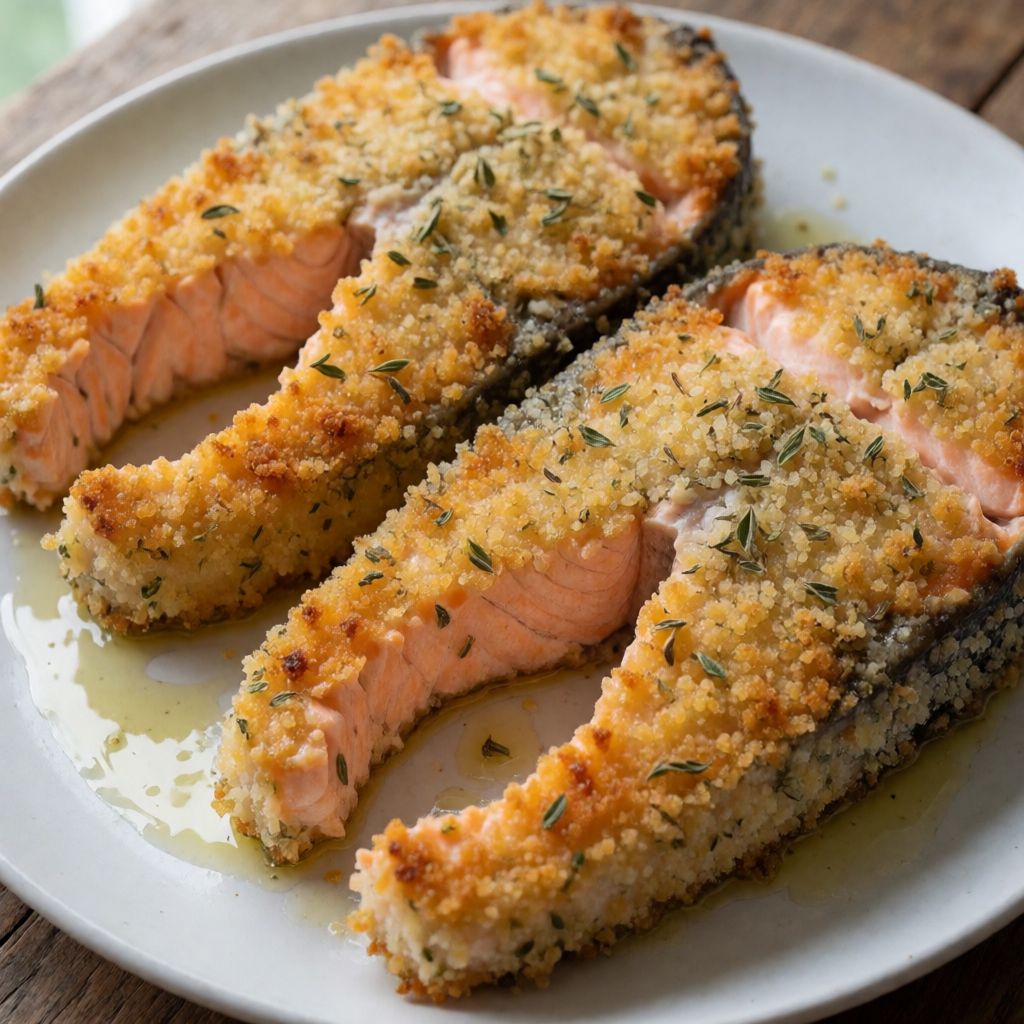
 AI photo
Breaded Salmon Steaks
Light salmon steaks coated in a herby breadcrumb crust and baked until just cooked through.
Labels are worked out automatically from the ingredients and can be wrong. Check the packaging if it matters to you.
Ingredients
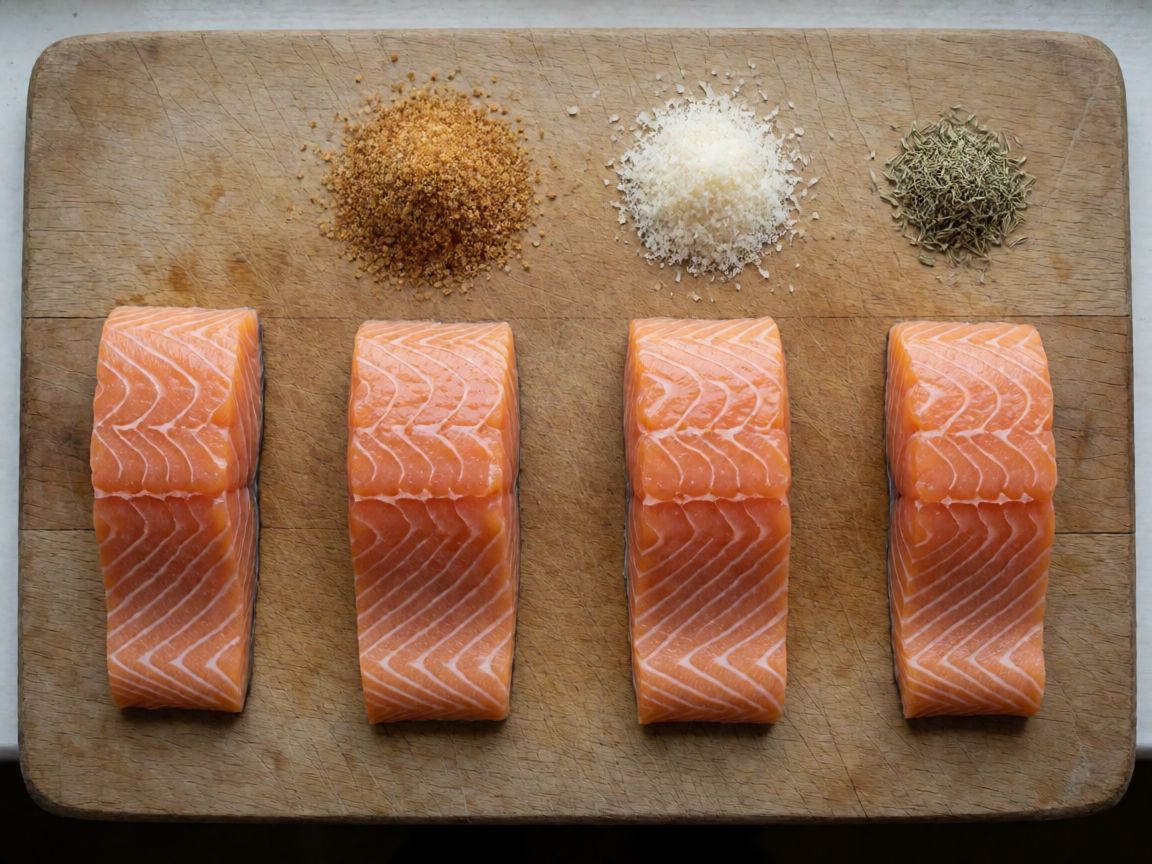
- 4 pcs Salmon
- Olive oil to taste
- 2 tbsp Breadcrumbs dried
- 1 tbsp Parmesan
- Marjoram to taste
- Salt to taste
- White pepper to taste







Steps
Carefully remove any small bones from the salmon steaks with tweezers, if any remain.
In a bowl, mix the breadcrumbs, Parmesan, a pinch of salt, white pepper and marjoram.
Brush the salmon steaks with olive oil, then coat both sides in the breadcrumb mixture.
Place the steaks on a baking tray lined with parchment paper.
Bake in an oven preheated to 180°C for 25 minutes. Doneness: 63°C at the thickest point.
25 minServe with a generous mixed salad.
This isn't fried fish — it's fish under a crust, baked. The crust's whole job is to stand between the salmon and the dry heat of the oven, so the flesh steams gently in its own fat instead of drying out under direct heat. Whether it works comes down to two numbers staying in the right order: the crust colouring before the middle overshoots, and the middle stopping at 63°C — the point where salmon flesh has just set and still trembles, not the point where it's turned to flaking chalk.
Some say you oil the fish "for flavour". No — the oil here is glue, not seasoning. Breadcrumbs don't cling to wet raw flesh; they slide straight off onto the parchment the moment they hit heat. A thin, even film of oil first gives the crumb something to grip, which is the difference between a crust that holds and a tray scattered with burnt crumbs and bare fish.
The tweezers step at the start isn't fussiness, it's a fix for how the fish was cut. A steak is a cross-section through the whole body of the salmon — bone-in, skin at the edges — and the pin bones that run lengthwise along a fillet get sliced straight through when the fish is cut into steaks. That leaves short bone fragments buried sideways in the flesh, easy to miss by eye, found only by running a thumb or tweezers across the cut face. Skip it and the defect doesn't show until someone's fork finds it.
Pick steaks of even thickness, roughly two centimetres, because an oven cooks by time and surface, not by intention — a thick end and a thin end on the same steak will never hit 63°C at the same minute. If your fishmonger only has fillet, use fillet, skin left on; it's thinner so it gets there faster, and you'll want to start checking it sooner than the 25-minute mark given here, which was written for steaks.
The breadcrumb and parmesan mix isn't really two ingredients for two flavours — it's one dry layer built to brown. Parmesan is low in moisture and high in salt and fat, so it does three jobs at once: seasons the crust, dries it further, and browns fast under heat through the same reaction that browns toast. The criterion for a substitute is simple — any hard, aged, low-moisture cheese that grates fine: pecorino, an aged gouda, whatever's in the fridge going hard at the edges. For the breadcrumbs themselves, the criterion is dryness and fineness, no sugar in them — panko, or crumbs you've made yourself from stale bread left out overnight. That last option is the honest history of breaded dishes generally: they were never a technique dreamed up for texture, they were a way to not waste bread that had gone past eating on its own. Frugality dressed up as a method.
Marjoram and white pepper follow the same logic — mild, dried, won't fight the fish. If you don't have marjoram, thyme or oregano do the same job: they're there to round off the crust, not to announce themselves. White pepper is chosen here for two real reasons, not tradition for its own sake — no dark flecks showing through a pale crust, and a gentler, rounder heat than black pepper. If you've only got black, a light pinch, finely ground, works fine; just don't go coarse, or you'll bite into a hot fragment where you expected crumb.
On the heat: 180°C in a UK oven, especially if it's fan-assisted, is already doing real work on a thin layer of oiled crumb spread over a wide surface — crumbs that size brown at that temperature without help. Going hotter doesn't get you there faster, it just means the surface colours while the bone end of a thick steak is still cold in the middle, because thickness, not time, is what the heat has to get through.
If you own a probe thermometer from doing a Sunday roast, use it here too — it's the same question, just a smaller piece of meat. Treat 25 minutes as the lower bound the recipe gives you, not a deadline: check from there. Pull the steaks a touch before 63°C if you can, because the fish keeps climbing a degree or two from its own residual heat once it's out of the oven, sitting on a hot tray. That's the patience part of this dish — not standing over it, but trusting the carryover and not cutting into it the second it comes out, so the juice stays in the flesh instead of running out onto the plate.