
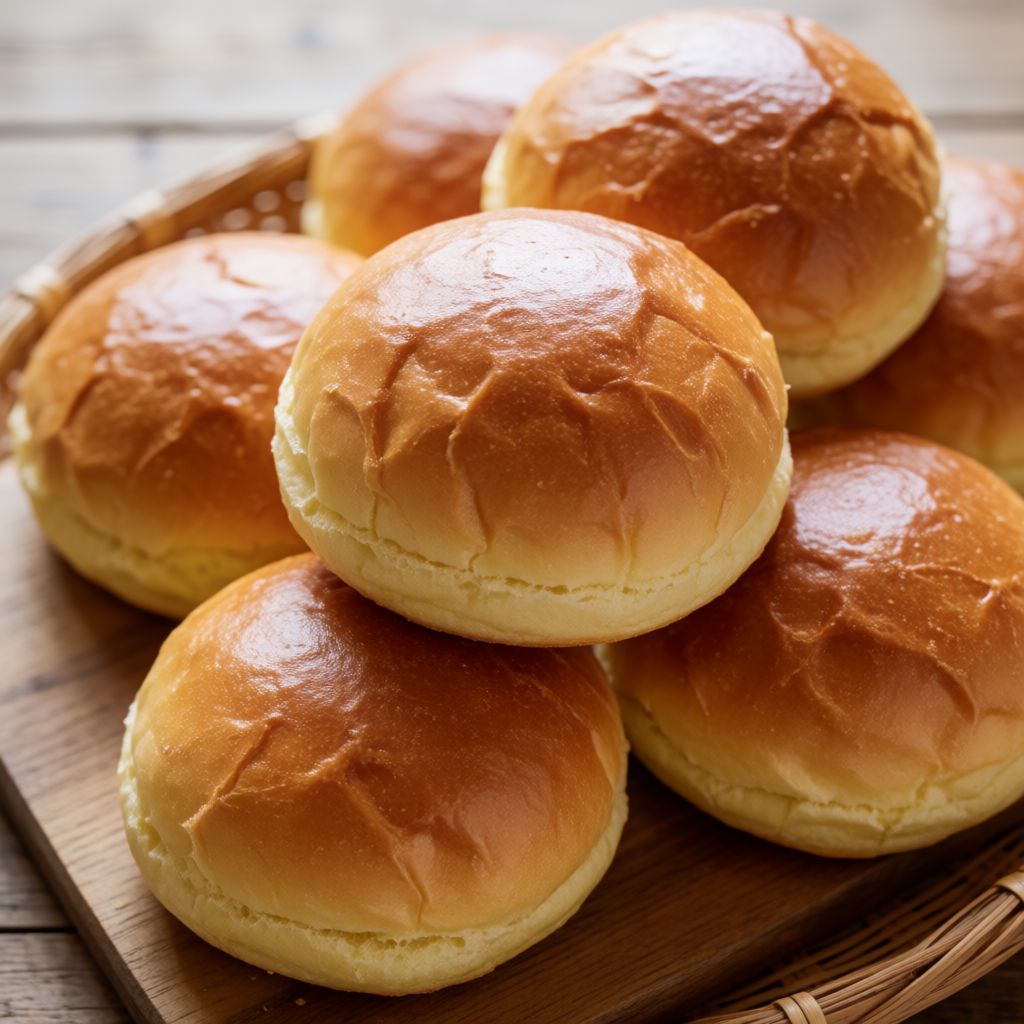
 AI photo
Burger Buns
Soft homemade burger buns topped with seeds, perfect for filling with your favourite burger ingredients.
Labels are worked out automatically from the ingredients and can be wrong. Check the packaging if it matters to you.
Ingredients
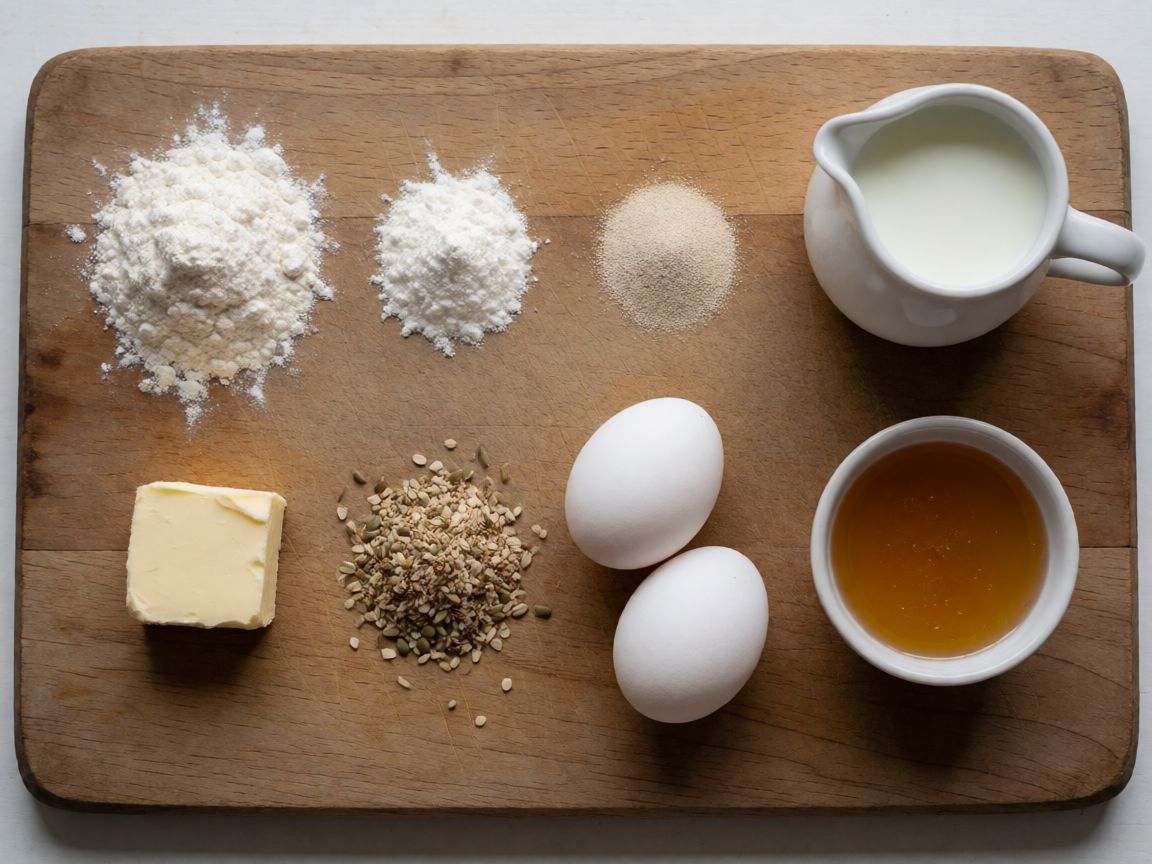
- 250 g Strong white bread flour
- 250 g Strong white bread flour (Manitoba type)
- 7 g Yeast
- 10 g Salt
- 150 g Milk
- 100 g Butter
- 2 pcs Eggs
- 1 tsp Honey
- 50 g Mixed dried seeds
- 50 ml Water
- 1 pcs Egg
- 30 g Butter








Steps
Soak the seeds in 50 ml of water for at least 3 hours.
180 minIn a large bowl, combine the sifted strong white bread flour and the Manitoba-type flour, with the yeast crumbled in with your fingers.
Add the salt and honey, and mix with a wooden spoon.
Beat the eggs and slowly pour them into the mixture, continuing to stir until smooth.
Gently warm the milk, add 100 g of butter and pour this mixture into the dough in small amounts.
Turn the dough out onto the table and knead vigorously, folding it until smooth.
Place the dough in a bowl, cover with cling film and leave to rise at room temperature for about 2 hours.
120 minDivide the dough into balls of 80-85 g and shape into even round buns.
Place the buns on a baking tray lined with baking paper, cover with cling film and leave to rise for 45 minutes.
45 minCombine 30 g of butter with the egg, mix and brush over the surface of the buns.
If desired, sprinkle the buns with drained seeds.
Bake in an oven preheated to 200°C for 2-3 minutes, then at 180°C for 8-10 minutes.
Remove the buns from the oven and let them cool completely.
Once cooled, cut the buns with a serrated knife and fill as desired.
A burger bun is bread doing a disguise job. It has to be soft enough to bite through without a fight, sturdy enough to hold a wet patty and sauce without turning to paste, and sweet-ish and rich enough that it reads as "bun" rather than "roll." That richness comes from butter, egg and milk going into the dough itself — not just brushed on top — which is what separates a burger bun from a dinner roll playing dress-up.
What decides whether it works is almost entirely gluten and fat management. Two eggs, 100g of butter worked into the dough, and milk instead of water give you a dough that's softer and stickier than a baguette dough — your instinct will be to add flour to make it behave. Don't. That's the whole trick: a wetter, richer dough gives a closer, tender crumb; a drier one gives you something chewier and more hole-riddled, fine for a baguette, wrong here. Knead it properly instead of flouring your way out of the stickiness.
The seeds soaking for three hours aren't decoration logic, they're mechanical: a dry sesame or poppy seed dropped onto wet egg wash half-sticks and half-falls off in the oven, leaving bald patches and a tray full of char. Soaked, they're heavier, they sit, and they don't scorch as fast either — raw dry seeds on a 200°C tray go from toasted to bitter in the time it takes you to check your phone.
Flour first. You're using two strong white bread flours together — one ordinary strong flour, one Manitoba type, which is just a very high-protein wheat, often Canadian or North American in origin, bred for strength rather than flavour. The reason to blend them rather than use one or the other: this dough already carries a heavy load of fat, sugar and egg, all of which get in gluten's way and weaken the structure. A higher-protein flour blend gives you the backbone to still hold a rise under all that richness. If you can't get Manitoba, use your strongest bread flour across the board and don't sub in plain or self-raising — that's cake logic, not bun logic, and the dough won't hold gas.
The yeast is fresh/fast-action dried, crumbled in by hand rather than dissolved separately in liquid — that's a workflow choice, not a magic one, it just means less washing up and the yeast gets evenly distributed through the dry flour before any liquid hits it. If you're worried about killing it, the enemy isn't the flour, it's heat: don't pour hot milk straight on top of it, warm the milk to roughly skin-temperature, no hotter than a bath you'd happily sit in.
Salt and honey go in early with the flour — salt for flavour and for tightening the gluten network a touch, honey for a background sweetness and because sugar feeds the yeast a little and helps the crust colour (sugars caramelise, plain flour-and-water dough stays paler). People sometimes worry salt and yeast touching will kill the yeast outright — no, that's only a real risk with a heavy direct dump of salt straight onto a small clump of yeast with no flour buffering it; mixed through dry flour like this, it's a non-issue.
Butter, 100g worked into the dough plus milk, is what gives you tenderness — it coats gluten strands and shortens them, literally "shortening," which is why enriched doughs are softer-crumbed than lean ones. Use unsalted if you can so you control the salt total yourself; if you're out of butter, a neutral oil will soften the crumb too but won't give you the same flavour or the slight structure butter provides when it firms up again on cooling. The two eggs do double duty — moisture and protein for structure, and the yolks specifically for colour and a short, rich texture.
Shaping into 80-85g balls and getting them even isn't fussiness for its own sake — buns of uneven size cook at different rates on the same tray, so the big ones are still pale and underdone when the small ones are already past their colour. A kitchen scale earns its keep here.
On your hob at home you won't have a proper proving drawer, so "room temperature for about 2 hours" is doing real work as a lower bound — a cold flat in a British winter will take longer, and that's fine, go by what you see: the dough should have visibly doubled and feel soft and slightly springy, not by the clock. Same with the second prove on the tray — cling film loosely over the top, or an upturned bowl if you haven't got enough film, just something that stops a skin forming on the surface while they sit. That skin, if it forms, is why some buns come out with a tough, wrinkled crust instead of a smooth one — it's not the oven's fault, it's a dry surface sitting uncovered too long beforehand.
The egg-and-butter wash brushed on before baking is for colour and shine, not structure — butter in the wash gives a softer, slightly richer sheen than egg alone, which tends to go harder and more lacquered. If you've no butter to spare for the wash, egg on its own, thinned with a splash of milk, still works, just a touch less soft on the crust.
Eight buns from this amount — enough for a proper family burger night, with maybe one spare for whoever always wants seconds. And the patience point is a real ingredient here, not a platitude: a rushed first prove gives you a tight, dense bun because the gluten hasn't had time to relax and the yeast hasn't built the flavour or the lift it needs — there's no shortcut that doesn't show up on the plate.