
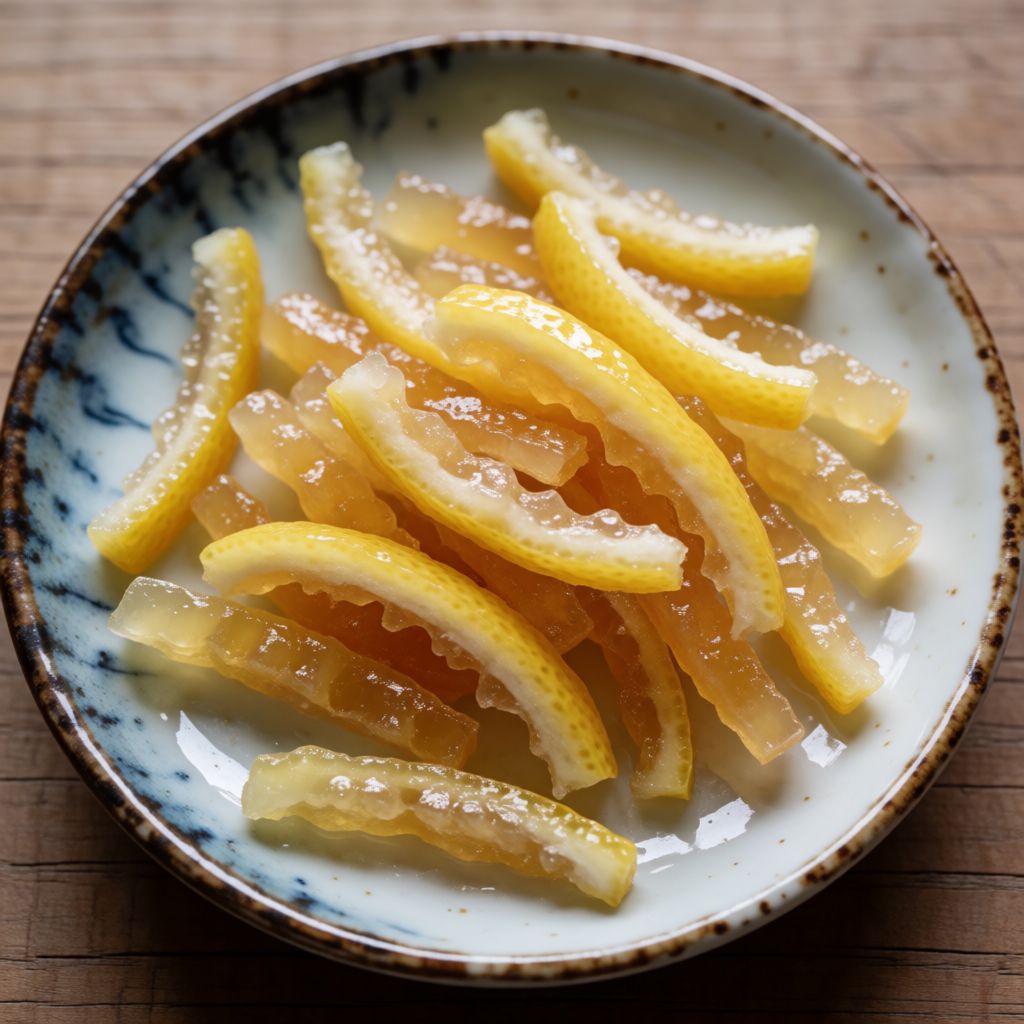
 AI photo
Candied Lemon Peel
A slow-cooked candied lemon peel, boiled three times to remove bitterness, then simmered in sugar syrup and air-dried for a day.
Labels are worked out automatically from the ingredients and can be wrong. Check the packaging if it matters to you.
Ingredients
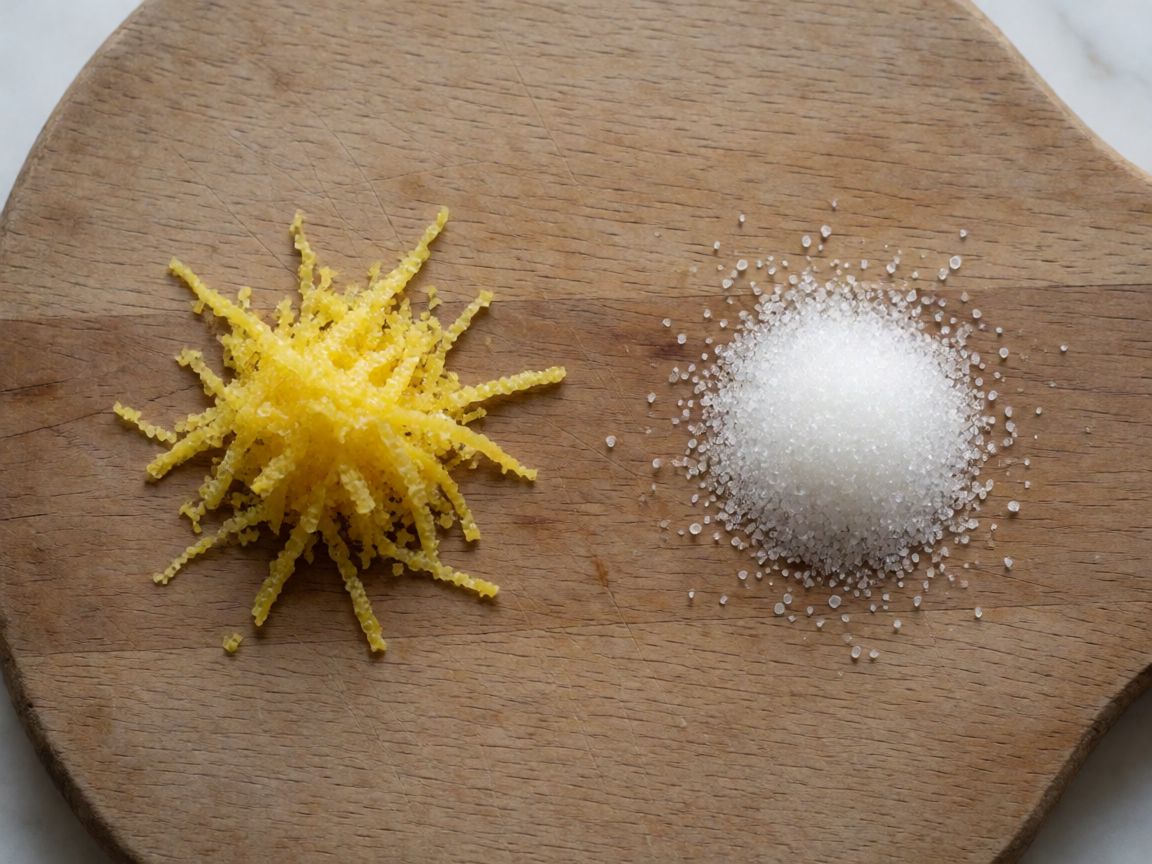
- Lemon peel weighed after blanching
- Caster sugar same weight as the peel
- Water same weight as the peel



Steps
Remove the peel from the lemons, after washing them well and scrubbing under running water with a brush.
Put the peel in a pan and cover with water; bring to the boil and cook for about 3 minutes, then drain.
3 minRepeat the boiling and draining two more times.
Take the peel out of the pan and pat it dry.
Weigh the peel and add the same amount of water and sugar to the pan.
Simmer gently until the water has evaporated and the peel is dry.
Lift the peel out with a slotted spoon and lay the pieces on baking paper, spaced apart.
Leave to dry for at least 24 hours, turning the pieces over after 12 hours.
1440 min
This isn't really a dessert in the usual sense — it's a rescue job. You take rind that normally goes in the bin once you've squeezed the lemon for something else, and you turn it into something that keeps on a shelf for months. The whole process is one exchange, repeated patiently: the water sitting inside the spongy white pith gets swapped for sugar syrup, bit by bit, until there's more sugar in there than water ever was. That's what candying means, mechanically — not flavouring something, replacing something.
Some say you must scrape the white pith off the peel first because it's the bitter part. No — because the pith is exactly what you're candying. It's the sponge that soaks up the syrup; strip it away and you're left with coloured skin and nothing to fill. What's actually bitter is a group of compounds (the same family that makes grapefruit pith sharp) and they dissolve out in hot water. That's the job of the three separate boils and drains — not a knife. Skip a boil, or try to do it in one long simmer instead of three short, fresh-watered ones, and the bitterness just redistributes instead of leaving.
What decides whether the rest works is arithmetic, not skill: peel, water and sugar in equal weight. You weigh the peel after blanching, not before, because blanching swells it — it's been sitting in boiling water three times and has taken some of that water into its structure. Weigh it before and your syrup will be too weak to finish the job; the peel will be slack and sugarless at the core, soft instead of set.
Lemon peel is the obvious choice but not the only one — what the recipe actually needs is citrus with a decent thickness of pith, because that's the sponge doing the absorbing. Orange or grapefruit peel works by the same mechanism and in the same ratios; thin-skinned citrus like lime won't, because there's barely any sponge there to hold syrup, and you'll end up with something closer to candied skin than candied peel. Scrub the fruit well before you start, not for the recipe's sake but because whatever's on the surface — wax, residue — is about to sit in your sugar for a day and a half.
Sugar: caster, because the fine grain dissolves into the water fast and evenly, with nothing left ungoverned at the bottom of the pan to scorch. Granulated will get there too, just slower, and you need to watch it a little harder in the first few minutes so nothing sits undissolved against the hot metal. There's no substitute for sugar here that does the same job — this isn't about sweetness, it's about mass: sugar is what's physically filling the space water leaves behind. Honey or syrup won't candy the same way; they don't crystallise and set the same way sucrose does, and the peel will stay tacky rather than finishing dry.
Water: it's not really an ingredient so much as a carrier, there to dissolve the sugar into something the peel can actually absorb, then to leave again by evaporation once its job's done. That's why the quantity matters as much as the sugar's — too much water and you're just boiling peel in syrup forever waiting for it to reduce; too little and the sugar won't dissolve properly before the peel's cooked soft.
On a domestic hob, keep the heat low enough that you can watch the syrup rather than listen for trouble. You're not after a rolling boil, you're after a slow, visible thickening — small busy bubbles turning into fewer, slower, larger ones, and the peel itself going from opaque to glassy. Some say you need a sugar thermometer for this stage. No — because your eyes are the instrument. A thermometer tells you a number; what you actually need to know is whether the peel has gone translucent and the syrup has gone heavy, and no probe shows you that better than looking.
For the drying, a flat plate or tray lined with baking paper is honest enough for a flat kitchen — you don't need a dehydrator. If you've got a wire cooling rack, raise the paper on it; air moving underneath as well as over means both faces dry at a similar rate, which matters more than it sounds like it should. Turning the pieces at the halfway point exists for the same reason: the side touching the paper dries slower than the side open to the room, and if you never turn them, you get peel that's ready on top and still faintly tacky underneath — fine to eat, not fine to store.
This kind of thing has a place in British baking for a reason that's economic, not mystical: candied peel used to be a bought, imported commodity, which made it worth having a method for making your own out of fruit you'd already used for something else — curd, lemonade, a Sunday roast's gravy sharpened with juice. Christmas cake and mincemeat both lean on it. Making your own doesn't make it more traditional than the shop kind, it just means the lemon you already bought does two jobs instead of one.