
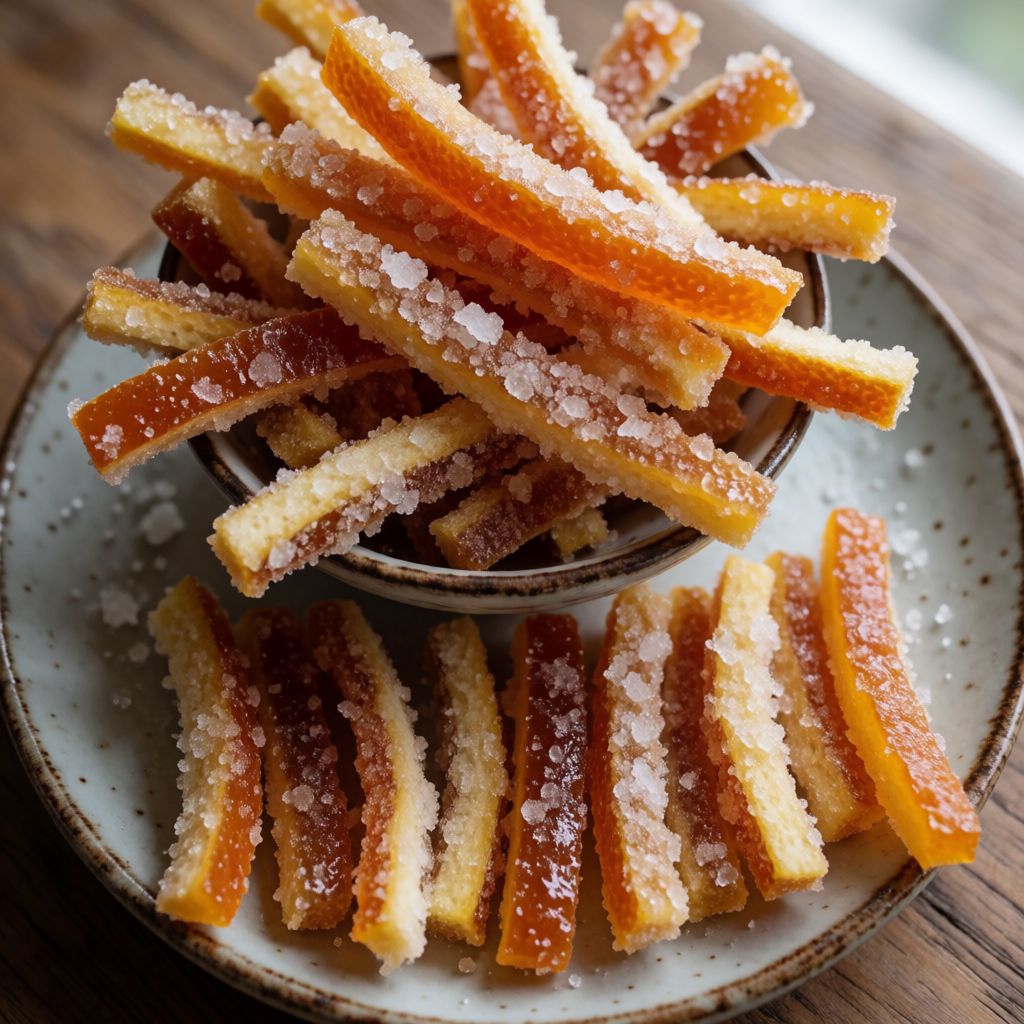
 AI photo
Candied Orange Peel
Sweet candied orange peel, slowly cooked in syrup and dried to a sticky, sugary finish.
Labels are worked out automatically from the ingredients and can be wrong. Check the packaging if it matters to you.
Ingredients
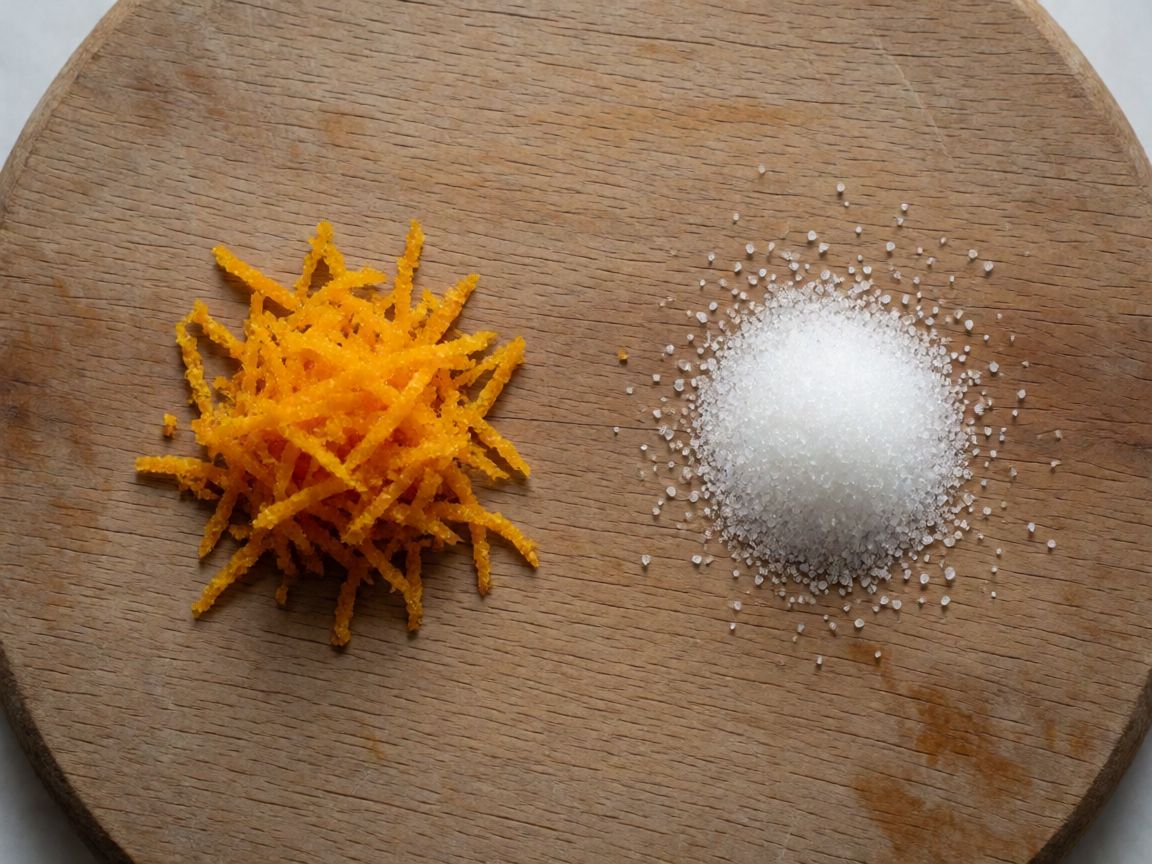
- 400 g orange peel
- 250 g caster sugar
- water as needed


Steps
Carefully peel the oranges and cut the peel into thin strips.
Put the peel in a pan, add 200g of the sugar and enough water to fully cover the peel.
Bring to the boil and cook for about ten minutes.
10 minRemove the pan from the heat and let the peel steep in the syrup for 24 hours.
Return to the heat, add a little more water with 2-3 tbsp of the remaining sugar dissolved in it, so the peel is covered again.
Simmer gently for about 15 minutes.
15 minLeave to steep for a full day.
Using a two-pronged fork, lift all the peel out of the liquid.
Put the liquid back on the heat and simmer for a further five minutes, stirring constantly.
5 minReturn the peel to the syrup and leave to steep for another 24 hours.
Simmer the peel in the syrup for a further two to three minutes.
3 minLift the orange peel out of the syrup, spread the pieces out on a tray lined with baking paper, spacing them apart, and leave to dry.
Toss the peel in sugar to coat.
This is orange peel that refuses to be thrown out — the bitter white jacket of the fruit, usually peeled off and binned, turned into something you'd put on a cake or eat straight from the jar with tea. Three oranges give you 400g of peel, enough for four people to have a proper handful each, more if it ends up chopped into a fruit cake.
What decides whether it works has nothing to do with how long you boil it and everything to do with how patiently you let sugar get inside. Peel is mostly cell walls full of water. Sugar is slow and heavy — it can't just rush in and swap places with that water in ten minutes flat. Push it with a hard boil and heavy syrup from the start, and you get one of two failures: the outside seizes into a tough amber shell while the middle stays pale, raw and bitter, or the peel shrinks into little leather curls that snap instead of bend. That's why this recipe is built in rounds — simmer, rest a full day, simmer again, rest again — each round a little more sugar than the last. Every rest is the sugar quietly working its way further into the peel while you do something else entirely.
So some say you can candy peel in an afternoon, just boil it longer in thicker syrup. No — because a longer boil doesn't speed up how fast sugar diffuses into plant tissue, it just cooks the outside harder. The clock here is measured in days, not minutes, and the active cooking adds up to under an hour across all of them.
Choose peel from oranges with real thickness to the skin — navel oranges, or Seville if you can find them, which is where marmalade-makers get their peel from in the first place and candying is simply the other half of that same economy: nothing from the fruit goes to waste. Thin-skinned, easy-peeler oranges don't have enough pith to hold together through three days of simmering and resting; they just go to mush. If the oranges are a shiny supermarket batch, scrub the skin under hot water first — that shine is wax, not orange, and you don't want it in your syrup.
The pith — the white, spongy layer under the coloured skin — is where the bitterness lives. This method doesn't strip it off separately; instead, each long soak in dilute syrup does double duty, drawing sugar in and bitterness out at the same time, a little more with every round. If your peel still tastes sharply bitter after the first day's steep, that's not a fault in the method, it's telling you the oranges were bitter to begin with, and you'll need one more round than written to settle it.
Caster sugar dissolves fast, which matters when you're only heating the syrup gently and don't want undissolved grains sitting on the bottom scorching while the rest of the pan is barely at a simmer. Granulated sugar works exactly the same in the end, just give it longer in the water before you bring the heat up, and stir once to help it along — any sugar that dissolves cleanly in water will do this job, there's nothing special about caster beyond convenience.
Water is just the carrier, so don't measure it precisely — add only enough each time to cover the peel, because a thin layer of peel drowning in syrup takes longer to concentrate than a snug one. On your hob, a simmer means the surface trembles with small bubbles breaking slowly, nothing rolling or splashing; a hard boil at this stage is the single easiest way to scorch sugar syrup, since it has nowhere to escape the heat except by catching on the bottom of the pan.
Use a two-pronged fork, not a slotted spoon, to lift the peel out between rounds — a spoon presses and bruises the strips, squeezing out the sugar you've spent a day getting into them, and clouding the syrup with released juice. When you spread the finished peel on the tray, give each piece its own space rather than letting them touch. Crowded, still-damp peel sweats against its neighbours, and that moisture dissolves the sugar coating straight back into a sticky mess instead of a dry one — the spacing isn't fussiness, it's what stops that from happening.
A domestic hob has no kazan-sized gentle zone and no loose-fitting lid that lets steam wander off the way a stockpot lid does — use your widest pan so the peel lies in a single layer rather than stewing in a deep pile, and during the long rests just sit a plate over the top to keep dust and fruit flies out, nothing needs to be sealed in. And treat the days of resting as the real ingredient here: this dish costs you almost no effort and quite a lot of calendar. Plan it the way you'd plan a Sunday roast that needs to go in early — start it on a day you don't need the result until the one after next, and it will be ready in time for Christmas cake, or just for the tea tray, without ever asking you to stand over the stove.