
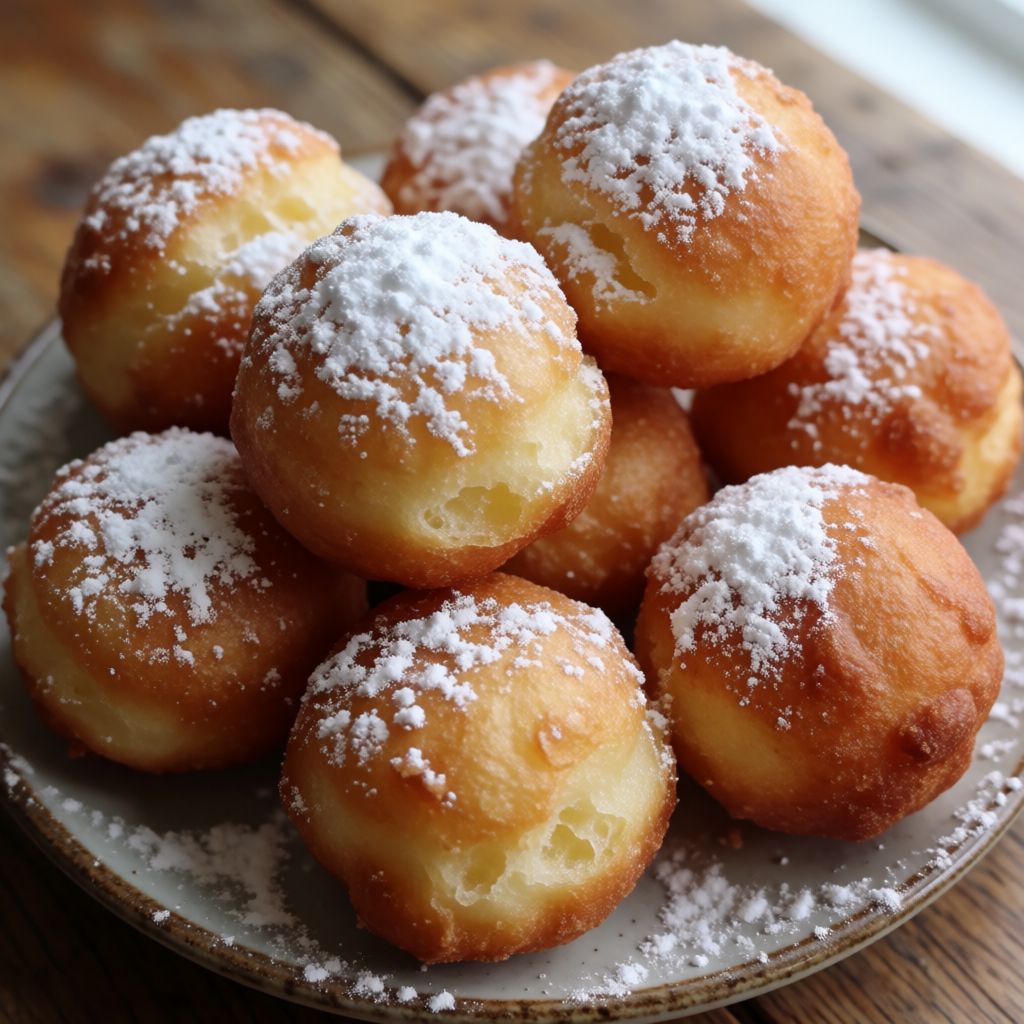
 AI photo
Carnival Doughnut Puffs (Pampushky)
A light, golden fried dough puff with lemon zest, rolled in sugar - a traditional carnival treat.
Labels are worked out automatically from the ingredients and can be wrong. Check the packaging if it matters to you.
Ingredients
- 400 g Plain flour
- 300 ml Water
- 60 g Butter
- 4 pcs Eggs
- 1 pcs Lemon
- 200 g Sugar
- Vegetable oil to taste, for frying
- pinch Salt a pinch








Steps
Pour the water into a wide saucepan, add the salt and set over the heat.
Add the butter, stirring, and bring to the boil.
Gradually add the flour, stirring briskly with a wooden spoon so no lumps form.
Let the dough cool, if needed placing the saucepan in the fridge for about 15 minutes.
15 minAdd the eggs, mixing thoroughly so they are fully absorbed.
Grate the lemon zest and add it to the dough along with two tablespoons of sugar.
Mix well: the dough should be creamy and smooth, with no lumps.
Pour plenty of oil into a large frying pan for frying and heat over high heat.
Transfer the dough into a piping bag without a nozzle.
Squeeze the dough into rings directly into the hot oil.
Fry the puffs in the bubbling oil until golden, then remove with a slotted spoon.
Place on a plate lined with paper towels and roll in sugar.
What was changed
For frying, Vegetable oil replaces the oil with a neutral vegetable oil, which British cooks typically use.
This is choux pastry fried instead of baked — the same dough that makes profiteroles and éclairs, but here you squeeze it straight into hot oil and let the steam inside do the work rather than an oven. What decides whether it puffs or sits flat is the dough itself: it has to be cooked twice before it ever meets the oil — once on the stove to gelatinise the flour, once more from the residual heat while you beat in the eggs. Skip either and you get something gluey or something that won't rise at all.
The mechanism is this: boiling the flour into the butter-and-water mixture swells the starch and drives off a lot of the raw flour's water-holding capacity, so the paste can later absorb four whole eggs without turning into batter. Those eggs are not there for flavour — they're there for steam. Once the ring hits oil hot enough to fry rather than simmer, the water inside the eggs and dough flashes to vapour, and because the paste has enough gluten and cooked starch to hold a skin, it blows up like a little balloon instead of dissolving into the fat.
Some say choux dough needs a stand mixer and exact oven science to behave — no, because frying is far more forgiving than baking here. You're not asking the oven's dry heat to slowly set a structure over twenty minutes; you're asking violently hot oil to seal the outside almost instantly, so small inconsistencies in the dough matter less. What you can't fudge is temperature of the oil and patience with the cooling dough before the eggs go in.
Cooling the dough before adding eggs isn't fussiness, it's protection: tip beaten egg into paste still near boiling and you don't make custard, you make scrambled egg laced through starch — the proteins set the instant they touch the heat, and no amount of stirring brings that back together smooth. Fifteen minutes in the fridge, or just enough time for the saucepan to go from "burns you" to "warm hand on it," is the real indicator, not the clock. You're waiting for a feel, not a number.
Flour here is just flour — nothing fancy, because its job is starch content and some gluten, not flavour. The water-and-butter base is really there to deliver fat and moisture evenly through that starch; butter also gives you a cleaner, less greasy crumb than oil would baked into the dough, and a flavour that oil frying later won't wash out. If you're out of butter, a neutral oil works in the dough itself, though you lose a little richness in the crumb.
Eggs are the leavening, full stop. Four medium-to-large eggs, added one at a time if your dough feels tight, until the mixture falls from the spoon in a slow, heavy ribbon rather than a drip or a dollop. Too few eggs and you get a dense, bready puff; too many and the ring won't hold its shape going into the oil — it slumps instead of ringing. This is why you check "creamy and smooth, no lumps" by eye and touch rather than trusting a fixed number from a recipe card.
The lemon zest is not decoration — it cuts the richness of fried dough and butter, and because it's zest rather than juice, it adds no extra liquid to unbalance the dough you've just calibrated. Any citrus zest with a clean smell works the same way; orange is traditional in some versions, for the same reason.
On a domestic hob, "plenty of oil, heated over high heat" needs translating: you want it hot enough that a dropped scrap of dough sizzles and rises within seconds, not hot enough to smoke. No lid on this pan, obviously, and no need for a thermometer if you don't own one — just watch the first ring. If it sits sullen on the bottom not moving, the oil's not ready; if it browns before it's puffed through, back the heat off a touch. Frying in a wide pan rather than a deep kazan-style pot just means more surface area and you fry in smaller batches, nothing lost.
Some say doughnuts must be deep-fried in a dedicated fryer to work — no, because what matters is depth of oil relative to the ring's size, not the vessel. A domestic frying pan with oil a few centimetres deep does the same job, provided the puffs can float and turn rather than scrape the bottom.
Sugar for rolling should go on while the puffs are still hot from the fryer — the surface needs to be slightly damp with its own oil for sugar to cling, not bone dry and cold. This is also why they go straight onto paper towels first: not styling, but genuinely pulling excess oil off so the sugar doesn't just slide into a puddle at the base of each puff.